. 2024 Feb 1;151(3):dev202255.
doi: 10.1242/dev.202255. Epub 2024 Feb 5.

A new experimental evidence-weighted signaling pathway resource in FlyBase

Affiliations

A new experimental evidence-weighted signaling pathway resource in FlyBase

Helen Attrill et al. Development. .

Abstract

Research in model organisms is central to the characterization of signaling pathways in multicellular organisms. Here, we present the comprehensive and systematic curation of 17 Drosophila signaling pathways using the Gene Ontology framework to establish a dynamic resource that has been incorporated into FlyBase, providing visualization and data integration tools to aid research projects. By restricting to experimental evidence reported in the research literature and quantifying the amount of such evidence for each gene in a pathway, we captured the landscape of empirical knowledge of signaling pathways in Drosophila.

Keywords: Drosophila; Biocuration; FlyBase; Gene Ontology; Network; Signaling pathways.


Conflict of interest statement

Competing interests The authors declare no competing or financial interests.

Figures
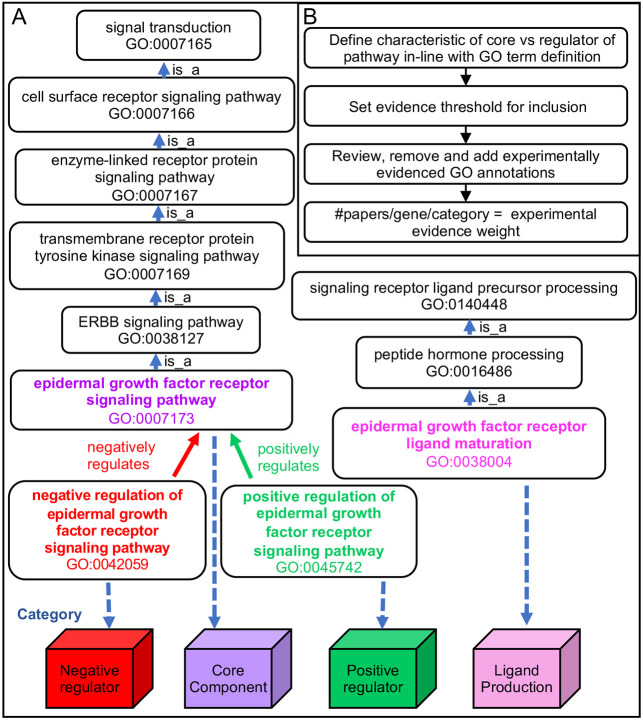
Fig. 1.
Fig. 1.
Strategy for experimental evidence-weighted curation of signaling pathways, using the EGFR signaling pathway as an example. (A) How use of the GO to curate pathway research papers allows the terms to be used as labels to place pathway members in different categories. The structure of the GO relevant to the EGFR signaling pathway is used as an example. (B) Schematic of the signaling pathway review, curation process and calculation of evidence weight for inclusion.
Fig. 2.
Fig. 2.
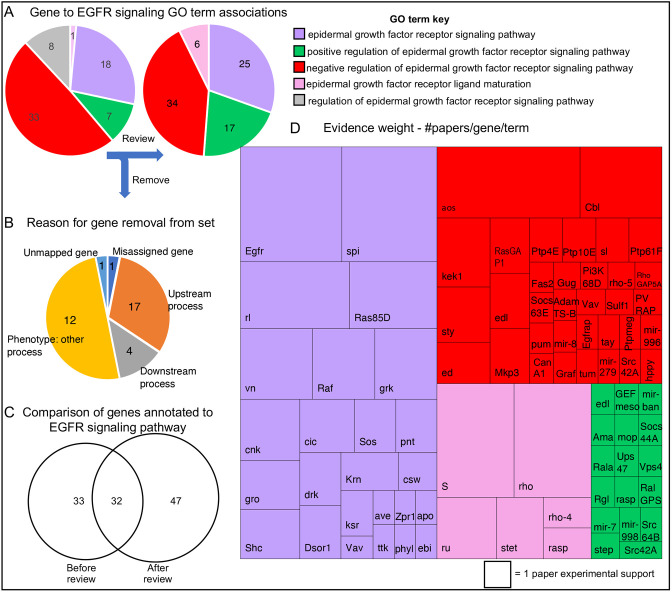
Evidence-weighted curation of the EGFR signaling pathway. (A) The number of genes associated with each EGFR-related GO term before (left pie chart) and after (right pie chart) review. The key is shown to the right. During the review process, all regulatory components were classed as positive or negative regulators and therefore there were no direct annotations to ‘regulation of epidermal growth factor receptor signaling pathway’ (grey segment) after review. (B) Pie chart displaying the reasons for removal of 32 genes previously annotated to the EGFR pathway, but which did not pass our curation criteria. (C) A Venn diagram of GO annotated gene sets, before and after review, summarizes the extent of revision. (D) A treemap chart displaying experimental evidence weight. The block size is proportional to the number of research papers supporting the role of each gene in the EGFR signaling pathway. The corresponding gene symbols are shown. The term key is the same as in A.
Fig. 3.
Fig. 3.
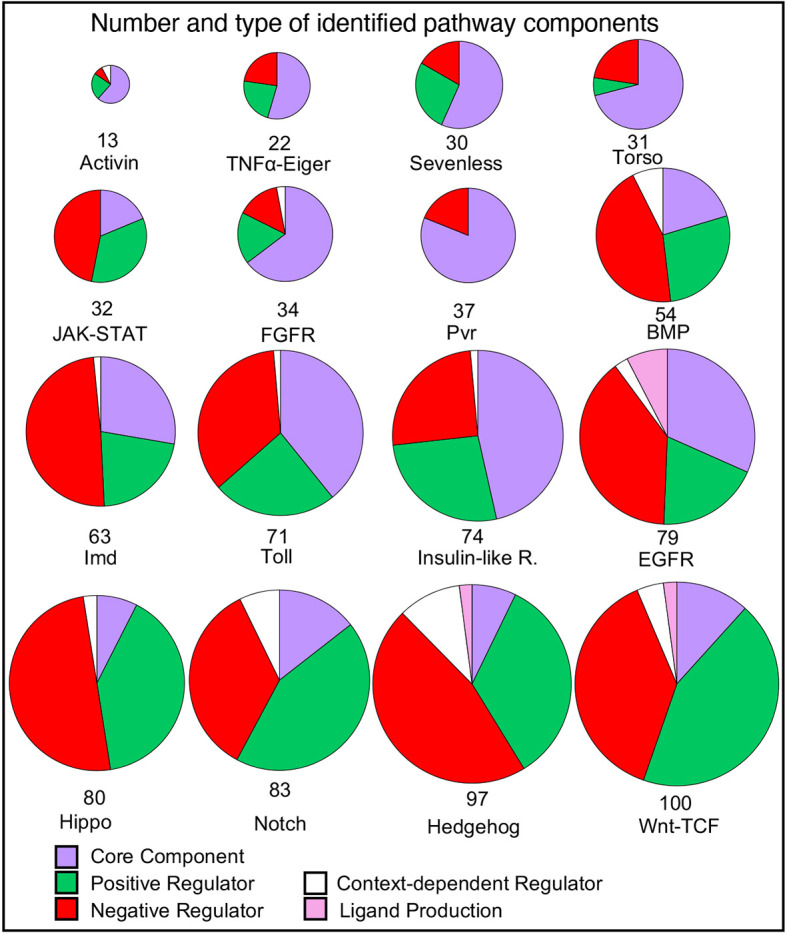
Distribution of types of components in each pathway. The number of genes associated by GO annotations for each pathway are illustrated as pie charts. Each pie chart is broken down into the categories indicated by the key. The total number of genes in the pathway is illustrated by the diameter of the circle and the number at the base. The pathways are ordered by the number of component genes. Where genes have different regulatory effects in different contexts, they are classed as context-dependent regulators. Note that for this figure, in the Toll signaling pathway, which has a more complex extracellular activation cascade, those genes annotated to ‘negative regulation of Toll receptor ligand protein activation cascade’ (GO:0160035) are included in the ‘Negative Regulator’ category and genes annotated to ‘Toll receptor ligand protein activation cascade’ (GO:0160032) are included in the ‘Core Component’ category.
Fig. 4.
Fig. 4.
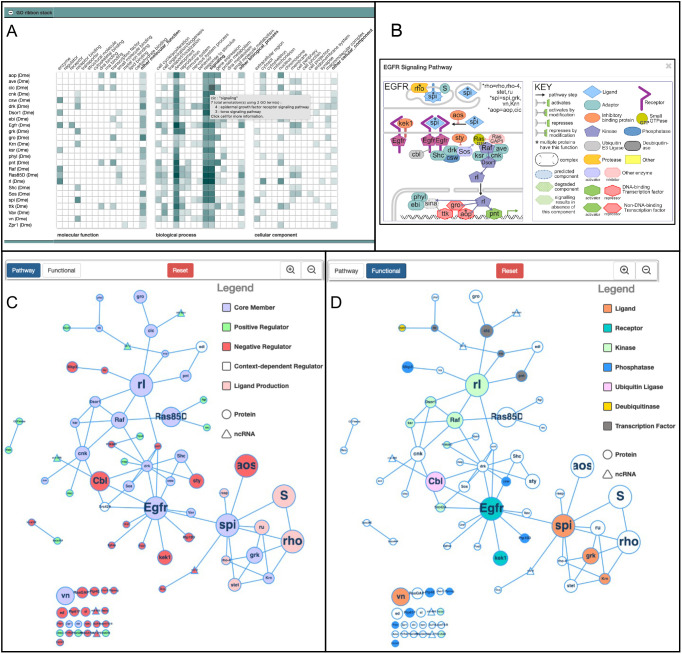
FlyBase Pathway Report pages. (A-D) Three visual summaries are presented on the Pathway pages, exemplified with the EGFR Signaling Pathway. (A) The GO ribbon stack is a graphical summary of the GO annotations for each gene, with annotations grouped under high-level categories. The color intensity of each cell indicates how many unique terms are grouped in that particular category. The unique terms that are grouped under a particular cell can be seen by hovering over or clicking on the cell, as shown for one of the cells of cic. (B) A thumbnail review-style image for the EGFR Signaling Pathway. (C,D) A physical interaction network in which the nodes represent genes, the sizes of which are proportional to the number of supporting papers, up to ≥10. C shows the ‘Pathway view’ and D shows the ‘Functional view’ (for visual simplicity, we selected fewer higher level categories compared with the thumbnails). The edges represent physical interactions between components, from FlyBase. Unconnected nodes are also displayed.

Update of

References

    1. Ashburner, M., Ball, C. A., Blake, J. A., Botstein, D., Butler, H., Cherry, J. M., Davis, A. P., Dolinski, K., Dwight, S. S., Eppig, J. T.et al. (2000). Gene Ontology: tool for the unification of biology. The Gene Ontology Consortium. Nat. Genet. 25, 25-29. 10.1038/75556 - DOI - PMC - PubMed
    1. Attrill, H., Falls, K., Goodman, J. L., Millburn, G. H., Antonazzo, G., Rey, A. J. and Marygold, S. J.. and the FlyBase consortium. (2016). FlyBase: establishing a Gene Group resource for Drosophila melanogaster. Nucleic. Acids Res. 44, D786-D792. 10.1093/nar/gkv1046 - DOI - PMC - PubMed
    1. Babaoglan, A. B., O'Connor-Giles, K. M., Mistry, H., Schickedanz, A., Wilson, B. A. and Skeath, J. B. (2009). Sanpodo: a context-dependent activator and inhibitor of Notch signaling during asymmetric divisions. Development 136, 4089-4098. 10.1242/dev.040386 - DOI - PMC - PubMed
    1. Balci, H. and Dogrusoz, U. (2022). fCoSE: a fast compound graph layout algorithm with constraint support. IEEE Trans. Vis. Comput. Graph 28, 4582-4593. 10.1109/TVCG.2021.3095303 - DOI - PubMed
    1. Chang, Y.-C., Wu, J.-W., Wang, C.-W. and Jang, A. C.-C. (2019). Hippo Signaling-Mediated Mechanotransduction in Cell Movement and Cancer Metastasis. Front. Mol. Biosci. 6, 157. 10.3389/fmolb.2019.00157 - DOI - PMC - PubMed

LinkOut - more resources