Differentiation of hypervirulent and classical Klebsiella pneumoniae with acquired drug resistance
- PMID: 38231533
- PMCID: PMC10865842
- DOI: 10.1128/mbio.02867-23
Differentiation of hypervirulent and classical Klebsiella pneumoniae with acquired drug resistance
Abstract
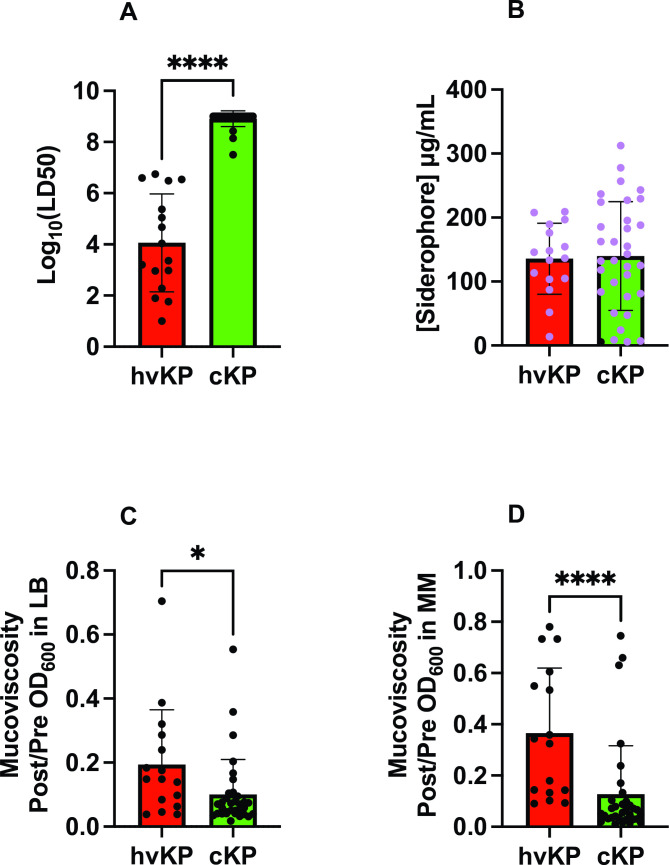
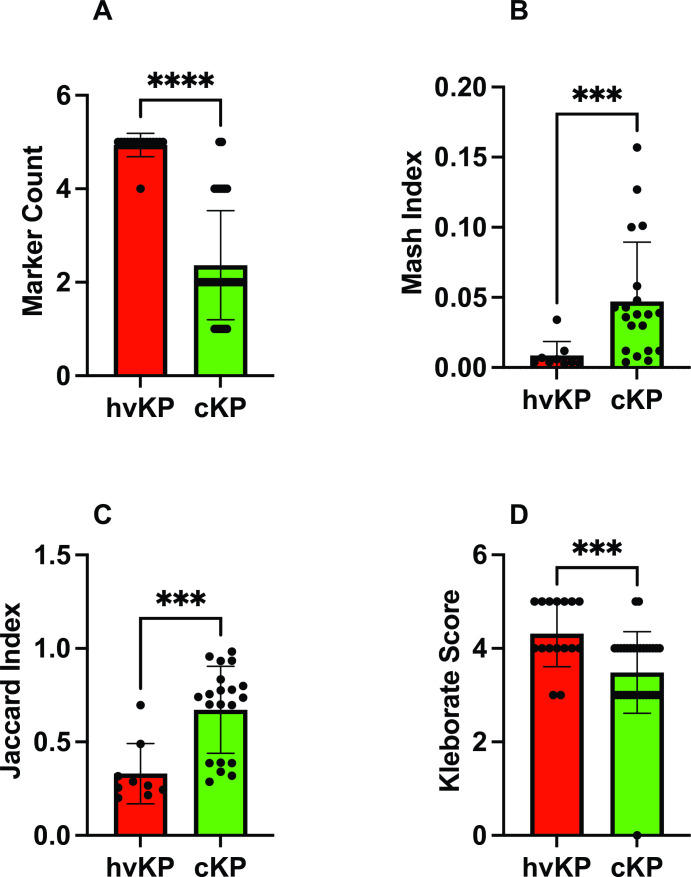
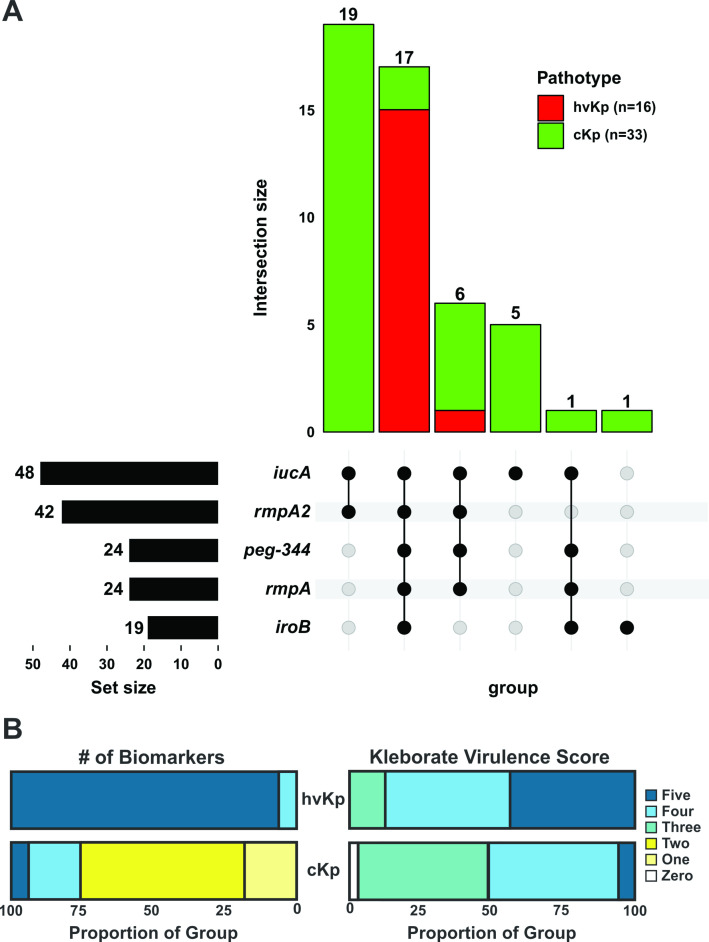
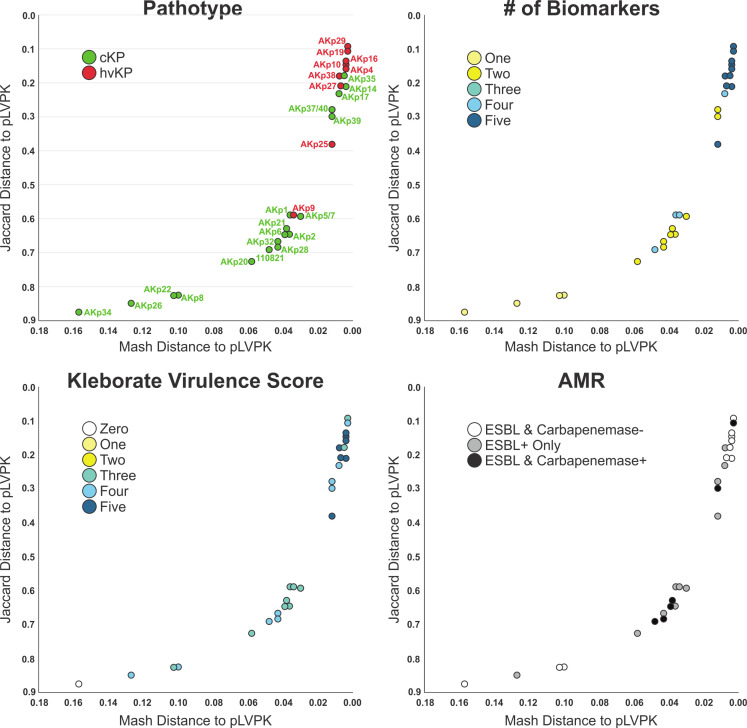
Distinguishing hypervirulent (hvKp) from classical Klebsiella pneumoniae (cKp) strains is important for clinical care, surveillance, and research. Some combinations of iucA, iroB, peg-344, rmpA, and rmpA2 are most commonly used, but it is unclear what combination of genotypic or phenotypic markers (e.g., siderophore concentration, mucoviscosity) most accurately predicts the hypervirulent phenotype. Furthermore, acquisition of antimicrobial resistance may affect virulence and confound identification. Therefore, 49 K. pneumoniae strains that possessed some combinations of iucA, iroB, peg-344, rmpA, and rmpA2 and had acquired resistance were assembled and categorized as hypervirulent hvKp (hvKp) (N = 16) or cKp (N = 33) via a murine infection model. Biomarker number, siderophore production, mucoviscosity, virulence plasmid's Mash/Jaccard distances to the canonical pLVPK, and Kleborate virulence score were measured and evaluated to accurately differentiate these pathotypes. Both stepwise logistic regression and a CART model were used to determine which variable was most predictive of the strain cohorts. The biomarker count alone was the strongest predictor for both analyses. For logistic regression, the area under the curve for biomarker count was 0.962 (P = 0.004). The CART model generated the classification rule that a biomarker count = 5 would classify the strain as hvKP, resulting in a sensitivity for predicting hvKP of 94% (15/16), a specificity of 94% (31/33), and an overall accuracy of 94% (46/49). Although a count of ≥4 was 100% (16/16) sensitive for predicting hvKP, the specificity and accuracy decreased to 76% (25/33) and 84% (41/49), respectively. These findings can be used to inform the identification of hvKp.IMPORTANCEHypervirulent Klebsiella pneumoniae (hvKp) is a concerning pathogen that can cause life-threatening infections in otherwise healthy individuals. Importantly, although strains of hvKp have been acquiring antimicrobial resistance, the effect on virulence is unclear. Therefore, it is of critical importance to determine whether a given antimicrobial resistant K. pneumoniae isolate is hypervirulent. This report determined which combination of genotypic and phenotypic markers could most accurately identify hvKp strains with acquired resistance. Both logistic regression and a machine-learning prediction model demonstrated that biomarker count alone was the strongest predictor. The presence of all five of the biomarkers iucA, iroB, peg-344, rmpA, and rmpA2 was most accurate (94%); the presence of ≥4 of these biomarkers was most sensitive (100%). Accurately identifying hvKp is vital for surveillance and research, and the availability of biomarker data could alert the clinician that hvKp is a consideration, which, in turn, would assist in optimizing patient care.
Keywords: Klebsiella; biomarker; classical; diagnosis; hypervirulent.
Conflict of interest statement
The authors declare no conflict of interest.
Figures
Update of
-
Differentiation of hypervirulent and classical Klebsiella pneumoniae with acquired drug resistance.bioRxiv [Preprint]. 2023 Oct 26:2023.06.30.547231. doi: 10.1101/2023.06.30.547231. bioRxiv. 2023. Update in: mBio. 2024 Feb 14;15(2):e0286723. doi: 10.1128/mbio.02867-23. PMID: 37961280 Free PMC article. Updated. Preprint.
References
-
- Liu C, Du P, Xiao N, Ji F, Russo TA, Guo J. 2020. Hypervirulent Klebsiella pneumoniae is emerging as an increasingly prevalent K. pneumoniae pathotype responsible for nosocomial and healthcare-associated infections in Beijing, China. Virulence 11:1215–1224. doi:10.1080/21505594.2020.1809322 - DOI - PMC - PubMed
-
- Russo TA, Olson R, Fang C-T, Stoesser N, Miller M, MacDonald U, Hutson A, Barker JH, La Hoz RM, Johnson JR. 2018. Identification of biomarkers for differentiation of hypervirulent Klebsiella pneumoniae from classical K. pneumoniae. J Clin Microbiol 56:e00776-18. doi:10.1128/JCM.00776-18 - DOI - PMC - PubMed
MeSH terms
Substances
Grants and funding
LinkOut - more resources
Full Text Sources
Molecular Biology Databases