


Association of sleep quality with duty hours, mental health, and medical errors among Japanese postgraduate residents: a cross-sectional study
- PMID: 38233476
- PMCID: PMC10794685
- DOI: 10.1038/s41598-024-51353-8
Association of sleep quality with duty hours, mental health, and medical errors among Japanese postgraduate residents: a cross-sectional study
Abstract
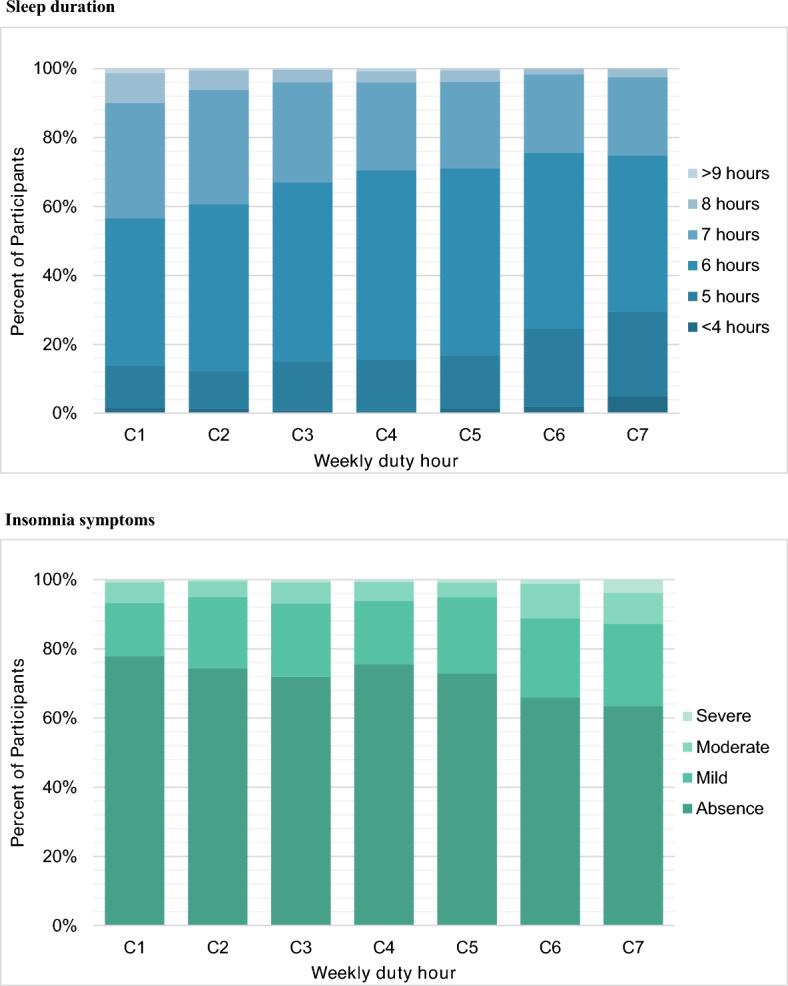
Long duty hours (DH) impair sleep and negatively affect residents' health and medical safety. This cross-sectional study investigated the association among residents' DH, sleep duration, insomnia, sleep impairment, depressive symptoms, and self-reported medical errors among 5579 residents in Japan who completed the General Medicine In-Training Examination (2021) and participated in the training-environment survey. Weekly DH was classified under seven categories. Sleep duration and insomnia symptoms, from the Athens Insomnia Scale, were analysed to determine sleep impairment; depressive symptoms and medical errors were self-reported. Among 5095 residents, 15.5% slept < 5 h/day, and 26.7% had insomnia. In multivariable analysis, compared with ≥ 60 and < 70, DH ≥ 90 h/week associated with shorter sleep duration and worsen insomnia symptoms. Shorter durations of sleep and more intense symptoms of insomnia were associated with increased depressive symptoms. Medical errors increased only among residents with insomnia, but were not associated with sleep duration. DH > 90 h/week could lead to shorter sleep duration, worsen insomnia symptoms, and negatively impact well-being and medical safety. There was no significant association between sleep duration and medical errors; however, insomnia conferred an increased risk of medical errors. Limiting DH for residents to avoid excessive workload can help improve resident sleep, enhance resident well-being, and potentially reduce insomnia-associated medical errors.
© 2024. The Author(s).
Conflict of interest statement
Dr. Nishizaki received an honorarium from JAMEP as the GM-ITE project manager. Dr. Tokuda is the JAMEP director. Dr. Kobayashi and Dr. Shikino received an honorarium from JAMEP as speakers for the JAMEP lecture. Dr. Shimizu, Dr. Yamamoto, Dr. Shikino, and Dr. Fukui received an honorarium from JAMEP as exam preparers for GM-ITE. Dr. Nishizaki, Dr. Tokuda, Dr. Kobayashi, Dr. Shimizu, Dr. Yamamoto, Dr. Shikino, and Dr. Fukui were not involved in this analysis. Dr. Nagasaki, Dr. Kurihara, Dr. Watari, Dr. Nishiguchi, and Dr. Katayama have no conflicts of interest to declare.
Figures

References
-
- Ministry of Health, Labour and Welfare. Addressing the reform of the working style of physicians in the clinical training system; (2023, accessed 2 Ma 2023). https://www.mhlw.go.jp/content/10803000/000590866.pdf (in Japanese).
MeSH terms
LinkOut - more resources
Full Text Sources
Medical
