. 2022 Jul 12:48:91-149.
doi: 10.3767/persoonia.2023.48.03. Epub 2022 Apr 4.

More smooth-spored species of Inocybe (Agaricales, Ba sidiomycota): type studies and 12 new species from Europe

Affiliations

More smooth-spored species of Inocybe (Agaricales, Ba sidiomycota): type studies and 12 new species from Europe

D Bandini et al. Persoonia. .

Abstract

Twelve new species of Inocybe (I. adorabilis, I. comis, I. demetris, I. filiana, I. galactica, I. morganae, I. othini, I. ovilla, I. proteica, I. somae, I. suryana and I. venerabilis) are described from Europe on the basis of detailed morphological and molecular investigation. A portrait of the recently described I. ianthinopes is given. All species are smooth-spored and some pruinose only in the apical part of the stipe, and some on entire length. The new species are compared to 24 type specimens (17 characterized by at least partial ITS sequence data), all of which are described and revised here. Epitypes were selected for two species, I. hirtella and I. sindonia. Based on our studies, we confirm that I. kuehneri and I. sindonia on one hand, and I. subalbidodisca and I. ochroalba on the other, are synonyms and furthermore suggest that I. abietis is synonymous with I. catalaunica, I. exilis with I. rufobrunnea, I. hirtellarum with I. mycenoides, I. lapidicola with I. deianae, I. ochraceolutea with I. sindonia, I. stangliana with I. pelargonium, I. subrubens with I. subhirtella and I. sulfovirescens with I. langei. All of the new species are supported by phylogenetic analyses. Among the 16 previously described species accepted here, 10 are represented by types in the phylogenetic analyses and five by own collections corresponding to the type. Two species, I. eutheloides (remaining doubtful) and I. pallidolutea are only treated morphologically. In summary, we describe as new or verify the taxonomic status and provide or corroborate morphological concepts for 37 smooth-spored species of Inocybe. Citation: Bandini D, Oertel B, Eberhardt U. 2022. More smooth-spored species of Inocybe (Agaricales, Basidiomycota): type studies and 12 new species from Europe. Persoonia 48: 91-149. https://doi.org/10.3767/persoonia.2022.48.03.

Keywords: Agaricales; ITS; Inocybaceae; Inocybe; LSU; RPB2; alpha taxonomy; epitypification; molecular systematics.


Figures

Fig. 1
Fig. 1
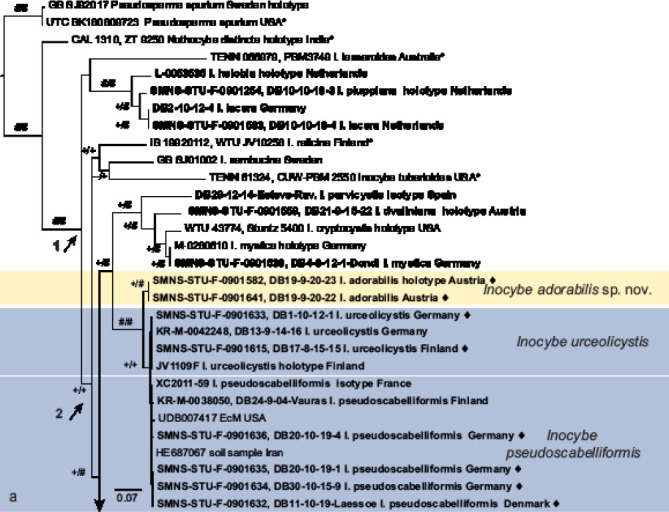
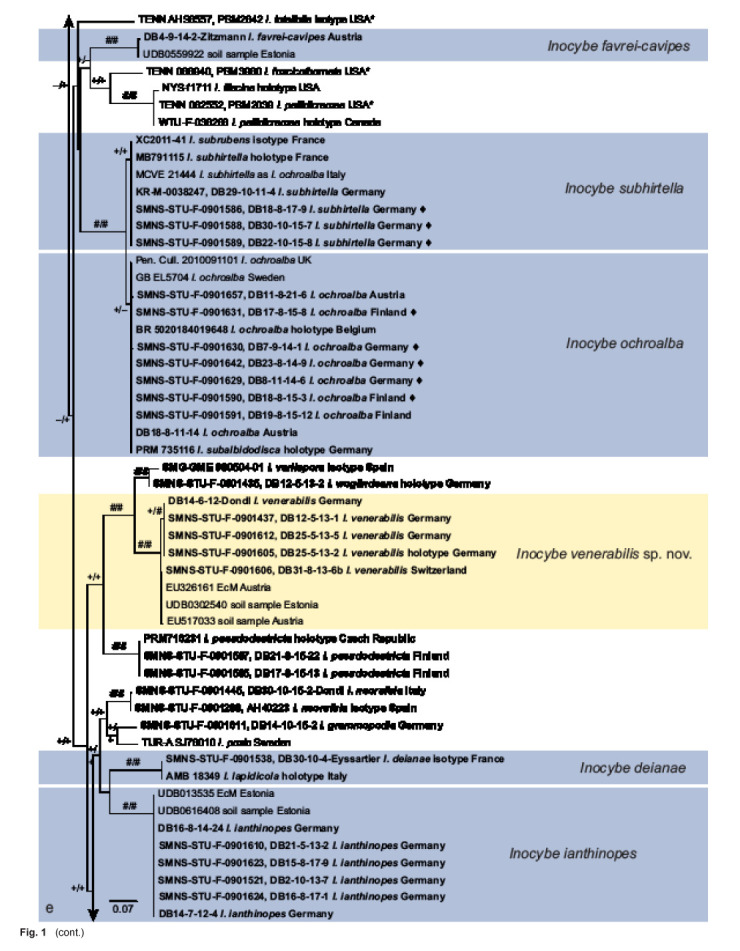
a–f. ML topology of ITS and partial LSU sequences from the species of Inocybe treated or discussed here. Pseudosperma spurium is used for rooting. Clades of species that are described here as new are highlighted in yellow; species clades for which type material is described here are highlighted in blue. Sequences indicated by ♦ also include RPB2 data. Material studied is in bold font. Sequences taken from Matheny et al. (2020) are indicated by *. Arrow 1: Inocybe (genus); arrow 2: smooth-spored temperate boreal clade (STBC, see Matheny et al. 2020) as interpreted here; and arrow 3: STBC as in Matheny et al. (2020). Support values from 5 000 replicates of SH-like approximate likelihood ratio test (SH-aLRT) support / 5 000 replicates of ultrafast bootstrap (ufb) indicated at the branches, # indicating 100 % support, + indicating values ≥ 80 % SH-aLRT or ≥ 0.95 ufb. The SH-aLRT value is given first. The clade of I. urceolicystis (too short to be visible as distinct in the figure) received – / + support
Fig. 1
Fig. 1
a–f. ML topology of ITS and partial LSU sequences from the species of Inocybe treated or discussed here. Pseudosperma spurium is used for rooting. Clades of species that are described here as new are highlighted in yellow; species clades for which type material is described here are highlighted in blue. Sequences indicated by ♦ also include RPB2 data. Material studied is in bold font. Sequences taken from Matheny et al. (2020) are indicated by *. Arrow 1: Inocybe (genus); arrow 2: smooth-spored temperate boreal clade (STBC, see Matheny et al. 2020) as interpreted here; and arrow 3: STBC as in Matheny et al. (2020). Support values from 5 000 replicates of SH-like approximate likelihood ratio test (SH-aLRT) support / 5 000 replicates of ultrafast bootstrap (ufb) indicated at the branches, # indicating 100 % support, + indicating values ≥ 80 % SH-aLRT or ≥ 0.95 ufb. The SH-aLRT value is given first. The clade of I. urceolicystis (too short to be visible as distinct in the figure) received – / + support
Fig. 1
Fig. 1
a–f. ML topology of ITS and partial LSU sequences from the species of Inocybe treated or discussed here. Pseudosperma spurium is used for rooting. Clades of species that are described here as new are highlighted in yellow; species clades for which type material is described here are highlighted in blue. Sequences indicated by ♦ also include RPB2 data. Material studied is in bold font. Sequences taken from Matheny et al. (2020) are indicated by *. Arrow 1: Inocybe (genus); arrow 2: smooth-spored temperate boreal clade (STBC, see Matheny et al. 2020) as interpreted here; and arrow 3: STBC as in Matheny et al. (2020). Support values from 5 000 replicates of SH-like approximate likelihood ratio test (SH-aLRT) support / 5 000 replicates of ultrafast bootstrap (ufb) indicated at the branches, # indicating 100 % support, + indicating values ≥ 80 % SH-aLRT or ≥ 0.95 ufb. The SH-aLRT value is given first. The clade of I. urceolicystis (too short to be visible as distinct in the figure) received – / + support
Fig. 1
Fig. 1
a–f. ML topology of ITS and partial LSU sequences from the species of Inocybe treated or discussed here. Pseudosperma spurium is used for rooting. Clades of species that are described here as new are highlighted in yellow; species clades for which type material is described here are highlighted in blue. Sequences indicated by ♦ also include RPB2 data. Material studied is in bold font. Sequences taken from Matheny et al. (2020) are indicated by *. Arrow 1: Inocybe (genus); arrow 2: smooth-spored temperate boreal clade (STBC, see Matheny et al. 2020) as interpreted here; and arrow 3: STBC as in Matheny et al. (2020). Support values from 5 000 replicates of SH-like approximate likelihood ratio test (SH-aLRT) support / 5 000 replicates of ultrafast bootstrap (ufb) indicated at the branches, # indicating 100 % support, + indicating values ≥ 80 % SH-aLRT or ≥ 0.95 ufb. The SH-aLRT value is given first. The clade of I. urceolicystis (too short to be visible as distinct in the figure) received – / + support
Fig. 1
Fig. 1
a–f. ML topology of ITS and partial LSU sequences from the species of Inocybe treated or discussed here. Pseudosperma spurium is used for rooting. Clades of species that are described here as new are highlighted in yellow; species clades for which type material is described here are highlighted in blue. Sequences indicated by ♦ also include RPB2 data. Material studied is in bold font. Sequences taken from Matheny et al. (2020) are indicated by *. Arrow 1: Inocybe (genus); arrow 2: smooth-spored temperate boreal clade (STBC, see Matheny et al. 2020) as interpreted here; and arrow 3: STBC as in Matheny et al. (2020). Support values from 5 000 replicates of SH-like approximate likelihood ratio test (SH-aLRT) support / 5 000 replicates of ultrafast bootstrap (ufb) indicated at the branches, # indicating 100 % support, + indicating values ≥ 80 % SH-aLRT or ≥ 0.95 ufb. The SH-aLRT value is given first. The clade of I. urceolicystis (too short to be visible as distinct in the figure) received – / + support
Fig. 1
Fig. 1
a–f. ML topology of ITS and partial LSU sequences from the species of Inocybe treated or discussed here. Pseudosperma spurium is used for rooting. Clades of species that are described here as new are highlighted in yellow; species clades for which type material is described here are highlighted in blue. Sequences indicated by ♦ also include RPB2 data. Material studied is in bold font. Sequences taken from Matheny et al. (2020) are indicated by *. Arrow 1: Inocybe (genus); arrow 2: smooth-spored temperate boreal clade (STBC, see Matheny et al. 2020) as interpreted here; and arrow 3: STBC as in Matheny et al. (2020). Support values from 5 000 replicates of SH-like approximate likelihood ratio test (SH-aLRT) support / 5 000 replicates of ultrafast bootstrap (ufb) indicated at the branches, # indicating 100 % support, + indicating values ≥ 80 % SH-aLRT or ≥ 0.95 ufb. The SH-aLRT value is given first. The clade of I. urceolicystis (too short to be visible as distinct in the figure) received – / + support
Fig. 2
Fig. 2
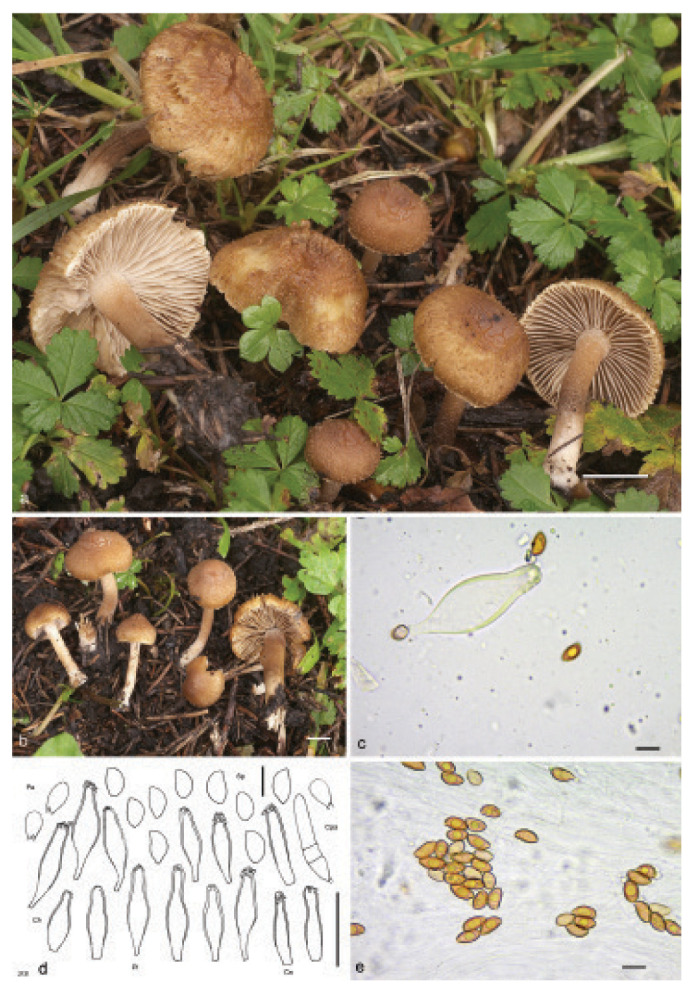
Inocybe adorabilis sp. nov. a. Holotype, in situ; b. collection DB19-9-20-22, in situ; c. pleurocystidia (coll. DB19-9-20-22); d. microscopic characters (holotype), Ca = Caulocystidia, Cpa = Cauloparacystidia, Ch = Cheilocystidia, Pa = Paracystidia, Pl = Pleurocystidia, Sp = Spores; e. spores (holotype). — Scale bars: a–b = 1 cm; c, e = 10 μm; d (Ca, Ch, Cpa, Pa, Pl) = 50 μm, d (Sp) = 10 μm.
Fig. 3
Fig. 3
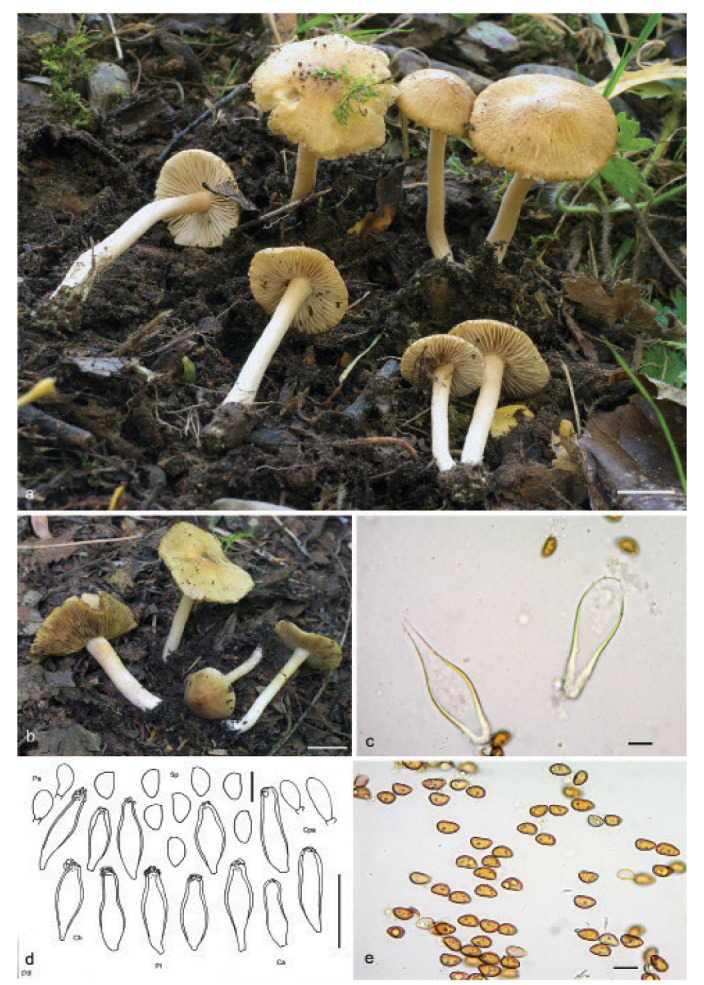
Inocybe comis sp. nov. a. Holotype, in situ; b. collection DB13-8-13-27, in situ; c. cheilocystidia (coll. DB13-8-13-27); d. microscopic characters (holotype), Ca = Caulocystidia, Cpa = Cauloparacystidia, Ch = Cheilocystidia, Pa = Paracystidia, Pl = Pleurocystidia, Sp = Spores; e. spores (coll. DB13-8-13-27). — Scale bars: a–b = 1 cm; c, e = 10 μm; d (Ca, Ch, Cpa, Pa, Pl) = 50 μm, d (Sp) = 10 μm.
Fig. 4
Fig. 4
Inocybe demetris sp. nov. a. Holotype, in situ; b. collection DB22-9-20-13, in situ; c. cheilocystidia (coll. DB12-8-14-7); d. microscopic characters (holotype), Ca = Caulocystidia, Cpa = Cauloparacystidia, Ch = Cheilocystidia, Pa = Paracystidia, Pl = Pleurocystidia, Sp = Spores; e. spores (coll. DB21-10-17-10). — Scale bars: a–b = 1 cm; c, e = 10 μm; d (Ca, Ch, Cpa, Pa, Pl) = 50 μm, d (Sp) = 10 μm.
Fig. 5
Fig. 5
Inocybe filiana sp. nov. a. Holotype, in situ; b. collection DB2-10-12-2, in situ; c. pleurocystidia (coll. DB5-5-16-9); d. microscopic characters (holotype), Ca = Caulocystidia, Cpa = Cauloparacystidia, Ch = Cheilocystidia, Pa = Paracystidia, Pl = Pleurocystidia, Sp = Spores; e. spores (coll. DB5-5-16-9). — Scale bars: a–b = 1 cm; c, e = 10 μm; d (Ca, Ch, Cpa, Pa, Pl) = 50 μm, d (Sp) = 10 μm.
Fig. 6
Fig. 6
Inocybe galactica sp. nov. a. Holotype, in situ; b. collection DB14-9-19-14, in situ; c. cheilocystidia (holotype); d. microscopic characters (holotype), Ca = Caulocystidia, Cpa = Cauloparacystidia, Ch = Cheilocystidia, Pa = Paracystidia, Pl = Pleurocystidia, Sp = Spores; e. spores (holotype). — Scale bars: a–b = 1 cm; c, e = 10 μm; d (Ca, Ch, Cpa, Pa, Pl) = 50 μm, d (Sp) = 10 μm
Fig. 7
Fig. 7
Inocybe hirtella. a. Epitype, in situ; b. collection DB12-10-11-2, in situ; c. cheilocystidia (coll. DB28-9-14-5); d. microscopic characters (epitype), Ca = Caulocystidia, Cpa = Cauloparacystidia, Ch = Cheilocystidia, Pa = Paracystidia, Pl = Pleurocystidia, Sp = Spores; e. spores (coll. DB3-10-14-3). — Scale bars: a–b = 1 cm; c, e = 10 μm; d (Ca, Ch, Cpa, Pa, Pl) = 50 μm, d (Sp) = 10 μm.
Fig. 8
Fig. 8
Inocybe ianthinopes. a. Coll. STU SMNS-STU-F-0901623, in situ; b. collection DB14-7-12-4, in situ; c. cheilocystide (coll. DB14-7-12-4); d. microscopic characters (coll. STU SMNS-STU-F-0901623), Ca = Caulocystidia, Cpa = Cauloparacystidia, Ch = Cheilocystidia, Pa = Paracystidia, Pl = Pleurocystidia, Sp = Spores; e. spores (coll. DB14-7-12-4). — Scale bars: a–b = 1 cm; c, e = 10 μm; d (Ca, Ch, Cpa, Pa, Pl) = 50 μm, d (Sp) = 10 μm.
Fig. 9
Fig. 9
Inocybe morganae sp. nov. a. Holotype, in situ; b. collection DB9-9-19-11, in situ; c. cheilocystide (coll. DB25-7-18-16); d. microscopic characters (holotype), Ca = Caulocystidia, Cpa = Cauloparacystidia, Ch = Cheilocystidia, Pa = Paracystidia, Pl = Pleurocystidia, Sp = Spores; e. spores (holotype). — Scale bars: a–b = 1 cm; c, e = 10 μm; d (Ca, Ch, Cpa, Pa, Pl) = 50 μm, d (Sp) = 10 μm.
Fig. 10
Fig. 10
Inocybe othini sp. nov. a. Holotype, in situ; b. collection DB19-9-20-12, in situ; c. cheilocystide (holotype); d. microscopic characters (holotype), Ca = Caulocystidia, Cpa = Cauloparacystidia, Ch = Cheilocystidia, Pa = Paracystidia, Pl = Pleurocystidia, Sp = Spores; e. spores (holotype). — Scale bars: a–b = 1 cm; c, e = 10 μm; d (Ca, Ch, Cpa, Pa, Pl) = 50 μm, d (Sp) = 10 μm.
Fig. 11
Fig. 11
Inocybe ovilla sp. nov. a. Holotype, in situ; b. collection DB14-9-16-5, in situ; c. cheilocystidia (holotype); d. microscopic characters (holotype), Ca = Caulocystidia, Cpa = Cauloparacystidia, Ch = Cheilocystidia, Pa = Paracystidia, Pl = Pleurocystidia, Sp = Spores; e. spores (holotype). — Scale bars: a–b = 1 cm; c, e = 10 μm; d (Ca, Ch, Cpa, Pa, Pl) = 50 μm, d (Sp) = 10 μm.
Fig. 12
Fig. 12
Inocybe ovilla sp. nov. a. Holotype, in situ; b. collection DB14-9-16-5, in situ; c. cheilocystidia (holotype); d. microscopic characters (holotype), Ca = Caulocystidia, Cpa = Cauloparacystidia, Ch = Cheilocystidia, Pa = Paracystidia, Pl = Pleurocystidia, Sp = Spores; e. spores (holotype). — Scale bars: a–b = 1 cm; c, e = 10 μm; d (Ca, Ch, Cpa, Pa, Pl) = 50 μm, d (Sp) = 10 μm.
Fig. 13
Fig. 13
Inocybe ovilla sp. nov. a. Holotype, in situ; b. collection DB14-9-16-5, in situ; c. cheilocystidia (holotype); d. microscopic characters (holotype), Ca = Caulocystidia, Cpa = Cauloparacystidia, Ch = Cheilocystidia, Pa = Paracystidia, Pl = Pleurocystidia, Sp = Spores; e. spores (holotype). — Scale bars: a–b = 1 cm; c, e = 10 μm; d (Ca, Ch, Cpa, Pa, Pl) = 50 μm, d (Sp) = 10 μm.
Fig. 14
Fig. 14
Inocybe ovilla sp. nov. a. Holotype, in situ; b. collection DB14-9-16-5, in situ; c. cheilocystidia (holotype); d. microscopic characters (holotype), Ca = Caulocystidia, Cpa = Cauloparacystidia, Ch = Cheilocystidia, Pa = Paracystidia, Pl = Pleurocystidia, Sp = Spores; e. spores (holotype). — Scale bars: a–b = 1 cm; c, e = 10 μm; d (Ca, Ch, Cpa, Pa, Pl) = 50 μm, d (Sp) = 10 μm.
Fig. 15
Fig. 15
Inocybe ovilla sp. nov. a. Holotype, in situ; b. collection DB14-9-16-5, in situ; c. cheilocystidia (holotype); d. microscopic characters (holotype), Ca = Caulocystidia, Cpa = Cauloparacystidia, Ch = Cheilocystidia, Pa = Paracystidia, Pl = Pleurocystidia, Sp = Spores; e. spores (holotype). — Scale bars: a–b = 1 cm; c, e = 10 μm; d (Ca, Ch, Cpa, Pa, Pl) = 50 μm, d (Sp) = 10 μm.
Fig. 16
Fig. 16
Inocybe ovilla sp. nov. a. Holotype, in situ; b. collection DB14-9-16-5, in situ; c. cheilocystidia (holotype); d. microscopic characters (holotype), Ca = Caulocystidia, Cpa = Cauloparacystidia, Ch = Cheilocystidia, Pa = Paracystidia, Pl = Pleurocystidia, Sp = Spores; e. spores (holotype). — Scale bars: a–b = 1 cm; c, e = 10 μm; d (Ca, Ch, Cpa, Pa, Pl) = 50 μm, d (Sp) = 10 μm.
Fig. 17
Fig. 17
Inocybe ovilla sp. nov. a. Holotype, in situ; b. collection DB14-9-16-5, in situ; c. cheilocystidia (holotype); d. microscopic characters (holotype), Ca = Caulocystidia, Cpa = Cauloparacystidia, Ch = Cheilocystidia, Pa = Paracystidia, Pl = Pleurocystidia, Sp = Spores; e. spores (holotype). — Scale bars: a–b = 1 cm; c, e = 10 μm; d (Ca, Ch, Cpa, Pa, Pl) = 50 μm, d (Sp) = 10 μm.
Fig. 18
Fig. 18
Inocybe ovilla sp. nov. a. Holotype, in situ; b. collection DB14-9-16-5, in situ; c. cheilocystidia (holotype); d. microscopic characters (holotype), Ca = Caulocystidia, Cpa = Cauloparacystidia, Ch = Cheilocystidia, Pa = Paracystidia, Pl = Pleurocystidia, Sp = Spores; e. spores (holotype). — Scale bars: a–b = 1 cm; c, e = 10 μm; d (Ca, Ch, Cpa, Pa, Pl) = 50 μm, d (Sp) = 10 μm.
Fig. 19
Fig. 19
Inocybe ovilla sp. nov. a. Holotype, in situ; b. collection DB14-9-16-5, in situ; c. cheilocystidia (holotype); d. microscopic characters (holotype), Ca = Caulocystidia, Cpa = Cauloparacystidia, Ch = Cheilocystidia, Pa = Paracystidia, Pl = Pleurocystidia, Sp = Spores; e. spores (holotype). — Scale bars: a–b = 1 cm; c, e = 10 μm; d (Ca, Ch, Cpa, Pa, Pl) = 50 μm, d (Sp) = 10 μm.

References

    1. Aignon HL, Naseer A, Boukary AA. et al. 2021. Inocybaceae and affiliated taxa from West Africa. Moroccan Journal of Agricultural Sciences 2(1): 9–13.
    1. Arnolds E, Chrispijn R, Enzlin R. 2015. Ecologische atlas van paddenstoelen in Drenthe. 3 vols. Stichting Paddestoelen Werkgroep Drenthe, Beilen.
    1. Bahram M, Kõljalg U, Kohout P, et al. 2013. Ectomycorrhizal fungi of exotic pine plantations in relation to native host trees in Iran: evidence of host range expansion by local symbionts to distantly related host taxa. Myco­rrhiza 23(1): 11–19. - PubMed
    1. Bahram M, Põlme S, Kõljalg U, et al. 2012. Regional and local patterns of ectomycorrhizal fungal diversity and community structure along an altitudinal gradient in the Hyrcanian forests of northern Iran. New Phytologist 193(2): 465–473. - PubMed
    1. Bandini D. 2014. Zusammenfassung der Inocybe-Funde während der siebten Bayerischen Mykologischen Tagung. Mycologia Bavarica 15: 33–36.

LinkOut - more resources