This is a preprint.
Air cleaners and respiratory infections in schools: A modeling study using epidemiological, environmental, and molecular data
- PMID: 38234723
- PMCID: PMC10793541
- DOI: 10.1101/2023.12.29.23300635
Air cleaners and respiratory infections in schools: A modeling study using epidemiological, environmental, and molecular data
Update in
-
Air Cleaners and Respiratory Infections in Schools: A Modeling Study Based on Epidemiologic, Environmental, and Molecular Data.Open Forum Infect Dis. 2024 Mar 21;11(4):ofae169. doi: 10.1093/ofid/ofae169. eCollection 2024 Apr. Open Forum Infect Dis. 2024. PMID: 38665173 Free PMC article.
Abstract
Background: Using a multiple-measurement approach, we examined the real-world effectiveness of portable HEPA-air filtration devices (air cleaners) in a school setting.
Methods: We collected environmental (CO2, particle concentrations), epidemiological (absences related to respiratory infections), audio (coughing), and molecular data (bioaerosol and saliva samples) over seven weeks during winter 2022/2023 in two Swiss secondary school classes. Using a cross-over study design, we compared particle concentrations, coughing, and the risk of infection with vs without air cleaners.
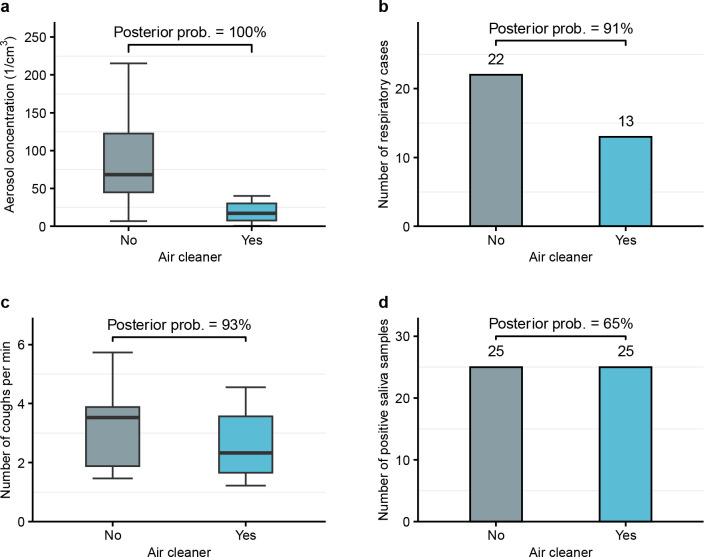
Results: All 38 students (age 13-15 years) participated. With air cleaners, mean particle concentration decreased by 77% (95% credible interval 63%-86%). There were no differences in CO2 levels. Absences related to respiratory infections were 22 without vs 13 with air cleaners. Bayesian modeling suggested a reduced risk of infection, with a posterior probability of 91% and a relative risk of 0.73 (95% credible interval 0.44-1.18). Coughing also tended to be less frequent (posterior probability 93%). Molecular analysis detected mainly non-SARS-CoV-2 viruses in saliva (50/448 positive), but not in bioaerosols (2/105 positive) or HEPA-filters (4/160). The detection rate was similar with vs without air cleaners. Spatiotemporal analysis of positive saliva samples identified several likely transmissions.
Conclusions: Air cleaners improved air quality, showed a potential benefit in reducing respiratory infections, and were associated with less coughing. Airborne detection of non-SARS-CoV-2 viruses was rare, suggesting that these viruses may be more difficult to detect in the air. Future studies should examine the importance of close contact and long-range transmission, and the cost-effectiveness of using air cleaners.
Keywords: air cleaner; airborne transmission; molecular detection; respiratory viruses; schools.
Figures


References
-
- Wang C, Pan R, Wan X, Tan Y, Xu L, Ho CS, et al. Immediate psychological responses and associated factors during the initial stage of the 2019 Coronavirus Disease (COVID-19) epidemic among the general population in China. Int J Environ Res Public Health. 2020;17(5):E1729. doi:10.3390/ijerph17051729. - DOI - PMC - PubMed
Publication types
Grants and funding
LinkOut - more resources
Full Text Sources
Miscellaneous