This is a preprint.
Malaria species prevalence among asymptomatic individuals in four regions of Mainland Tanzania
- PMID: 38234751
- PMCID: PMC10793544
- DOI: 10.1101/2023.12.28.23300584
Malaria species prevalence among asymptomatic individuals in four regions of Mainland Tanzania
Update in
-
Prevalence of non-falciparum malaria infections among asymptomatic individuals in four regions of Mainland Tanzania.Parasit Vectors. 2024 Mar 23;17(1):153. doi: 10.1186/s13071-024-06242-4. Parasit Vectors. 2024. PMID: 38519992 Free PMC article.
Abstract
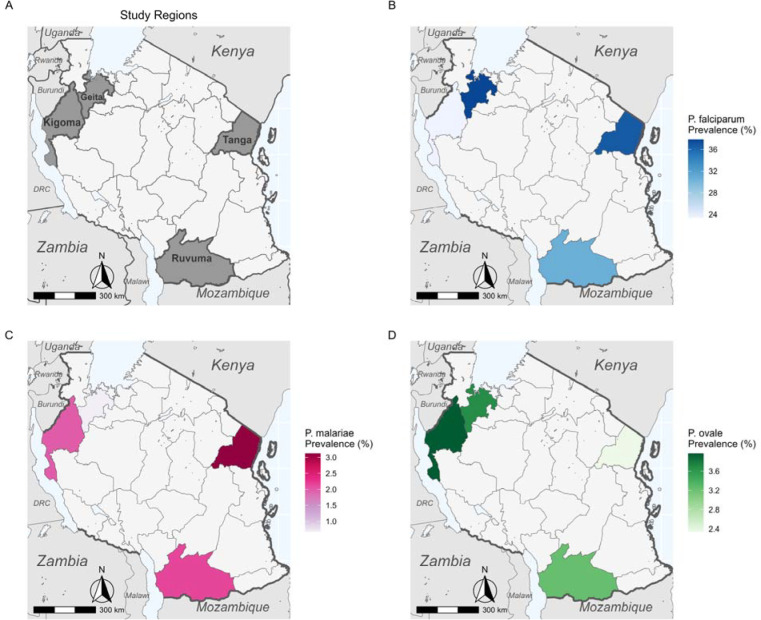
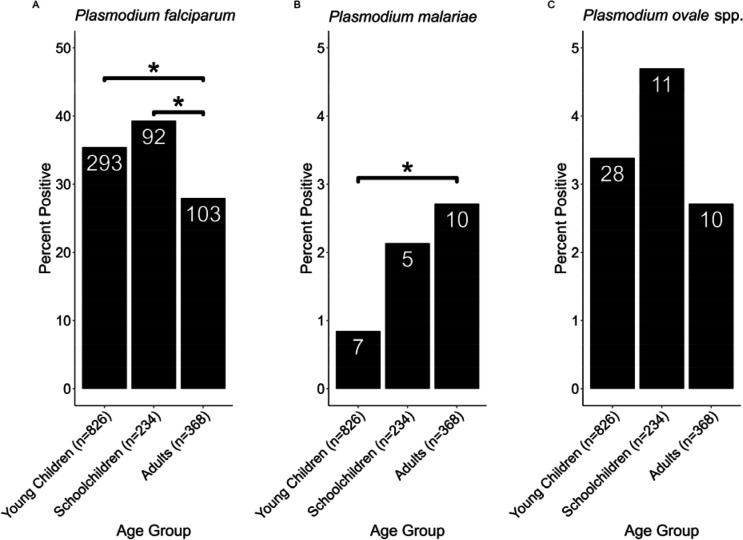
Recent studies point to the need to incorporate non-falciparum species detection into malaria surveillance activities in sub-Saharan Africa, where 95% of malaria cases occur. Although Plasmodium falciparum infection is typically more severe, diagnosis, treatment, and control for P. malariae, P. ovale spp., and P. vivax may be more challenging. The prevalence of these species throughout sub-Saharan Africa is poorly defined. Tanzania has geographically heterogeneous transmission levels but an overall high malaria burden. In order to estimate the prevalence of malaria species in Mainland Tanzania, 1,428 samples were randomly selected from 6,005 asymptomatic isolates collected in cross-sectional community surveys across four regions and analyzed via qPCR to detect each Plasmodium species. P. falciparum was most prevalent, with P. malariae and P. ovale spp. detected at lower prevalence (<5%) in all four regions. P. vivax was not detected. Malaria elimination efforts in Tanzania will need to account for these non-falciparum species.
Keywords: Plasmodium malariae; Plasmodium ovale; Plasmodium vivax; Tanzania; asymptomatic malaria; malaria; non-falciparum species.
Conflict of interest statement
Competing Interests: We declare no competing interests.
Figures
References
-
- World Health Organization. World malaria report 2022. Geneva; 2022.
-
- Akala HM, Watson OJ, Mitei KK, Juma DW, Verity R, Ingasia LA, et al. Plasmodium interspecies interactions during a period of increasing prevalence of Plasmodium ovale in symptomatic individuals seeking treatment: an observational study. The Lancet Microbe [Internet]. 2021. [cited 2022 Mar 31];2:e141–50. Available from: https://linkinghub.elsevier.com/retrieve/pii/S2666524721000094 - PMC - PubMed
-
- Betson M, Clifford S, Stanton M, Kabatereine NB, Stothard JR. Emergence of Nonfalciparum Plasmodium Infection Despite Regular Artemisinin Combination Therapy in an 18-Month Longitudinal Study of Ugandan Children and Their Mothers. J Infect Dis [Internet]. Oxford Academic; 2018. [cited 2022 Mar 31];217:1099–109. Available from: https://academic.oup.com/jid/article/217/7/1099/4791878 - PMC - PubMed
-
- Yman V, Wandell G, Mutemi DD, Miglar A, Asghar M, Hammar U, et al. Persistent transmission of Plasmodium malariae and Plasmodium ovale species in an area of declining Plasmodium falciparum transmission in eastern Tanzania. Marks F, editor. PLoS Negl Trop Dis [Internet]. Public Library of Science; 2019. [cited 2021 Apr 19];13:e0007414. Available from: 10.1371/journal.pntd.0007414 - DOI - PMC - PubMed
-
- Nguiffo-Nguete D, Nongley Nkemngo F, Ndo C, Agbor J-P, Boussougou-Sambe ST, Salako Djogbénou L, et al. Plasmodium malariae contributes to high levels of malaria transmission in a forest–savannah transition area in Cameroon. Parasites Vectors 2023 161 [Internet]. BioMed Central; 2023. [cited 2023 Jan 30];16:1–10. Available from: 10.1186/s13071-022-05635-7 - DOI - PMC - PubMed
Publication types
Grants and funding
LinkOut - more resources
Full Text Sources
Miscellaneous