


Patient activation and psychological coping strategies to manage challenging circumstances during the COVID-19 pandemic in people with kidney disease
- PMID: 38236468
- PMCID: PMC11043035
- DOI: 10.1007/s40620-023-01851-1
Patient activation and psychological coping strategies to manage challenging circumstances during the COVID-19 pandemic in people with kidney disease
Abstract
Background: Coping with health problems requires some degree of self-management; however, an individual's ability to self-manage can be threatened during challenging times, such as the COVID-19 pandemic. Exploring differences and changes in psychological well-being and coping strategies between those with low and high patient activation may inform appropriate interventions to support psychological coping.
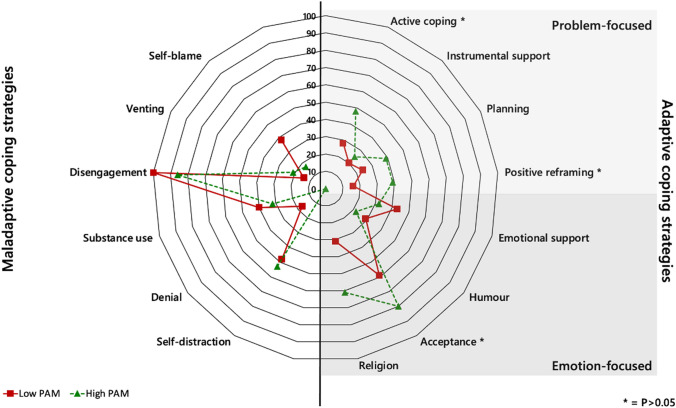
Methods: People with chronic kidney disease (CKD) (non-dialysis and transplant) were recruited from 11 hospital sites across England between August and December 2020. Participants responded to an online survey study, including the Brief Coping Orientation to Problem Experienced (COPE) Inventory, Depression, Anxiety and Stress Scale (DASS-21), Short Health Anxiety Index (SHAI), and Patient Activation Measure (PAM-13). A follow-up survey was conducted 6-9 months later. Paired t tests assessed within-group changes, and chi-squared tests compared coping strategies utilised by low- and high-activated participants. General linear modelling was performed to determine the relationship between patient activation and coping strategies, and covariates.
Results: Two hundred and fourteen participants were recruited (mean age: 60.7, 51% male, mean eGFR: 38.9 ml/min/1.73 m2). Low-activated participants were significantly more anxious than high-activated participants (P = 0.045). Health anxiety significantly decreased (i.e., got better) for high-activated participants (P = 0.016). Higher patient activation scores were associated with greater use of problem-focused strategies (β = 0.288, P < 0.001). Age (β = - 0.174, P = 0.012), sex (β = 0.188, P = 0.004), and education level (β = 0.159, P = 0.019) significantly predicted use of problem-focused strategies.
Discussion: Those with higher activation had lower levels of anxiety, and more frequently used adaptive coping strategies during the pandemic. Targeted support and interventions may be required for people with CKD to enhance patient activation, encourage more positive adaptive coping strategies, and mitigate maladaptive coping strategies.
Keywords: COVID-19; Chronic kidney disease; Coping behaviours; Patient activation; Self-management, psychological coping.
© 2024. The Author(s).
Conflict of interest statement
The authors declare that they have no potential conflicts of interest with respect to the research, authorship, and/or publication of this article.
Figures
References
-
- Hibbard J, Gilburt H. Supporting people to manage their health: an introduction to patient activation. London: The King's Fund; 2014.
Publication types
MeSH terms
LinkOut - more resources
Full Text Sources
Medical
Research Materials
Miscellaneous
