Review
. 2024 Jan 18;20(1):e1011898.
doi: 10.1371/journal.ppat.1011898. eCollection 2024 Jan.

The use of single-cell RNA-seq to study heterogeneity at varying levels of virus-host interactions

Affiliations
Review

The use of single-cell RNA-seq to study heterogeneity at varying levels of virus-host interactions

Sharmada Swaminath et al. PLoS Pathog. .

Abstract

The outcome of viral infection depends on the diversity of the infecting viral population and the heterogeneity of the cell population that is infected. Until almost a decade ago, the study of these dynamic processes during viral infection was challenging and limited to certain targeted measurements. Presently, with the use of single-cell sequencing technology, the complex interface defined by the interactions of cells with infecting virus can now be studied across the breadth of the transcriptome in thousands of individual cells simultaneously. In this review, we will describe the use of single-cell RNA sequencing (scRNA-seq) to study the heterogeneity of viral infections, ranging from individual virions to the immune response between infected individuals. In addition, we highlight certain key experimental limitations and methodological decisions that are critical to analyzing scRNA-seq data at each scale.


Conflict of interest statement

The authors have declared that no competing interests exist.

Figures
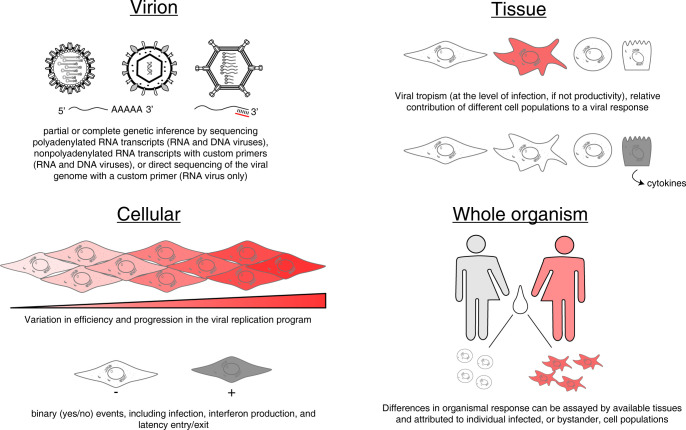
Fig 1
Fig 1. Broad examples of heterogeneity probed by scRNA-seq in the context of viral infection.
Specific instances of each provided in the text of the appropriate section.
Fig 2
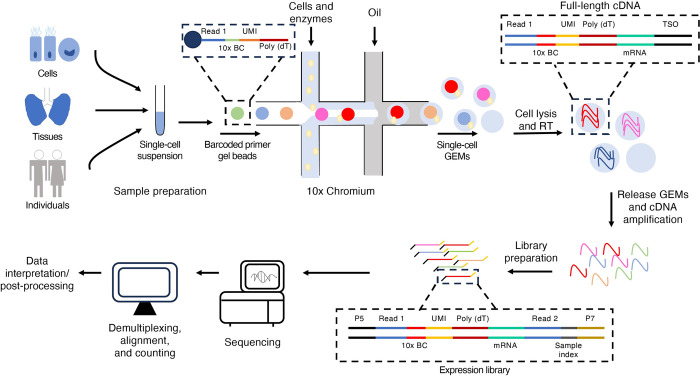
Fig 2. Single-cell sequencing workflow for droplet-based approaches exemplified by the 10x Genomics Chromium platform.
Infected cells from cell culture, tissues/organoids, or infected individuals are dissociated into a single-cell suspension. The cell suspension is loaded onto a microfluidic chip, and cells are partitioned into nanoliter-scale Gel Beads-in-emulsion (GEMs) droplets containing barcoded gel beads and reagents for reverse transcription (RT). Following cell lysis, the beads capture the mRNA molecules. Reverse transcription (RT) by template switching using a template switching oligonucleotide (TS) generates cDNA tagged with a 10x barcode (BC) to identify the cell and a unique molecular identifier (UMI) to label the mRNA transcript. The pooled cDNA is amplified in bulk, fragmented by enzymatic fragmentation, and sequencing adapters (P5 and P7) including a sample index, are added to the fragments by PCR to generate sequencing libraries. The sequencing libraries are sequenced, and the data are analyzed by alignment and demultiplexing, following which the data are interpreted.

References

    1. Tang F, Barbacioru C, Wang Y, Nordman E, Lee C, Xu N, et al. mRNA-Seq whole-transcriptome analysis of a single cell. Nat Methods. 2009;6:377–382. doi: 10.1038/nmeth.1315 - DOI - PubMed
    1. Picelli S, Faridani OR, Björklund ÅK, Winberg G, Sagasser S, Sandberg R. Full-length RNA-seq from single cells using Smart-seq2. Nat Protoc. 2014;9:171–181. doi: 10.1038/nprot.2014.006 - DOI - PubMed
    1. Picelli S, Björklund ÅK, Faridani OR, Sagasser S, Winberg G, Sandberg R. Smart-seq2 for sensitive full-length transcriptome profiling in single cells. Nat Methods. 2013;10:1096–1098. doi: 10.1038/nmeth.2639 - DOI - PubMed
    1. Picelli S, Björklund ÅK, Reinius B, Sagasser S, Winberg G, Sandberg R. Tn5 transposase and tagmentation procedures for massively scaled sequencing projects. Genome Res. 2014;24:2033–2040. doi: 10.1101/gr.177881.114 - DOI - PMC - PubMed
    1. Adey A, Morrison HG, Asan, Xun X, Kitzman JO, Turner EH, et al. Rapid, low-input, low-bias construction of shotgun fragment libraries by high-density in vitro transposition. Genome Biol. 2010;11:R119. doi: 10.1186/gb-2010-11-12-r119 - DOI - PMC - PubMed