


Projected income data under different shared socioeconomic pathways for Washington state
- PMID: 38238323
- PMCID: PMC10796341
- DOI: 10.1038/s41597-023-02906-5
Projected income data under different shared socioeconomic pathways for Washington state
Erratum in
-
Publisher Correction: Projected income data under different shared socioeconomic pathways for Washington state.Sci Data. 2024 Jan 29;11(1):140. doi: 10.1038/s41597-024-02992-z. Sci Data. 2024. PMID: 38286806 Free PMC article. No abstract available.
Abstract
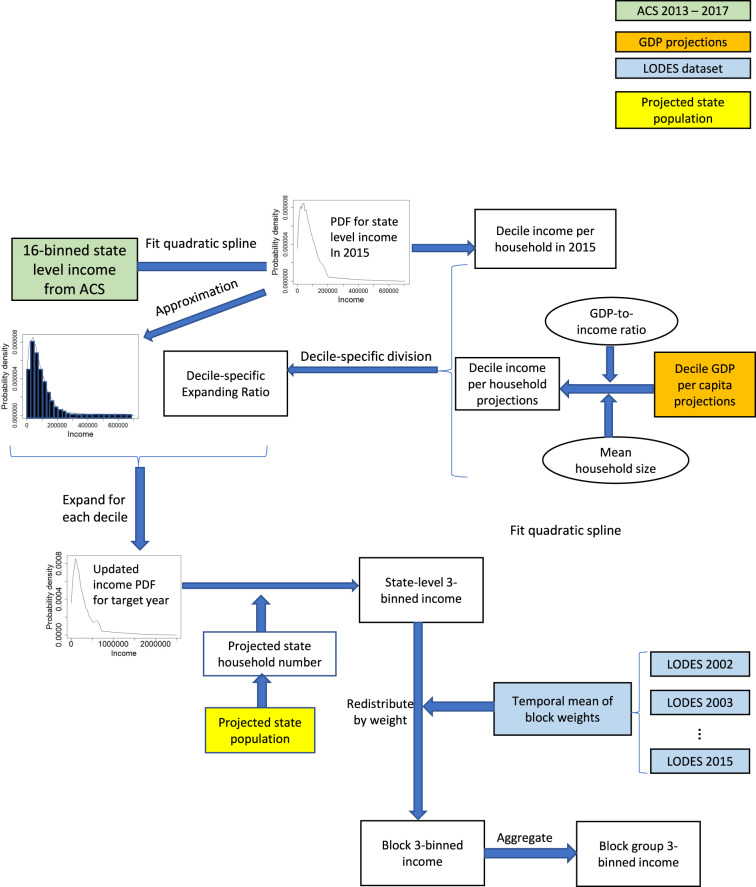
High-resolution income projections under different Shared Socioeconomic Pathways (SSPs) are essential for the climate change research communities to devise climate change adaptation and mitigation strategies. To generate income projections for Washington state, we obtain state-level GDP per capita projections and convert them into projected annual household income. The resulting state-level income projections are subsequently downscaled to the census block-level based on the Longitudinal Origin-Destination Employment Statistics (LODES) dataset. For accuracy assessment, we downscale historical income data from state- level to block- and block group-level and compare the downscaled results against the actual income data from LODES. County-level accuracy assessment is also conducted based on American Community Survey. The results demonstrate a good agreement (Average R2 of 0.67, 0.8, and 0.99 for block-, block group-, and county-level, respectively) between the downscaled income data and the reference data, thereby validating the methodology employed. Our approach is applicable to other states for income projections, which can be utilized by a broader audience, including those involved in demographic analysis, economic research, and urban planning.
© 2024. The Author(s).
Conflict of interest statement
The authors declare no competing interests.
References
-
- Becker GS, Murphy KM, Werning I. The equilibrium distribution of income and the market for status. Journal of Political Economy. 2005;113:282–310. doi: 10.1086/427463. - DOI
-
- Bischoff O. Explaining regional variation in equilibrium real estate prices and income. Journal of Housing Economics. 2012;21:1–15. doi: 10.1016/j.jhe.2011.11.002. - DOI
-
- Fransham M. Income and population dynamics in deprived neighbourhoods: measuring the poverty turnover rate using administrative data. Applied Spatial Analysis and Policy. 2019;12:275–300. doi: 10.1007/s12061-017-9242-6. - DOI
-
- Zhou X. Economic transformation and income inequality in urban China: evidence from panel data. American Journal of Sociology. 2000;105:1135–1174. doi: 10.1086/210401. - DOI
-
- Zhou Q, Shi W. How does town planning affect urban-rural income inequality: evidence from China with simultaneous equation analysis. Landscape and Urban Planning. 2022;221:104380. doi: 10.1016/j.landurbplan.2022.104380. - DOI
Publication types
LinkOut - more resources
Full Text Sources
