


The role of developmental caregiving programming in modulating our affiliation tendency and the vulnerability to social anxiety and eating disorders
- PMID: 38239461
- PMCID: PMC10794631
- DOI: 10.3389/fpsyg.2023.1259415
The role of developmental caregiving programming in modulating our affiliation tendency and the vulnerability to social anxiety and eating disorders
Abstract
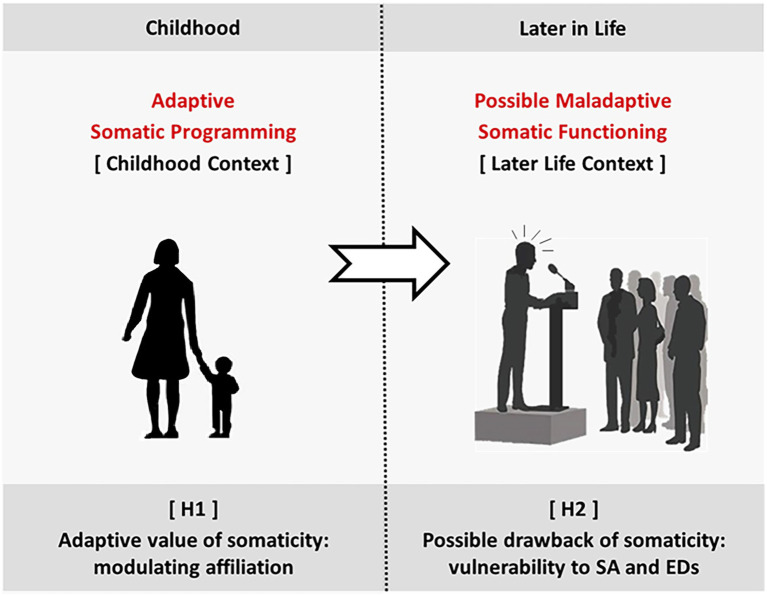
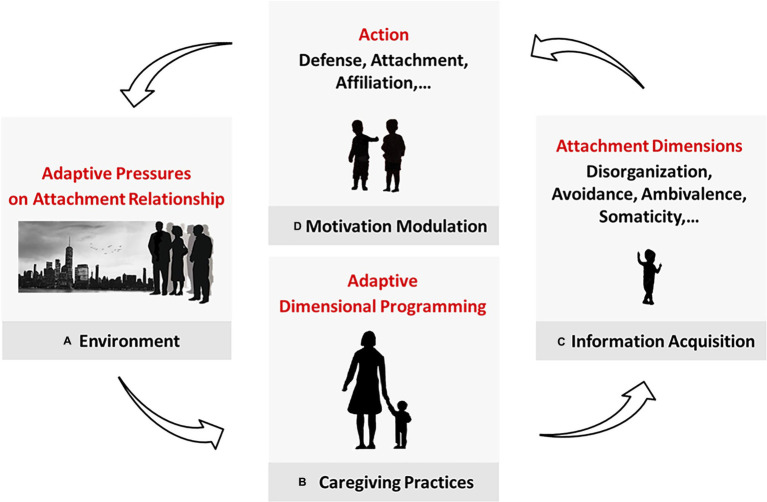
Attachment is the evolutionarily-established process through which humans create bonds with others to receive care from them. The phenomenon is as essential to our physical survival as it is to our psychological development. An increasing number of studies demonstrates that in sensitive periods during the early years of life, our brain circuitry is programmed in the interactions with our caregivers, with the imprinting of information over multiple attachment dimensions. Adopting a basic brain-computer analogy, we can think of this knowledge as the psycho-social firmware of our mind. According to a recently proposed extension of the classical three-dimensional view, one attachment dimension - somaticity - concerns the caregiver's task of reflecting and confirming the child's (internal) states - such as sensations, emotions, and representations - to support the child's ability to identify and define those entities autonomously. Relying on multidisciplinary evidence - from neuroscientific, developmental, evolutionary, and clinical sources - we suggest that somaticity (H1) has the adaptive function to modulate our tendency to comply and affiliate with a reference group but also (H2) increases the vulnerability to developing Social Anxiety (SA) and Eating Disorders (EDs). We evaluate H1-H2, (1) indicating the evolutionary role of somaticity in modulating our affiliation tendency to optimize the ancestral threat-opportunity balance coming from infectious diseases and (2) showing the deep connection between SA-EDs and the features most closely related to somaticity - interoception and parenting style. Finally, we discuss three relevant implications of H1-H2: (A) Bringing into research focus the adaptive role of our firmware knowledge system versus the hardware (neural substrate) and software (higher cognition) ones. (B) Complementing the well-grounded Objectification and Allocentric Lock Theories, allowing us to integrate multiple levels of explanation on the etiology of psychopathology. (C) Suggesting the design of new psychological treatments. While not aiming to prove H1-H2, our analysis supports them and encourages their direct testing.
Keywords: caregiving programming; eating disorders; evolution; imprinting; mental disorders; sensitive period; social anxiety; somaticity.
Copyright © 2024 Gagliardi.
Conflict of interest statement
The author declares that the research was conducted in the absence of any commercial or financial relationships that could be construed as a potential conflict of interest.
Figures

References
-
- APA (2013). (American Psychiatric Association). Diagnostic and statistical manual of mental disorders (DSM 5). Arlington, VA: American Psychiatric Publishing.
-
- Arntz A. (2012). Imagery rescripting as a therapeutic technique: review of clinical trials, basic studies, and research agenda. J. Exp. Psychopathol. 3, 189–208. doi: 10.5127/jep.024211 - DOI
-
- Asbrand J., Hudson J., Schmitz J., Tuschen-Caffier B. (2017). Maternal parenting and child behaviour: an observational study of childhood social anxiety disorder. Cogn. Ther. Res. 41, 562–575. doi: 10.1007/s10608-016-9828-3 - DOI
LinkOut - more resources
Full Text Sources
