


Sitting leg vasculopathy: potential adaptations beyond the endothelium
- PMID: 38241008
- PMCID: PMC11221807
- DOI: 10.1152/ajpheart.00489.2023
Sitting leg vasculopathy: potential adaptations beyond the endothelium
Abstract
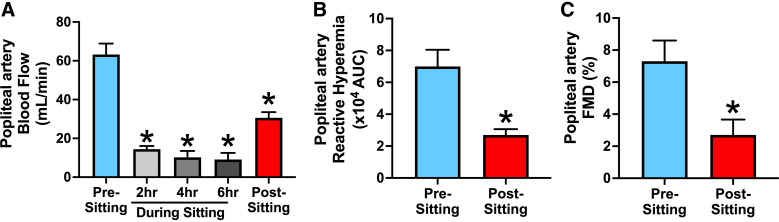
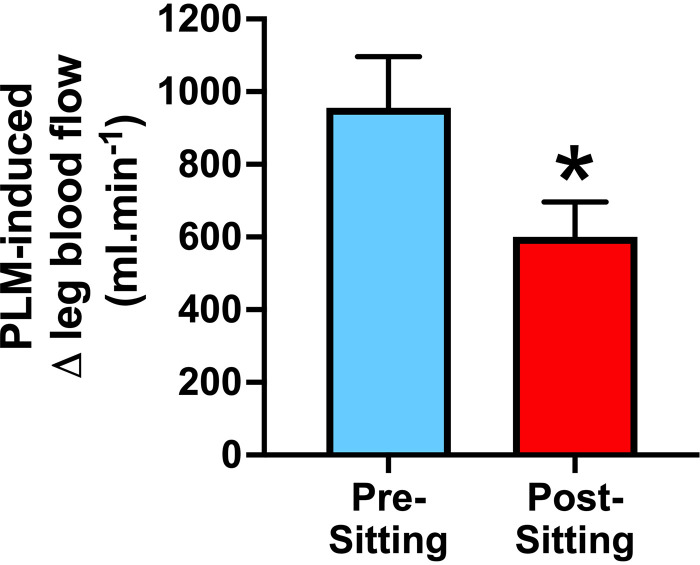
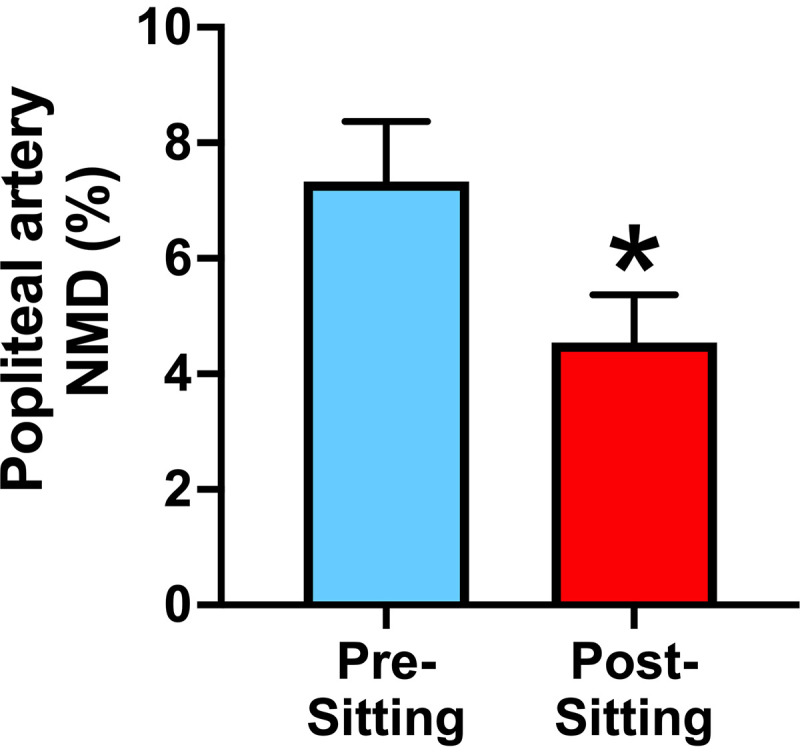
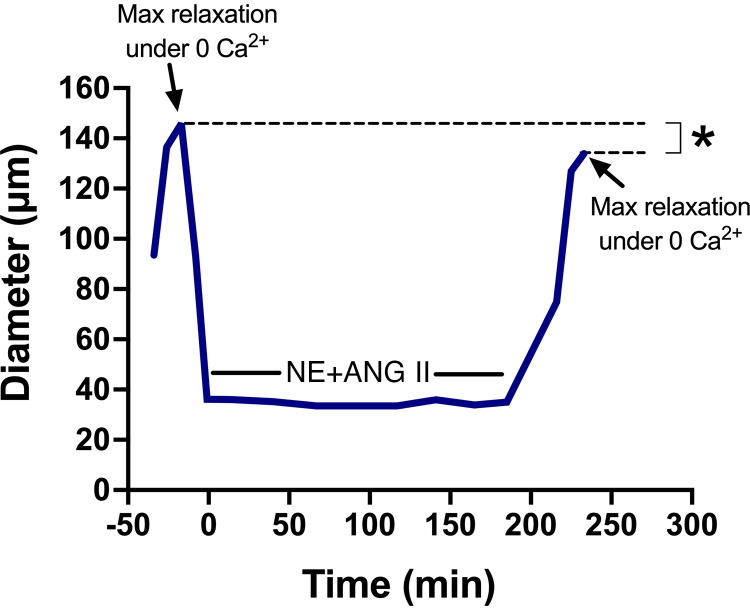
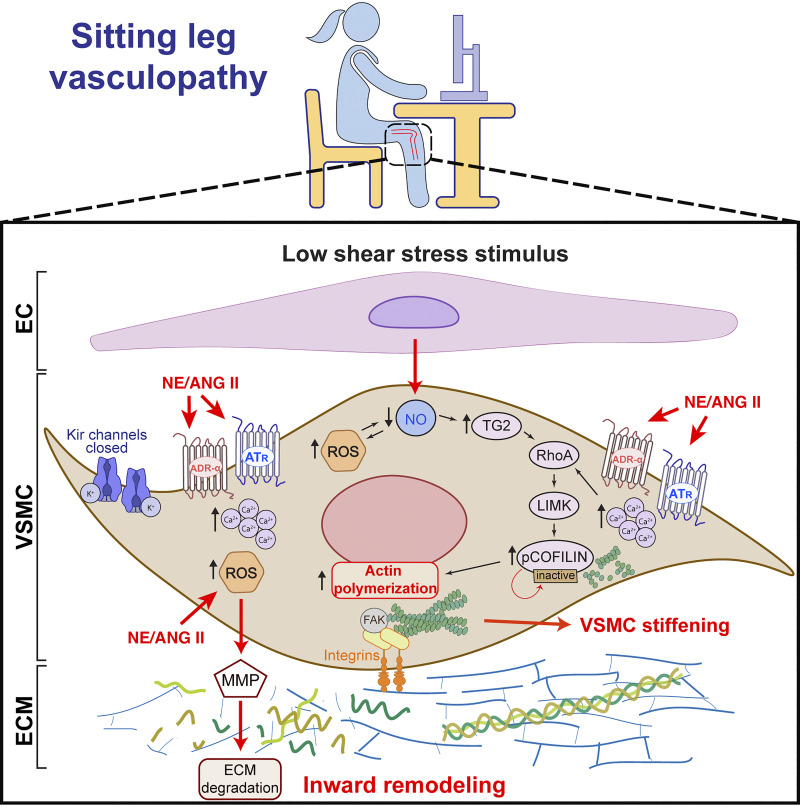
Increased sitting time, the most common form of sedentary behavior, is an independent risk factor for all-cause and cardiovascular disease mortality; however, the mechanisms linking sitting to cardiovascular risk remain largely elusive. Studies over the last decade have led to the concept that excessive time spent in the sitting position and the ensuing reduction in leg blood flow-induced shear stress cause endothelial dysfunction. This conclusion has been mainly supported by studies using flow-mediated dilation in the lower extremities as the measured outcome. In this review, we summarize evidence from classic studies and more recent ones that collectively support the notion that prolonged sitting-induced leg vascular dysfunction is likely also attributable to changes occurring in vascular smooth muscle cells (VSMCs). Indeed, we provide evidence that prolonged constriction of resistance arteries can lead to modifications in the structural characteristics of the vascular wall, including polymerization of actin filaments in VSMCs and inward remodeling, and that these changes manifest in a time frame that is consistent with the vascular changes observed with prolonged sitting. We expect this review will stimulate future studies with a focus on VSMC cytoskeletal remodeling as a potential target to prevent the detrimental vascular ramifications of too much sitting.
Keywords: cytoskeletal remodeling; endothelium-independent vasodilation; inward remodeling leg vascular dysfunction; prolonged sitting; vascular smooth muscle.
Conflict of interest statement
No conflicts of interest, financial or otherwise, are declared by the authors.
Figures
References
-
- Tremblay MS, Aubert S, Barnes JD, Saunders TJ, Carson V, Latimer-Cheung AE, Chastin SFM, Altenburg TM, Chinapaw MJM; SBRN Terminology Consensus Project Participants. Sedentary Behavior Research Network (SBRN) - terminology consensus project process and outcome. Int J Behav Nutr Phys Act 14: 75, 2017. doi:10.1186/s12966-017-0525-8. - DOI - PMC - PubMed
-
- Dempsey PC, Biddle SJH, Buman MP, Chastin S, Ekelund U, Friedenreich CM, Katzmarzyk PT, Leitzmann MF, Stamatakis E, van der Ploeg HP, Willumsen J, Bull F. New global guidelines on sedentary behaviour and health for adults: broadening the behavioural targets. Int J Behav Nutr Phys Act 17: 151, 2020. doi:10.1186/s12966-020-01044-0. - DOI - PMC - PubMed
-
- Bull FC, Al-Ansari SS, Biddle S, Borodulin K, Buman MP, Cardon G, Carty C, Chaput JP, Chastin S, Chou R, Dempsey PC, DiPietro L, Ekelund U, Firth J, Friedenreich CM, Garcia L, Gichu M, Jago R, Katzmarzyk PT, Lambert E, Leitzmann M, Milton K, Ortega FB, Ranasinghe C, Stamatakis E, Tiedemann A, Troiano RP, van der Ploeg HP, Wari V, Willumsen JF. World Health Organization 2020 guidelines on physical activity and sedentary behaviour. Br J Sports Med 54: 1451–1462, 2020. doi:10.1136/bjsports-2020-102955. - DOI - PMC - PubMed
-
- Ekelund U, Tarp J, Steene-Johannessen J, Hansen BH, Jefferis B, Fagerland MW, Whincup P, Diaz KM, Hooker SP, Chernofsky A, Larson MG, Spartano N, Vasan RS, Dohrn I-M, Hagströmer M, Edwardson C, Yates T, Shiroma E, Anderssen SA, Lee I-M. Dose-response associations between accelerometry measured physical activity and sedentary time and all cause mortality: systematic review and harmonised meta-analysis. BMJ 366: l4570, 2019. doi:10.1136/bmj.l4570. - DOI - PMC - PubMed
Publication types
MeSH terms
Grants and funding
LinkOut - more resources
Full Text Sources
Medical
