Upadacitinib therapy in refractory inflammatory myositis: a case series of 10 patients
- PMID: 38242552
- PMCID: PMC10806474
- DOI: 10.1136/rmdopen-2023-003837
Upadacitinib therapy in refractory inflammatory myositis: a case series of 10 patients
Abstract
Objectives: To evaluate the effectiveness and safety of upadacitinib in treatment-refractory inflammatory myositis.
Methods: Patients with refractory inflammatory myositis treated with upadacitinib from a single urban centre in Vancouver, British Columbia, Canada, were included from September 2020 to June 2023. The medical records of these patients were retrospectively reviewed.
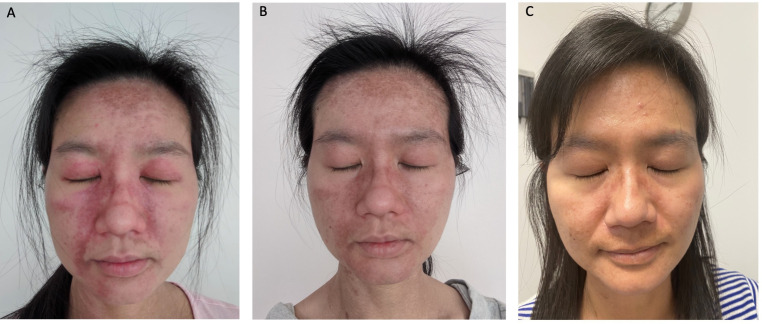
Results: 10 total patients were identified for review, including 5 classic dermatomyositis (DM), 3 amyopathic DM (ADM) and 2 antisynthetase syndrome. The patients failed an average of four immunosuppressants before initiation of upadacitinib. Three had prior Janus kinase inhibitor therapy with tofacitinib. In the classic DM and ADM aggregate group, upadacitinib offered clinically and statistically significant cutaneous improvement. Lack of active muscle disease at baseline precluded analysis of the effect of upadacitinib on muscle weakness. Nine patients remained on upadacitinib at the end of the study period. One patient discontinued upadacitinib due to severe facial acne.
Conclusion: Upadacitinib appears to be effective in targeting cutaneous manifestations of refractory inflammatory DM. Further research is still needed to validate its efficacy on a broader population scale.
Keywords: Autoimmune Diseases; Dermatomyositis; Polymyositis.
© Author(s) (or their employer(s)) 2024. Re-use permitted under CC BY-NC. No commercial re-use. See rights and permissions. Published by BMJ.
Conflict of interest statement
Competing interests: JD received speaker’s honoraria from AbbVie, Amgen, Bausch, Leo, Janssen, Novartis, Sanofi and Pfizer; he participated a Data Safety Monitoring Board for Bristol Myers Squib and is on the advisory board for Solius and Boehringer Ingelheim. He performs clinical research with Corbus, Eli Lilly and company. MB and KH have no conflict of interest to declare.
Figures
References
MeSH terms
Substances
LinkOut - more resources
Full Text Sources
Medical