Association of HFA-PEFF score with clinical outcomes after catheter ablation for atrial fibrillation
- PMID: 38242559
- PMCID: PMC10806505
- DOI: 10.1136/openhrt-2023-002526
Association of HFA-PEFF score with clinical outcomes after catheter ablation for atrial fibrillation
Abstract
Background: The Heart Failure Association Pretest assessment, echocardiography and natriuretic peptide, functional testing and final aetiology (HFA-PEFF) score has been developed for diagnosing heart failure with preserved ejection fraction (HFpEF), which is frequently associated with atrial fibrillation (AF). We aimed to investigate whether preprocedural HFA-PEFF score could be used to predict clinical outcomes in patients with AF who underwent catheter ablation (CA).
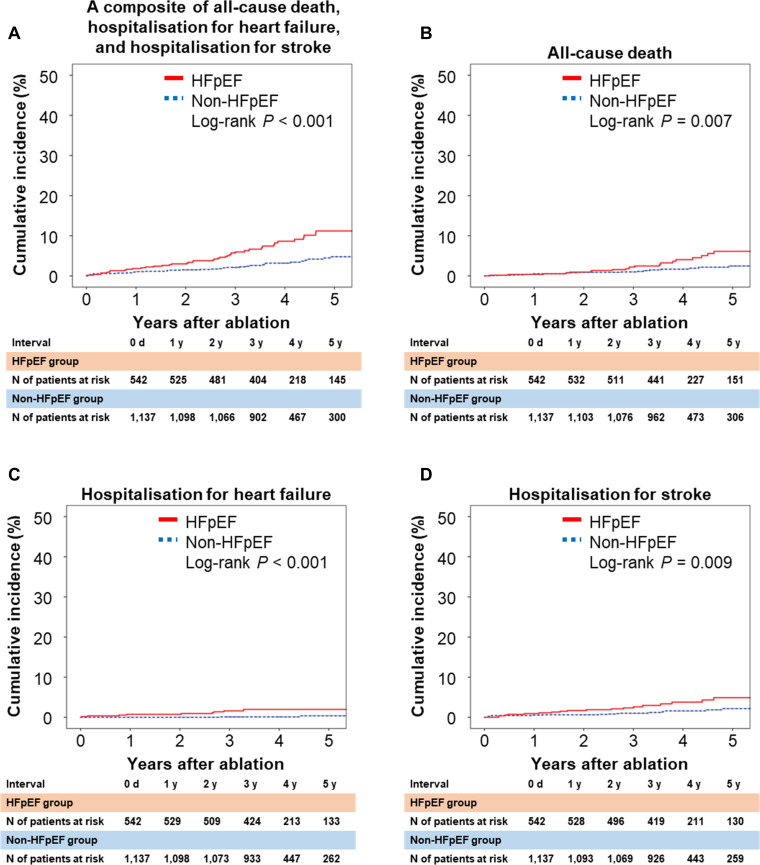
Methods: Overall, 1679 patients with AF who underwent primary CA (71±10 years, 1218 males (72.5%), median follow-up duration 3.3 years) from July 2011 to December 2019 were included in this retrospective study. HFpEF was defined as an HFA-PEFF score ≥5. The primary study outcome was 5-year major adverse cardiovascular and cerebrovascular events (MACCE), which is a composite of all-cause death, hospitalisation for heart failure (HF) and hospitalisation for stroke.
Results: The prevalence of HFpEF was 32.3%, but only 7.7% were diagnosed with HF at the time of CHADS2 scoring. Five-year MACCE occurred in 77 patients (4.6%). The cumulative 5-year incidence of MACCE was significantly higher in the HFpEF group than in the non-HFpEF group (11.2% vs 4.8% at 5 years, p<0.001). In the multivariable analysis, HFpEF by the HFA-PEFF score was associated with MACCE (adjusted HR 1.65, 95% CI 1.02 to 2.65, p=0.041).
Conclusions: Early detection of HFpEF using the HFA-PEFF score may have clinical applications in guiding therapeutic decision-making and improving prognosis by preventing HF and stroke in patients with AF undergoing CA.
Keywords: atrial fibrillation; catheter ablation; heart failure, diastolic.
© Author(s) (or their employer(s)) 2024. Re-use permitted under CC BY-NC. No commercial re-use. See rights and permissions. Published by BMJ.
Conflict of interest statement
Competing interests: None declared.
Figures


References
-
- Zafrir B, Lund LH, Laroche C, et al. Prognostic implications of atrial fibrillation in heart failure with reduced, mid-range, and preserved ejection fraction: a report from 14 964 patients in the European society of cardiology heart failure long-term Registry. Eur Heart J 2018;39:4277–84. 10.1093/eurheartj/ehy626 - DOI - PubMed
-
- McDonagh TA, Metra M, Adamo M, et al. 2021 ESC guidelines for the diagnosis and treatment of acute and chronic heart failure: developed by the task force for the diagnosis and treatment of acute and chronic heart failure of the European society of cardiology (ESC) with the special contribution of the heart failure Association (Hfa) of the ESC. Rev Esp Cardiol (Engl Ed) 2022;75:523. 10.1016/j.rec.2022.05.005 - DOI - PubMed
-
- Bozkurt B, Coats AJ, Tsutsui H, et al. Universal definition and classification of heart failure: A report of the heart failure society of America, heart failure Association of the European society of cardiology, Japanese heart failure society and writing committee of the universal definition of heart failure. J Card Fail 2021:00050–6. 10.1016/j.cardfail.2021.01.022 - DOI
MeSH terms
LinkOut - more resources
Full Text Sources
Medical
Research Materials
Miscellaneous