


Deep learning model for extensive smartphone-based diagnosis and triage of cataracts and multiple corneal diseases
- PMID: 38242700
- PMCID: PMC11503034
- DOI: 10.1136/bjo-2023-324488
Deep learning model for extensive smartphone-based diagnosis and triage of cataracts and multiple corneal diseases
Abstract
Aim: To develop an artificial intelligence (AI) algorithm that diagnoses cataracts/corneal diseases from multiple conditions using smartphone images.
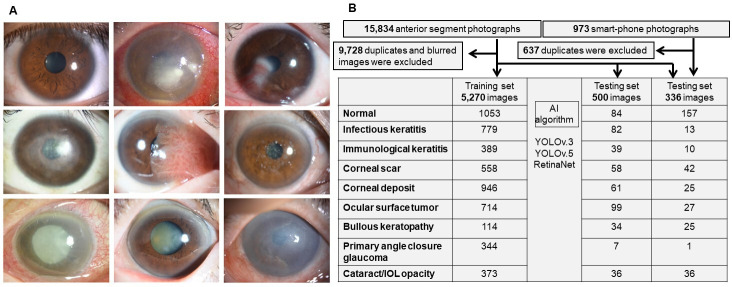
Methods: This study included 6442 images that were captured using a slit-lamp microscope (6106 images) and smartphone (336 images). An AI algorithm was developed based on slit-lamp images to differentiate 36 major diseases (cataracts and corneal diseases) into 9 categories. To validate the AI model, smartphone images were used for the testing dataset. We evaluated AI performance that included sensitivity, specificity and receiver operating characteristic (ROC) curve for the diagnosis and triage of the diseases.
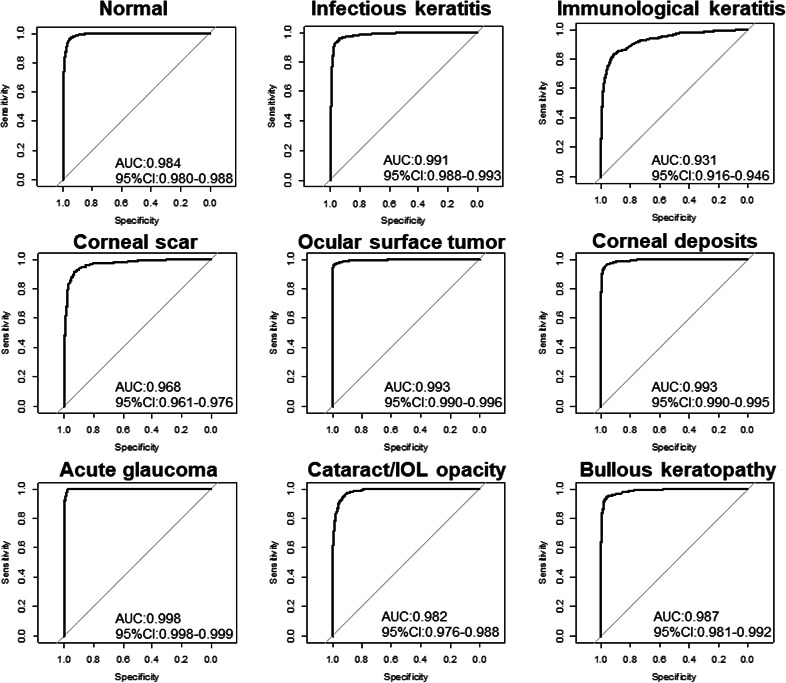
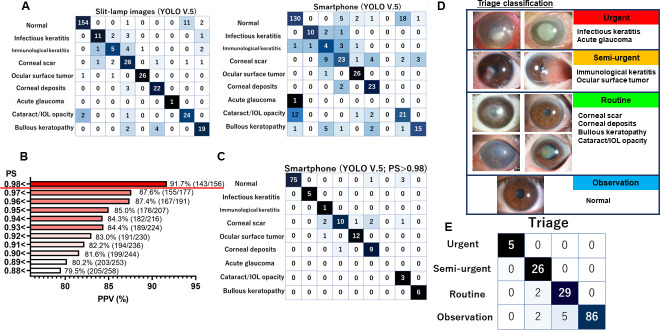
Results: The AI algorithm achieved an area under the ROC curve of 0.998 (95% CI, 0.992 to 0.999) for normal eyes, 0.986 (95% CI, 0.978 to 0.997) for infectious keratitis, 0.960 (95% CI, 0.925 to 0.994) for immunological keratitis, 0.987 (95% CI, 0.978 to 0.996) for cornea scars, 0.997 (95% CI, 0.992 to 1.000) for ocular surface tumours, 0.993 (95% CI, 0.984 to 1.000) for corneal deposits, 1.000 (95% CI, 1.000 to 1.000) for acute angle-closure glaucoma, 0.992 (95% CI, 0.985 to 0.999) for cataracts and 0.993 (95% CI, 0.985 to 1.000) for bullous keratopathy. The triage of referral suggestion using the smartphone images exhibited high performance, in which the sensitivity and specificity were 1.00 (95% CI, 0.478 to 1.00) and 1.00 (95% CI, 0.976 to 1.000) for 'urgent', 0.867 (95% CI, 0.683 to 0.962) and 1.00 (95% CI, 0.971 to 1.000) for 'semi-urgent', 0.853 (95% CI, 0.689 to 0.950) and 0.983 (95% CI, 0.942 to 0.998) for 'routine' and 1.00 (95% CI, 0.958 to 1.00) and 0.896 (95% CI, 0.797 to 0.957) for 'observation', respectively.
Conclusions: The AI system achieved promising performance in the diagnosis of cataracts and corneal diseases.
Keywords: Cornea; Ocular surface.
© Author(s) (or their employer(s)) 2024. Re-use permitted under CC BY-NC. No commercial re-use. See rights and permissions. Published by BMJ.
Conflict of interest statement
Competing interests: TY: Grants (Novartis Pharma); honoraria for lectures (Alcon Japan, HOYA, Novartis Pharma, AMO Japan, Santen Pharmaceuticals, Senju Pharmaceutical, Johnson & Johnson), MM: Grants (Novartis Pharma); honoraria for lectures (Bayer Yakuhin, Kowa Pharmaceutical, Alcon Japan, HOYA, Novartis Pharma, AMO Japan, Santen Pharmaceutical, Senju Pharmaceutical, Johnson & Johnson K.K., Japan Ophthalmic Instruments Association). MA: Grants (Novartis, Santen), honoraria for lectures (Novartis, Takeda, Senju, Chugai, Kowa), Support for attending meetings and travel (Wakamoto, Novartis), Endowed (NIDEK).
Figures
References
-
- GBD 2019 Blindness and Vision Impairment Collaborators on behalf of the Vision Loss Expert Group of the Global Burden of Disease Study Trends in prevalence of blindness and distance and near vision impairment over 30 years: an analysis for the global burden of disease study. Lancet Glob Health. 2021;9:e130–43. - PMC - PubMed
MeSH terms
LinkOut - more resources
Full Text Sources
Medical
