


Cancer mortality in chrysotile miners and millers, Russian Federation: main results (Asbest Chrysotile Cohort-Study)
- PMID: 38247448
- PMCID: PMC11160488
- DOI: 10.1093/jnci/djad262
Cancer mortality in chrysotile miners and millers, Russian Federation: main results (Asbest Chrysotile Cohort-Study)
Abstract
Background: We investigated mortality in workers of the world's largest chrysotile mine and enrichment factories located in the town of Asbest, Russian Federation.
Methods: This historical cohort study included all workers employed for at least 1 year between 1975 and 2010 and follow-up until the end of 2015. Cumulative exposure to dust was estimated based on workers' complete occupational history linked to dust measurements systematically collected from the 1950s. Exposure to chrysotile fibers was estimated using dust-to-fiber conversion factors. Relative risks (RRs) and 95% confidence intervals (CIs) were estimated as mortality rate ratios in Poisson regression models.
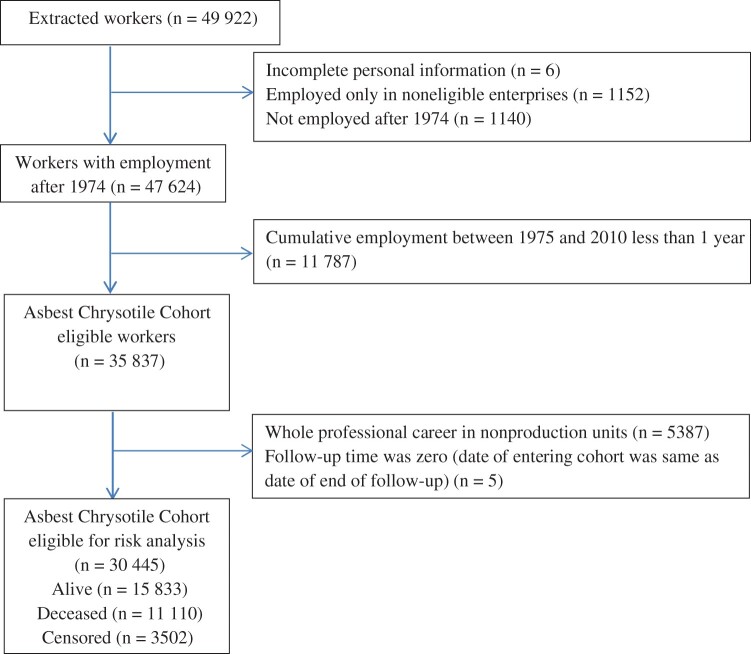
Results: A total of 30 445 (32% women) workers accumulated 721 312 person-years at risk and 11 110 (36%) died. Of the workers, 54% had more than 30 years since their first exposure. We found an exposure-response between cumulative dust and lung cancer mortality in men. No clear association with dust exposure but a modest increase in the highest category of fiber exposure was seen for lung cancer in women. Mesothelioma mortality was increased (RR = 7.64, 95% CI = 1.18 to 49.5, to at least 80 fibers per cm3 years and RR = 4.56, 95% CI = 0.94 to 22.1, to at least 150 mg/m3 years [dust]), based on 13 deaths. For colorectal and stomach cancer, there were inconsistent associations. No associations were seen for laryngeal or ovarian cancer.
Conclusion: In this large-scale epidemiological study in the world's largest active asbestos mine, we confirmed an increased risk of mesothelioma with high fiber exposure and an increasing mortality for lung cancer in men with increasing dust exposure. Less clear-cut increased lung cancer mortality was seen in the women. Continued mortality follow-up is warranted.
© The Author(s) 2024. Published by Oxford University Press.
Conflict of interest statement
Dr Kovalevskiy reported receiving, on behalf of his institute and personally through consulting firms, payments from companies to evaluate exposure to asbestos and risk of asbestos-related disease in those workplaces. All other authors have no competing interests to declare.
For full transparency, Dr Kovalevskiy reported participation as an occupational and environmental health expert as part of the delegation of the Russian Ministry of Health at multiple World Health Assembly meetings as well as at the Conference of the Parties to the Basel and Rotterdam Conventions. Dr Kovalevskiy reported attending meetings organized by the International Chrysotile Association and reported that all expenses for attendance were paid by his institute.
Dr Schüz, who is a JNCI Associate Editor and co-author on this paper, was not involved in the editorial review or decision to publish the manuscript.
Figures
References
-
- Schüz J, Bukhtiyarov I, Olsson A, et al. Occupational cohort study of current and former workers exposed to chrysotile in mine and processing facilities in Asbest, the Russian Federation: Cohort profile of the Asbest Chrysotile Cohort study. PLoS One 2020;15(7):e0236475. doi: 10.1371/journal.pone.0236475. - DOI - PMC - PubMed
-
- International Agency for Research on Cancer. Asbest Chrysotile Cohort Study. https://asbest-study.iarc.fr. Accessed January 2, 2024.
MeSH terms
Substances
Grants and funding
LinkOut - more resources
Full Text Sources
Medical
