


Rice Byproduct Compounds: From Green Extraction to Antioxidant Properties
- PMID: 38247461
- PMCID: PMC10812773
- DOI: 10.3390/antiox13010035
Rice Byproduct Compounds: From Green Extraction to Antioxidant Properties
Abstract
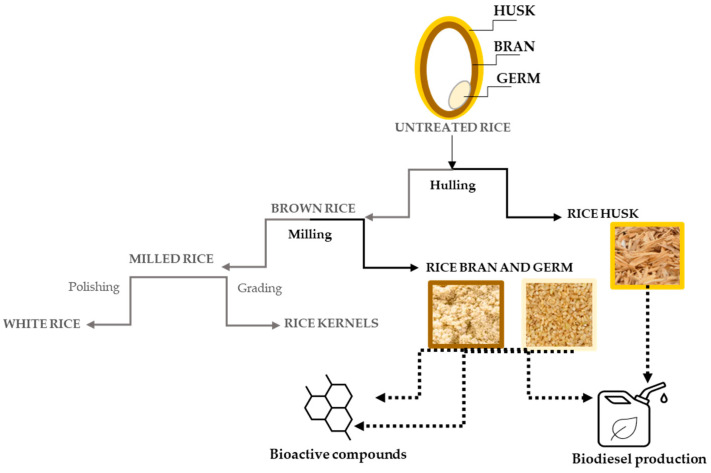
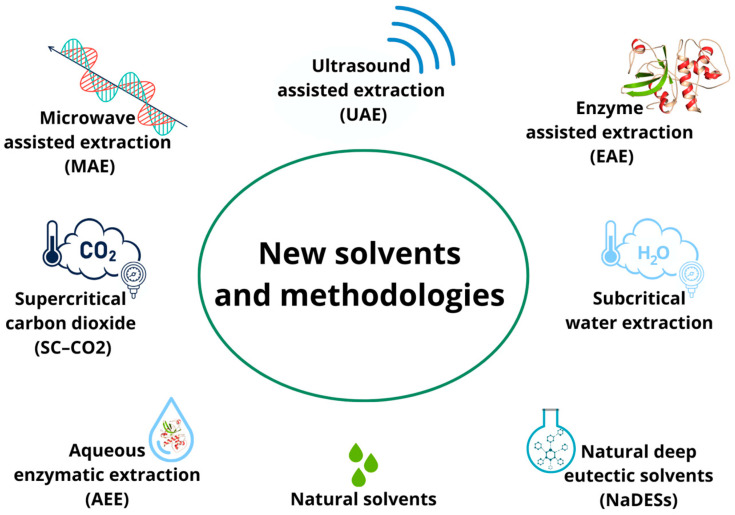
Currently, rice (Oryza sativa L.) production and consumption is increasing worldwide, and many efforts to decrease the substantial impact of its byproducts are needed. In recent years, the interest in utilizing rice kernels, husk, bran, and germ for the recovery of different molecules, from catalysts (to produce biodiesel) to bioactive compounds, has grown. In fact, rice byproducts are rich in secondary metabolites (phenolic compounds, flavonoids, and tocopherols) with different types of bioactivity, mainly antioxidant, antimicrobial, antidiabetic, and anti-inflammatory, which make them useful as functional ingredients. In this review, we focus our attention on the recovery of antioxidant compounds from rice byproducts by using innovative green techniques that can overcome the limitations of traditional extraction processes, such as their environmental and economic impact. In addition, traditional assays and more innovative methodologies to evaluate the antioxidant activity are discussed. Finally, the possible molecular mechanisms of action of the rice byproduct antioxidant compounds (phenolic acids, flavonoids, γ-oryzanol, and vitamin E) are discussed as well. In the future, it is expected that rice byproduct antioxidants will be important food ingredients that reduce the risk of the development of several human disorders involving oxidative stress, such as metabolic diseases, inflammatory disorders, and cancer.
Keywords: antioxidant compounds; bioactives; flavonoids; functional ingredients; green methodologies; innovative extraction techniques; phenolic acids; rice byproducts; structure-activity relationship; vitamin E.
Conflict of interest statement
The authors declare no conflicts of interest.
Figures
References
-
- Papargyropoulou E., Lozano R., Steinberger J.K., Wright N., Ujang Z. The food waste hierarchy as a framework for the management of food surplus and food waste. J. Clean. Prod. 2014;76:106–115. doi: 10.1016/j.jclepro.2014.04.020. - DOI
-
- United Nations. [(accessed on 7 November 2023)]. Available online: https://documents-dds-ny.un.org/doc/UNDOC/GEN/N15/291/89/PDF/N1529189.pd....
-
- FAOSTAT Food and Agriculture Data. [(accessed on 7 November 2023)]. Available online: http://www.fao.org/faostat/en/#data/QC.
-
- Sena S., Chakraborty R., Kalit P. Rice—Not just a staple food: A comprehensive review on its phytochemicals. Trends Food Sci. Technol. 2020;97:265–285. doi: 10.1016/j.tifs.2020.01.022. - DOI
Publication types
LinkOut - more resources
Full Text Sources
