


Outcome of High-Dose Chemotherapy Followed by Autologous Stem Cell Transplantation in Relapsed/Refractory Hodgkin Lymphoma after Different Numbers of Salvage Regimens
- PMID: 38247809
- PMCID: PMC10814926
- DOI: 10.3390/cells13020118
Outcome of High-Dose Chemotherapy Followed by Autologous Stem Cell Transplantation in Relapsed/Refractory Hodgkin Lymphoma after Different Numbers of Salvage Regimens
Abstract
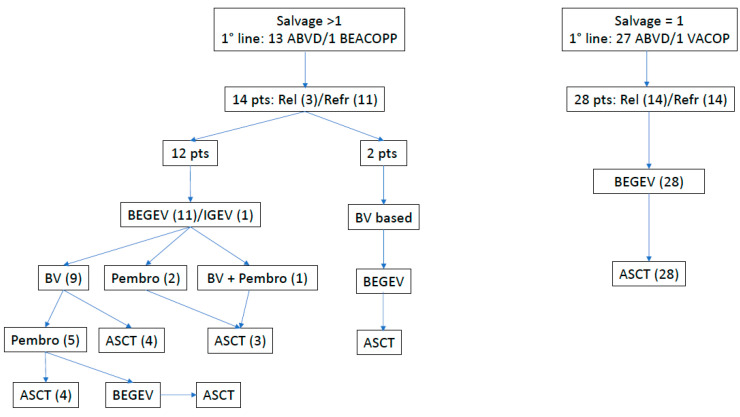
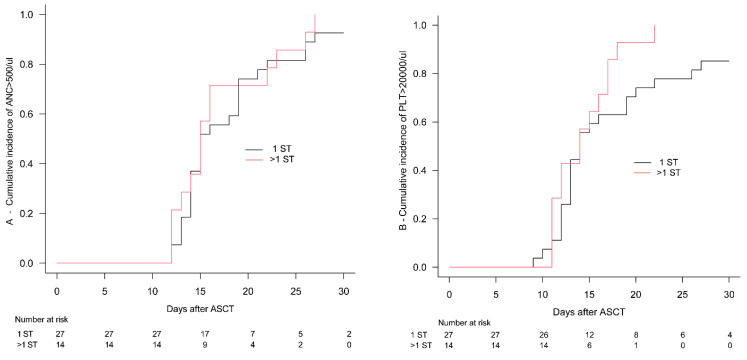
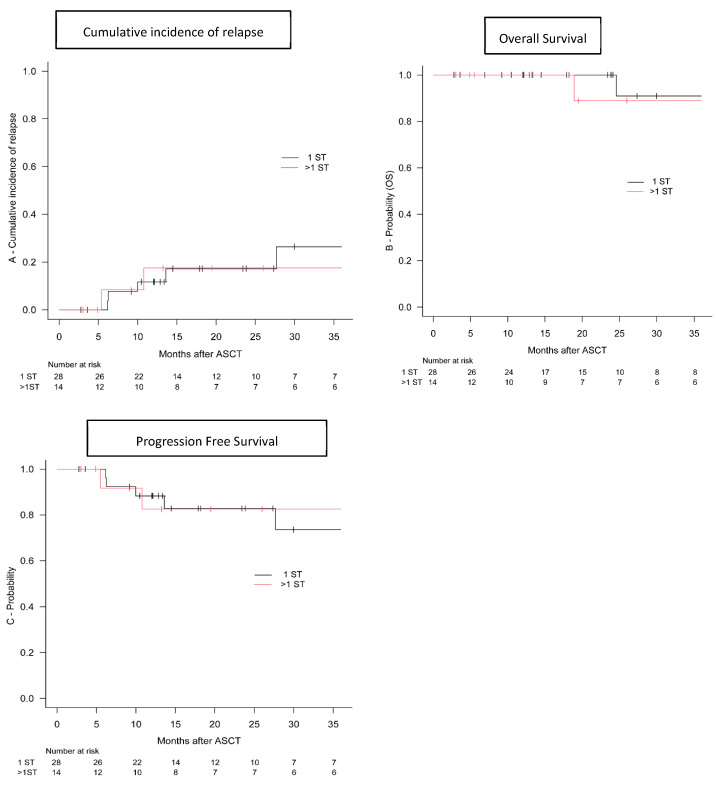
The introduction of novel drugs (PD-1 inhibitors and/or brentuximab vedotin) into salvage regimens has improved the response rate and the outcome of patients with relapsed/refractory Hodgkin lymphoma. However, the impact of new drugs on the outcome has not been adequately investigated so far. We retrospectively analyzed 42 consecutive patients treated at our institution with high-dose chemotherapy/autologous stem cell transplantation after either one standard chemotherapy represented by BEGEV (n = 28) or >1 salvage therapy (ST) comprising novel drugs (n = 14). With a median follow-up of 24 months, the 2-year cumulative incidence of relapse was similar between the two cohorts: 26% for 1 ST and 18% for >1 ST (p = 0.822). Consistently, overall survival and progression-free survival did not differ among the two groups: 3-year overall survival was 91% and 89% (p = 0.731), respectively, and 3-year progression-free survival was 74% and 83% (p = 0.822) for only one and more than one salvage regimens, respectively. Of note, the post-transplant side effects and engraftment rates were similar between the 1 ST and >1 ST cohorts. In conclusion, consolidation with high-dose chemotherapy/autologous stem cell transplantation is a safe and curative option, even for patients achieving disease response after more than one rescue line of therapy.
Keywords: Hodgkin lymphoma; new drugs; transplantation.
Conflict of interest statement
The authors declare no conflicts of interest.
Figures
References
-
- Linch D.C., Winfield D., Goldstone A.H., Moir D., Hancock B., McMillan A., Chopra R., Milligan D., Hudson G.V. Dose intensification with autologous bone-marrow transplantation in relapsed and resistant Hodgkin’s disease: Results of a BNLI randomised trial. Lancet. 1993;341:1051–1054. doi: 10.1016/0140-6736(93)92411-L. - DOI - PubMed
-
- Schmitz N., Pfistner B., Sextro M., Sieber M., Carella A.M., Haenel M., Boissevain F., Zschaber R., Müller P., Kirchner H., et al. Aggressive conventional chemotherapy compared with high-dose chemotherapy with autologous haemopoietic stem-cell transplantation for relapsed chemosensitive Hodgkin’s disease: A randomised trial. Lancet. 2002;359:2065–2071. - PubMed
-
- Morschhauser F., Brice P., Fermé C., Diviné M., Salles G., Bouabdallah R., Sebban C., Voillat L., Casasnovas O., Stamatoullas A., et al. Risk-adapted salvage treatment with single or tandem autologous stem-cell transplantation for first relapse/refractory Hodgkin’s lymphoma: Results of the prospective multicenter H96 trial by the GELA/SFGM study group. J. Clin. Oncol. 2008;26:5980–5987. doi: 10.1200/JCO.2007.15.5887. - DOI - PubMed
-
- Perales M.A., Ceberio I., Armand P., Burns L.J., Chen R., Cole P.D., Evens A.M., Laport G.G., Moskowitz C.H., Popat U., et al. Role of cytotoxic therapy with hematopoietic cell transplantation in the treatment of Hodgkin lymphoma: Guidelines from the American Society for Blood and Marrow Transplantation. Biol. Blood Marrow Transplant. 2015;21:971–983. doi: 10.1016/j.bbmt.2015.02.022. - DOI - PubMed
MeSH terms
Substances
LinkOut - more resources
Full Text Sources
Medical
