


The Mediating Role of Procrastination in the Relationship between Fear of Missing Out and Internet Addiction in University Students
- PMID: 38248514
- PMCID: PMC10815717
- DOI: 10.3390/ijerph21010049
The Mediating Role of Procrastination in the Relationship between Fear of Missing Out and Internet Addiction in University Students
Abstract
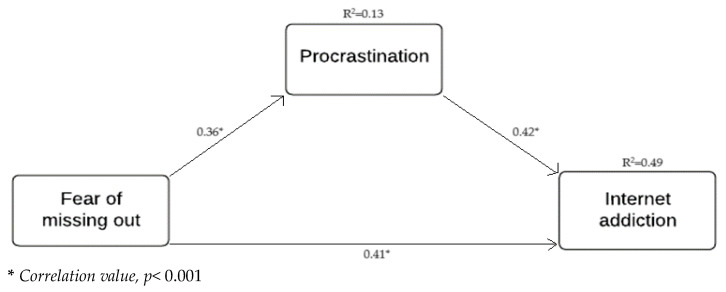
This study aims to examine the potential mediating role of procrastination in the relationship between fear of missing out and internet addiction. Employing a cross-sectional research design, this study utilized a paper-pencil form to collect data from 315 students (65.4% undergraduate and 66.3% females) between 18 and 32 (Mage = 22.43; SD = 3.81) studying at a state university in Türkiye. Data were collected through the convenience sampling method. The study was designed as a survey model. This design was tested via mediation analysis. The participants completed self-report assessments using the Fear of Missing Out Scale (FoMOs), General Procrastination Scale (GPS-9), and Young Internet Addiction Scale (short form). The findings showed that FoMO had a significant positive direct effect on both procrastination (R2 = 0.13) and internet addiction (R2 = 0.33). Procrastination also had a significant positive direct effect on internet addiction (R2 = 0.34). Additionally, procrastination mediated the relationship between the fear of missing out and internet addiction (β = 0.156, p < 0.001). These findings not only extend the scope of existing research but also hold practical implications for the development of sustainable interventions. It is believed that the findings will contribute to the consideration of procrastination when preparing psychoeducation or group guidance programs for internet addiction. These interventions can effectively address the process through which fear of missing out leads to internet addiction by considering the significant role of procrastination in students. Findings typically suggest that procrastination behavior is a key factor in explaining the association between FoMO and internet addiction.
Keywords: fear of missing out; internet addiction; procrastination; university students.
Conflict of interest statement
The authors declare no conflict of interest.
Figures
References
-
- Internet World Stats . Internet Usage Statistics, the Internet Big Picture. Internet World Stats; Lancaster, PA, USA: 2023. [(accessed on 8 June 2023)]. Available online: https://www.internetworldstats.com/stats.htm.
-
- Young K.S. Internet addiction: The emergence of a new clinical disorder. CyberPsychol. Behav. 2009;1:237–244. doi: 10.1089/cpb.1998.1.237. - DOI
-
- Servidio R. Exploring the effects of demographic factors, Internet usage and personality traits on Internet addiction in a sample of Italian university students. Comput. Hum. Behav. 2014;35:85–92. doi: 10.1016/j.chb.2014.02.024. - DOI
MeSH terms
LinkOut - more resources
Full Text Sources
