


Self-Objectification, Disordered Eating and Sexual Orientation in Men
- PMID: 38248568
- PMCID: PMC10815722
- DOI: 10.3390/ijerph21010106
Self-Objectification, Disordered Eating and Sexual Orientation in Men
Abstract
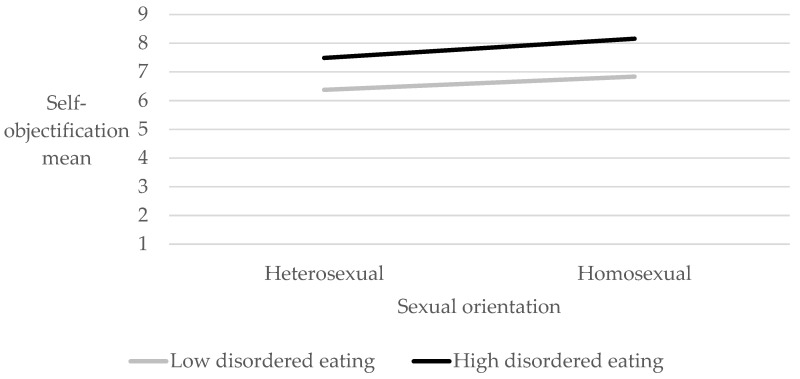
The interplay between disordered eating, depressive symptoms and self-objectification differs between genders and sexual orientations, and merits further study in homosexual and heterosexual men. We examined disordered eating, depressive symptoms and self-objectification in a sample of Israeli heterosexual and homosexual men. Participants were 215 men aged 19-65, 108 of whom were classified by the Kinsey scale as being heterosexual and 107 as homosexual. They completed online measures of self-objectification, disordered eating and depressive symptoms. Heterosexual men reported lower levels of disordered eating and self-objectification than homosexual men, however the difference in depressive symptoms was not statistically significant. Correlations between disordered eating, self-objectification and depressive symptoms when controlling for age, BMI and number of children were all significant, with similar patterns of association for heterosexual and homosexual men. Self-objectification partially mediated the association between sexual orientation and disordered eating. However, contrary to our hypothesis, sexual orientation (homosexual/heterosexual) did not moderate the association between disordered eating and self-objectification. The tendency of homosexual men towards self-objectification is linked to unhealthy eating habits. Self-objectification helps explain the propensity of homosexual versus heterosexual men to develop disordered eating and possibly eating disorders. It should therefore be targeted in prevention and in therapy.
Keywords: depressive symptoms; disordered eating; men; self-objectification; sexual orientation.
Conflict of interest statement
The authors declare no conflict of interest.
Figures


References
-
- Paxton S.J., Damiano S.R. The development of body image and weight bias in childhood. Adv. Child Dev. Behav. 2017;52:269–298. - PubMed
-
- Kostanski M., Gullone E. The impact of teasing on children’s body image. J. Child Fam. Stud. 2007;16:307–319. doi: 10.1007/s10826-006-9087-0. - DOI
-
- Liang V.X., Jackson A.C., McKenzie V.L. The effects of teasing in childhood or adolescence on young adults’ body image. Aust. Educ. Dev. Psychol. 2011;28:101–115. doi: 10.1375/aedp.28.2.101. - DOI
MeSH terms
LinkOut - more resources
Full Text Sources
Medical
