


Identification and Characterization of a Predominant Hydrophobin in the Edible Mushroom Grifola frondosa
- PMID: 38248935
- PMCID: PMC10820438
- DOI: 10.3390/jof10010025
Identification and Characterization of a Predominant Hydrophobin in the Edible Mushroom Grifola frondosa
Abstract
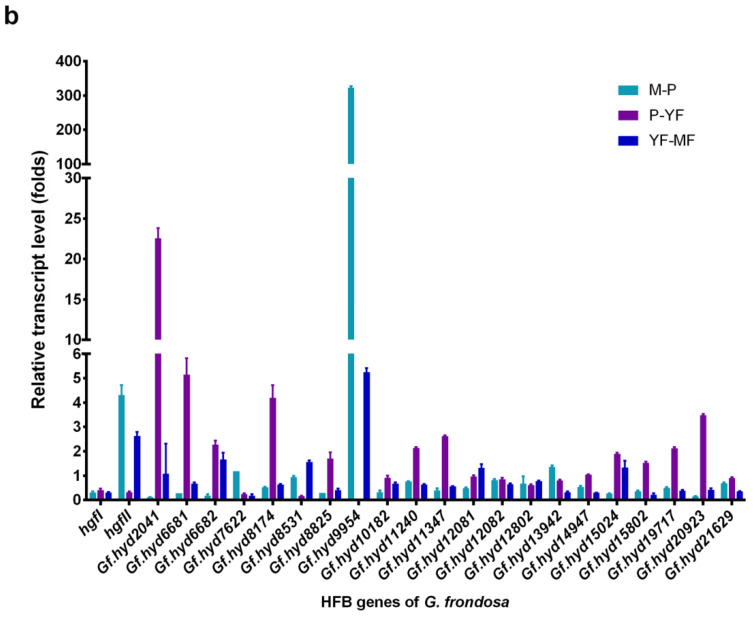
Hydrophobins (HFBs) are a group of small, secreted amphipathic proteins of fungi with multiple physiological functions and potential commercial applications. In this study, HFB genes of the edible mushroom, Grifola frondosa, were systematically identified and characterized, and their transcriptional profiles during fungal development were determined. In total, 19 typical class I HFB genes were discovered and bioinformatically analyzed. Gene expression profile examination showed that Gf.hyd9954 was particularly highly upregulated during primordia formation, suggesting its major role as the predominant HFB in the lifecycle of G. frondosa. The wettability alteration profile and the surface modification ability of recombinant rGf.hyd9954 were greater than for the Grifola HFB HGFII-his. rGf.hyd9954 was also demonstrated to form the typical class I HFB characteristic-rodlet bundles. In addition, rGf.hyd9954 was shown to possess nanoparticle characteristics and emulsification activities. This research sheds light on the regulation of fungal development and its association with the expression of HFB genes.
Keywords: fungal development; hydrophobins; life cycle; maitake; transcription levels.
Conflict of interest statement
The authors declare that they have no competing interests.
Figures




References
-
- Wessels J.G.H. Fungal hydrophobins: Proteins that function at an interface. Trends Plant Sci. 1996;1:9–15. doi: 10.1016/S1360-1385(96)80017-3. - DOI
Grants and funding
LinkOut - more resources
Full Text Sources
