


Frequency of Detection of Candida auris Colonization Outside a Highly Endemic Setting: What Is the Optimal Strategy for Screening of Carriage?
- PMID: 38248936
- PMCID: PMC10817263
- DOI: 10.3390/jof10010026
Frequency of Detection of Candida auris Colonization Outside a Highly Endemic Setting: What Is the Optimal Strategy for Screening of Carriage?
Abstract
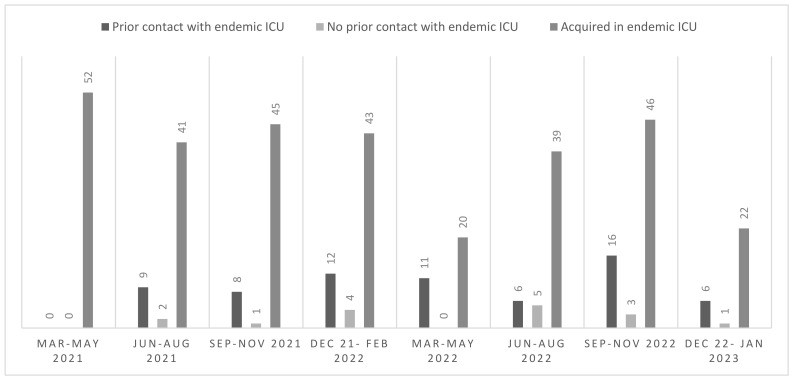
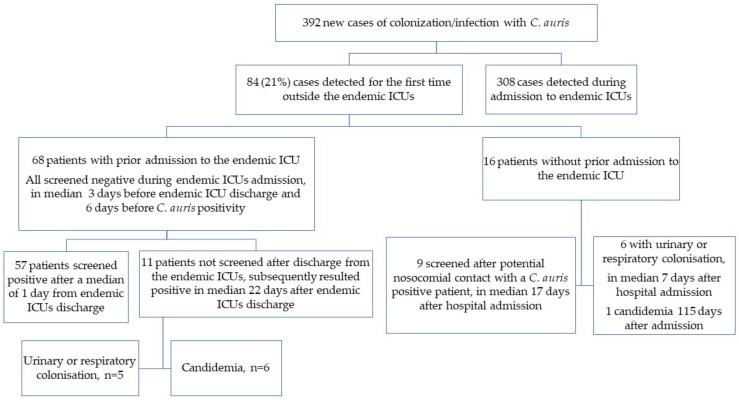
Candida auris outbreaks are increasingly frequent worldwide. In our 1000-bed hospital, an endemic transmission of C. auris was established in two of five intensive care units (ICUs). Aims of our study were to describe the occurrence of new cases of C. auris colonization and infection outside the endemic ICUs, in order to add evidence for future policies on screening in patients discharged as negative from an endemic setting, as well as to propose a new algorithm for screening of such high-risk patients. From 26 March 2021 to 26 January 2023, among 392 patients who were diagnosed as colonized or infected with C. auris in our hospital, 84 (21.4%) received the first diagnosis of colonization or infection outside the endemic ICUs. A total of 68 patients out of 84 (81.0%) had a history of prior admission to the endemic ICUs. All were screened and tested negative during their ICU stay with a median time from last screening to discharge of 3 days. In 57/68 (83.8%) of patients, C. auris was detected through screening performed after ICU discharge, and 90% had C. auris colonization detected within 9 days from ICU discharge. In 13 cases (13/57 screened, 22.8%), the first post-ICU discharge screening was negative. In those not screened, candidemia was the most frequent event of the first C. auris detection (6/11 patients not screened). In settings where the transmission of C. auris is limited to certain wards, we suggest screening both at discharge from the endemic ward(s) even in case of a recent negative result, and at least twice after admission to nonendemic settings.
Keywords: ICU; healthcare policies; horizontal transmission; infection control; intensive care unit; prevention.
Conflict of interest statement
Outside the submitted work, Matteo Bassetti reports research grants and/or personal fees for advisor/consultant and/or speaker/chairman from BioMérieux, Cidara, Gilead, Menarini, MSD, Pfizer and Shionogi. Outside the submitted work, Daniele Roberto Giacobbe reports investigator-initiated grants from Pfizer and Shionogi, and speaker/advisor fees from Pfizer, Menarini and Tillotts Pharma. Outside the submitted work, Malgorzata Mikulska reports a grant from Gilead paid to the Institution and speaker/advisor fees from Allovir, BioMérieux, Janssen, Moderna, Mundipharma and Pfizer. Outside the submitted work, Vincenzo Di Pilato reports a research grant from Seegene Inc., speaker’s bureau from A.d.a.
Figures
References
-
- CDC Newsroom. [(accessed on 29 July 2023)]; Available online: https://www.cdc.gov/media/releases/2023/p0320-cauris.html.
-
- Briano F., Magnasco L., Sepulcri C., Dettori S., Dentone C., Mikulska M., Ball L., Vena A., Robba C., Patroniti N., et al. Candida auris Candidemia in Critically Ill, Colonized Patients: Cumulative Incidence and Risk Factors. Infect. Dis. Ther. 2022;11:1149–1160. doi: 10.1007/s40121-022-00625-9. - DOI - PMC - PubMed
-
- Biran R., Cohen R., Finn T., Brosh-Nissimov T., Rahav G., Yahav D., Amit S., Shachor-Meyouhas Y., Atamna A., Bishara J., et al. Nationwide Outbreak of Candida auris Infections Driven by COVID-19 Hospitalizations, Israel, 2021–2022. Emerg. Infect. Dis. 2023;29:1297–1301. doi: 10.3201/eid2907.221888. - DOI - PMC - PubMed
-
- Villanueva-Lozano H., Treviño-Rangel R.d.J., González G.M., Ramírez-Elizondo M.T., Lara-Medrano R., Aleman-Bocanegra M.C., Guajardo-Lara C.E., Gaona-Chávez N., Castilleja-Leal F., Torre-Amione G., et al. Outbreak of Candida auris Infection in a COVID-19 Hospital in Mexico. Clin. Microbiol. Infect. 2021;27:813–816. doi: 10.1016/j.cmi.2020.12.030. - DOI - PMC - PubMed
LinkOut - more resources
Full Text Sources
