


Machine Learning-Based Predictive Model of Aortic Valve Replacement Modality Selection in Severe Aortic Stenosis Patients
- PMID: 38249079
- PMCID: PMC10801609
- DOI: 10.3390/medsci12010003
Machine Learning-Based Predictive Model of Aortic Valve Replacement Modality Selection in Severe Aortic Stenosis Patients
Abstract
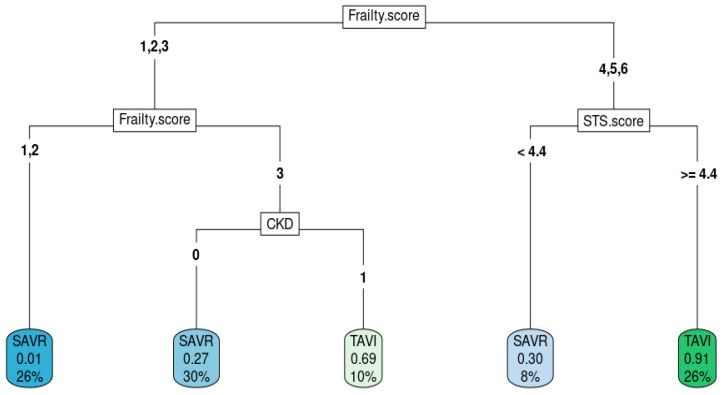
The current recommendation for bioprosthetic valve replacement in severe aortic stenosis (AS) is either surgical aortic valve replacement (SAVR) or transcatheter aortic valve replacement (TAVR). We evaluated the performance of a machine learning-based predictive model using existing periprocedural variables for valve replacement modality selection. We analyzed 415 patients in a retrospective longitudinal cohort of adult patients undergoing aortic valve replacement for aortic stenosis. A total of 72 clinical variables including demographic data, patient comorbidities, and preoperative investigation characteristics were collected on each patient. We fit models using LASSO (least absolute shrinkage and selection operator) and decision tree techniques. The accuracy of the prediction on confusion matrix was used to assess model performance. The most predictive independent variable for valve selection by LASSO regression was frailty score. Variables that predict SAVR consisted of low frailty score (value at or below 2) and complex coronary artery diseases (DVD/TVD). Variables that predicted TAVR consisted of high frailty score (at or greater than 6), history of coronary artery bypass surgery (CABG), calcified aorta, and chronic kidney disease (CKD). The LASSO-generated predictive model achieved 98% accuracy on valve replacement modality selection from testing data. The decision tree model consisted of fewer important parameters, namely frailty score, CKD, STS score, age, and history of PCI. The most predictive factor for valve replacement selection was frailty score. The predictive models using different statistical learning methods achieved an excellent concordance predictive accuracy rate of between 93% and 98%.
Keywords: LASSO; SAVR; TAVR; aortic valve replacement; decision tree.
Conflict of interest statement
The authors declare no conflicts of interest.
Figures
References
-
- Siemieniuk R.A., Agoritsas T., Manja V., Devji T., Chang Y., Bala M.M., Thabane L., Guyatt G.H. Transcatheter versus surgical aortic valve replacement in patients with severe aortic stenosis at low and intermediate risk: Systematic review and meta-analysis. BMJ. 2016;354:i5130. doi: 10.1136/bmj.i5130. - DOI - PMC - PubMed
-
- Otto C.M., Nishimura R.A., Bonow R.O., Carabello B.A., Erwin J.P., 3rd, Gentile F., Jneid H., Krieger E.V., Mack M., McLeod C., et al. 2020 ACC/AHA Guideline for the Management of Patients With Valvular Heart Disease: A Report of the American College of Cardiology/American Heart Association Joint Committee on Clinical Practice Guidelines. Circulation. 2021;143:e72–e227. - PubMed
-
- Siontis G.C.M., Overtchouk P., Cahill T.J., Modine T., Prendergast B., Praz F., Pilgrim T., Petrinic T., Nikolakopoulou A., Salanti G., et al. Transcatheter aortic valve implantation vs. surgical aortic valve replacement for treatment of symptomatic severe aortic stenosis: An updated meta-analysis. Eur. Heart J. 2019;40:3143–3153. doi: 10.1093/eurheartj/ehz275. - DOI - PubMed
-
- Prasitlumkum N., Kewcharoen J., Kanitsoraphan C., Rattanawong P., Mekritthikrai R., Gillaspie E.A., Mao M.A., Cheungpasitporn W. Previous coronary artery bypass graft is not associated with higher mortality in transcatheter aortic valve replacement: Systemic review and meta-analysis. Acta Cardiol. 2020;75:26–34. doi: 10.1080/00015385.2018.1541845. - DOI - PubMed
MeSH terms
LinkOut - more resources
Full Text Sources
Medical
Research Materials
Miscellaneous
