Review
. 2024 Jan 18:16:17588359231221910.
doi: 10.1177/17588359231221910. eCollection 2024.

MET alterations detection platforms and clinical implications in solid tumors: a comprehensive review of literature

Affiliations
Review

MET alterations detection platforms and clinical implications in solid tumors: a comprehensive review of literature

Pei Yuan et al. Ther Adv Med Oncol. .

Abstract

MET alterations, including MET exon 14 skipping variants, MET amplification, MET overexpression, and MET fusion, play pivotal roles in primary tumorigenesis and acquired resistance to targeted therapies, especially EGFR tyrosine kinase inhibitors. They represent important diagnostic, prognostic, and predictive biomarkers in many solid tumor types. However, the detection of MET alterations is challenging due to the complexity of MET alterations and the diversity of platform technologies. Therefore, techniques with high sensitivity, specificity, and reliable molecular detection accuracy are needed to overcome such hindrances and aid in biomarker-guided therapies. The current review emphasizes the role of MET alterations as oncogenic drivers in a variety of cancers and their involvement in the development of resistance to targeted therapies. Moreover, our review provides an overview of and recommendations on the selection of various cross-platform technologies for the detection of MET exon 14 skipping variants, MET amplification, MET overexpression, and MET fusion. Furthermore, challenges and hurdles underlying these common detection platforms are discussed.

Keywords: MET alterations; MET amplification; MET fusion; MET overexpression; detection platform; exon 14 skipping; targeted therapies.


Conflict of interest statement

The authors declare that there is no conflict of interest.

Figures
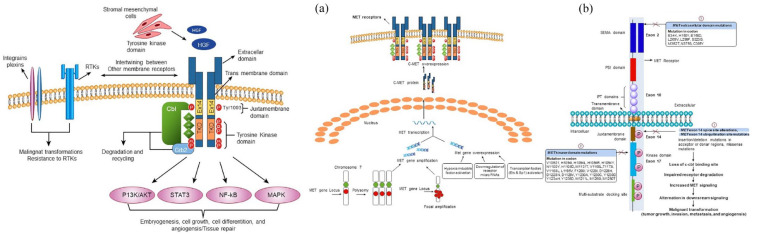
Figure 1.
Figure 1.
(1) Normal MET signaling pathway (left): The binding of hepatocyte growth factor (HGF) leads to receptor dimerization that activates the receptor and subsequently activates downstream signaling pathways including Ras, PI3K/Akt, STAT3, and NF-κB. This signaling basically instigates embryogenesis, cell growth, cell differentiation, angiogenesis, and tissue repair. Furthermore, downregulation of MET receptor is initiated by CBL and ubiquitin-mediated degradation, extracellular shedding as well as proteolytic cleavage. Intertwining between MET and other membrane receptors which includes plexins, integrins, EGFR, and other RTKs promotes malignant transformations and drug resistance. (2) Dysregulation of MET signaling pathway (right). Major mechanisms include (a) MET amplification (polysomy and focal amplification) and overexpression. (b) MET exon 14 skipping variants. (1) MET exon 14 splice site variants result in exon 14 exclusion, thereby lacking ubiquitin-binding site in the juxtamembrane domain and ultimately impairing MET degradation and increasing MET signaling. Furthermore, Missense mutations in the juxtamembrane domain prevent spliceosome binding and modify the Y1003 ubiquitylation site in the MET protein. (2) Mutations in the kinase domain lead to increased activation of the MET kinase and can be associated with conformational changes that favor the inactive conformation state. (3) The implications of extracellular mutations that include HGF-binding site (SEMA domain) are currently unclear. All these induce alterations in downstream signaling and ultimately induce mutagenic transformations. CBL, Casitas B lineage lymphoma proto-oncogene; Ets, erythroblast transformation specific; HGF, hepatocyte growth factor; IPT, immunoglobulin-like plexins and transcription factor; NF-κB, nuclear factor kappa-light-chain-Zkinase; PSI domain, plexin–semaphorin–integrin; SEMA, semaphorin; Sp1, specificity protein 1; STAT3, signal transducer and activator of transcription 3.
Figure 2.
Figure 2.
Schematic illustrations of workflow of various MET aberration detection techniques: (a) polymerase chain reaction, quantitative reverse transcription polymerase chain reaction (RT-qPCR) is based on conventional PCR which utilizes a fluorescent readout to measure the amount of PCR product after each round of amplification; (b) fluorescence in situ hybridization (FISH) assay involves three steps, that is, sample fixation and denaturing the sample that involves conversion of double-stranded DNA into single-stranded DNA and subsequent hybridization where denatured single-stranded DNA was tagged with fluorescent-labeled single-stranded DNA probes and followed by visualization of the hybridized probe-target DNA complexes under fluorescent microscope. (c) Next-generation sequencing (NGS) is a high-throughput technology that utilizes parallel sequencing of multiple fragments to determine the sequence. It is a complicated process with multiple steps and high requirements of quality control, different NGS platforms adopt their own specific protocol in the sequencing methods. An overview of NGS workflow (both DNA based and RNA based) was represented. (d) Immunohistochemistry: It involves the utilization of anti-MET antibodies [monoclonal antibodies (SP44, cMET, and MET4) or polyclonal antibodies (MET AF276)]. NGS, next-generation sequencing; RT-qPCR, reverse transcription polymerase chain reaction.

References

    1. Cho YA, Kim EK, Heo SJ, et al. Alteration status and prognostic value of MET in head and neck squamous cell carcinoma. Cancer 2016; 7: 2197–2206. - PMC - PubMed
    1. Guo A, Villén J, Kornhauser J, et al. Signaling networks assembled by oncogenic EGFR and c-Met. Proc Natl Acad Sci USA 2008; 105: 692–697. - PMC - PubMed
    1. Guo R, Luo J, Chang J, et al. MET-dependent solid tumours - molecular diagnosis and targeted therapy. Nat Rev Clin Oncol 2020; 17: 569–587. - PMC - PubMed
    1. Moosavi F, Giovannetti E, Saso L, et al. HGF/MET pathway aberrations as diagnostic, prognostic, and predictive biomarkers in human cancers. Crit Rev Clin Lab Sci 2019; 56: 533–566. - PubMed
    1. Tovar EA, Graveel CR. MET in human cancer: germline and somatic mutations. Ann Transl Med 2017; 5: 205. - PMC - PubMed
