


Evaluation of 6 years of eHealth data in the alcohol use disorder field indicates improved efficacy of care
- PMID: 38250054
- PMCID: PMC10796677
- DOI: 10.3389/fdgth.2023.1282022
Evaluation of 6 years of eHealth data in the alcohol use disorder field indicates improved efficacy of care
Abstract
Background: Predictive eHealth tools will change the field of medicine, however long-term data is scarce. Here, we report findings on data collected over 6 years with an AI-based eHealth system for supporting the treatment of alcohol use disorder.
Methods: Since the deployment of Previct Alcohol, structured data has been archived in a data warehouse, currently comprising 505,641 patient days. The frequencies of relapse and caregiver-patient messaging over time was studied. The effects of both introducing an AI-driven relapse prediction tool and the COVID-19 pandemic were analyzed.
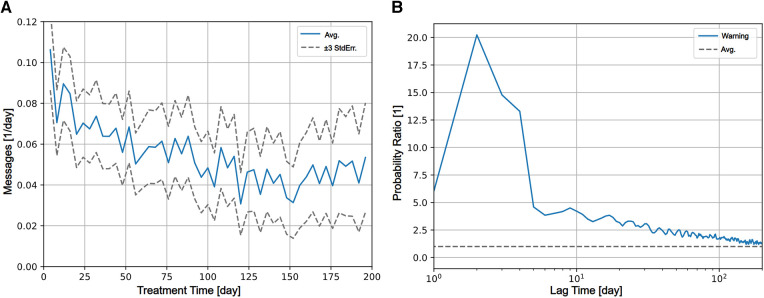
Results: The relapse frequency per patient day among Previct Alcohol users was 0.28 in 2016, 0.22 in 2020 and 0.25 in 2022 with no drastic change during COVID-19. When a relapse was predicted, the actual occurrence of relapse in the days immediately after was found to be above average. Additionally, there was a noticeable increase in caregiver interactions following these predictions. When caregivers were not informed of these predictions, the risk of relapse was found to be higher compared to when the prediction tool was actively being used. The prediction tool decreased the relapse risk by 9% for relapses that were of short duration and by 18% for relapses that lasted more than 3 days.
Conclusions: The eHealth system Previct Alcohol allows for high resolution measurements, enabling precise identifications of relapse patterns and follow up on individual and population-based alcohol use disorder treatment. eHealth relapse prediction aids the caregiver to act timely, which reduces, delays, and shortens relapses.
Keywords: addiction; alcohol; eHealth; prediction; relapse.
© 2024 Wallden, Dahlberg, Månflod, Knez, Winkvist, Zetterström, Andersson, Hämäläinen and Nyberg.
Conflict of interest statement
MH, AZ, MWi, and GD, are all employees of Kontigo Care AB. MWa and KA are employees of Skillsta Teknik Design och Kvalitet AB and are subcontractors to Kontigo Care AB. FN is a member of the scientific advisory committee of Kontigo Care AB. The remaining authors declare that the research was conducted in the absence of any commercial or financial relationships that could be construed as a potential conflict of interest.
Figures


References
-
- Zetterström A, Hämäläinen M D, Karlberg E, Winkvist M, Söderquist M, Öhagen P, et al. Maximum time between tests: a digital biomarker to detect therapy compliance and assess schedule quality in measurement-based eHealth systems for alcohol use disorder. Alcohol Alcohol. (2019) 54(1):70–2. 10.1093/alcalc/agy086 - DOI - PubMed
-
- Hämäläinen MD, Zetterström A, Winkvist M, Söderquist M, Öhagen P, Andersson K, et al. Breathalyser-based eHealth data suggest that self-reporting of abstinence is a poor outcome measure for alcohol use disorder clinical trials. Alcohol Alcohol. (2020) 55(3):237–45. 10.1093/alcalc/agaa004 - DOI - PubMed
LinkOut - more resources
Full Text Sources
