


Applicability of Food Monitoring Data for Assessing Relative Exposure Contributions of Pyrethroids in Retrospective Human Biomonitoring Risk Estimations
- PMID: 38250980
- PMCID: PMC10819063
- DOI: 10.3390/toxics12010024
Applicability of Food Monitoring Data for Assessing Relative Exposure Contributions of Pyrethroids in Retrospective Human Biomonitoring Risk Estimations
Abstract
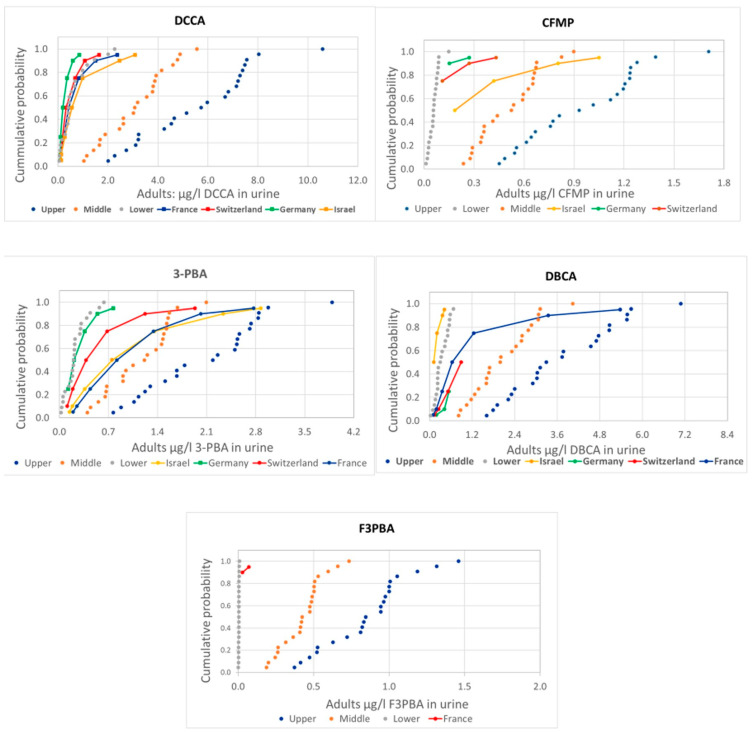
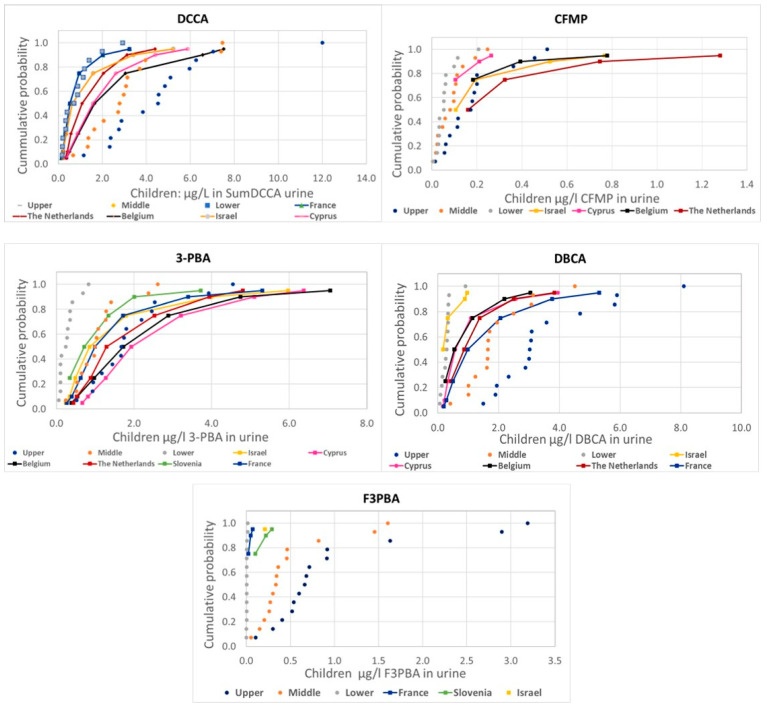
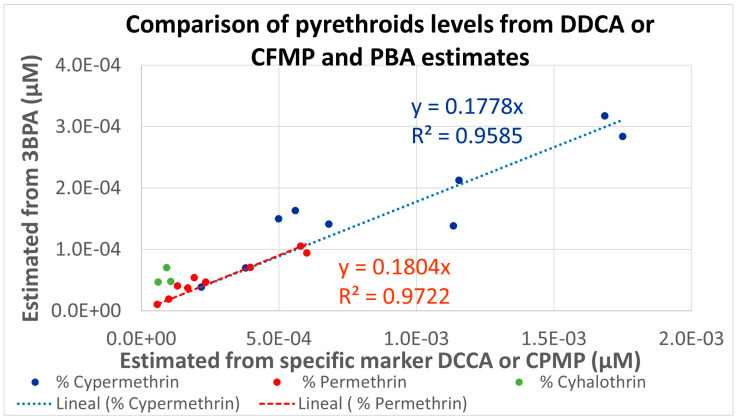
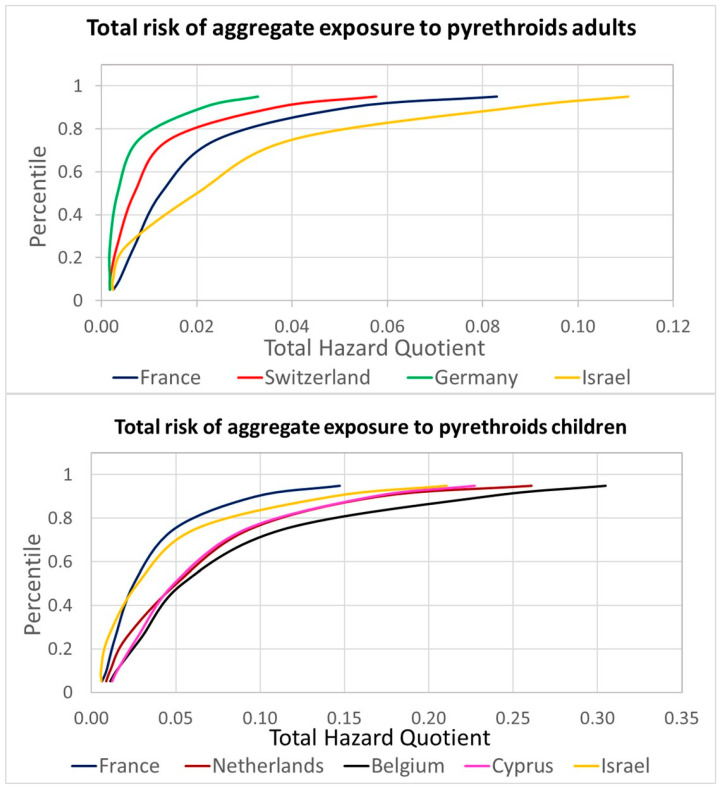
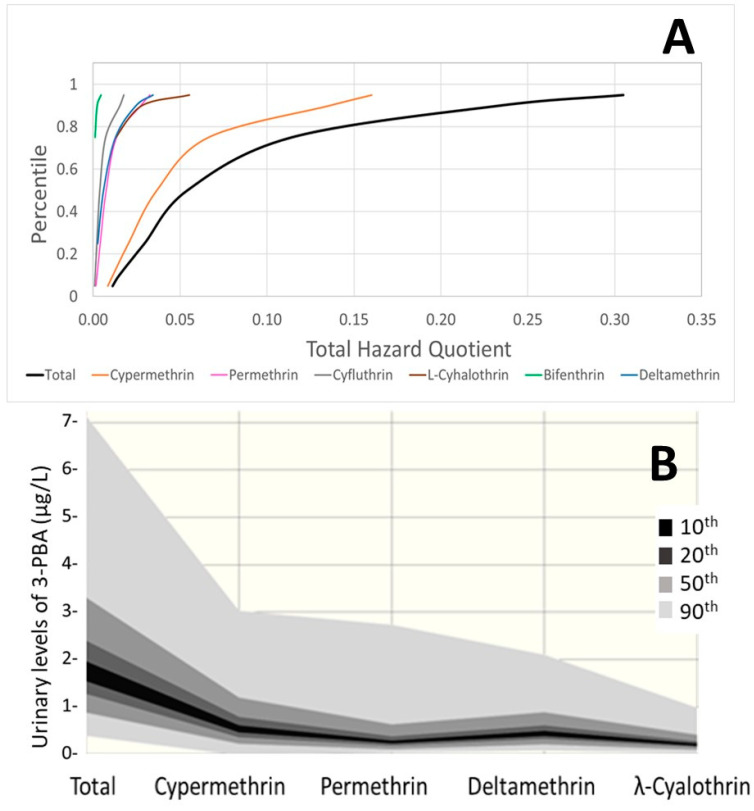
The use of pyrethroids is very broad and shows increasing trends. Human biomonitoring studies represent the best approach for realistic risk estimations, but their interpretation requires a tiered approach. A previous HBM4EU study indicated levels in European children groups just around the threshold for concern, requiring further refinement. The main difficulty is that several pyrethroids with different toxicity potencies generate the same urinary metabolites. As diet is the main pyrethroid source for the general population, EU food monitoring data reported by EFSA have been used to estimate the relative contribution of each pyrethroid. The main contributors were cypermethrin for DCCA and 3-PBA and lambda-cyhalothrin for CFMP. Urinary levels predicted from food concentration according to the EFSA diets were mostly within the range of measured levels, except 3-PBA and CFMP levels in children, both below measured levels. The predicted lower levels for 3-PBA can be explained by the very low Fue value, initially proposed as conservative, but that seems to be unrealistic. The discrepancies for CFMP are mostly for the highest percentiles and require further assessments. The refined assessments included the revision of the previously proposed human biomonitoring guidance values for the general population, HBM-GV Gen Pop, following recent toxicological reevaluations, and the estimation of hazard quotients (HQs) for each individual pyrethroid and for the combined exposure to all pyrethroids. All HQs were below 1, indicating no immediate concern, but attention is required, particularly for children, with HQs in the range of 0.2-0.3 for the highly exposed group. The application of probabilistic methods offers assessments at the population level, addressing the variability in exposure and risk and providing relevant information for Public Health impact assessments and risk management prioritization.
Keywords: 3PBA; CFMP; CLF3CA; DBCA; DCCA; F3PBA; HBM4EU; pesticide risk; pyrethroids; urinary levels.
Conflict of interest statement
The authors declare no conflicts of interest.
Figures
Similar articles
-
A Tiered Approach for Assessing Individual and Combined Risk of Pyrethroids Using Human Biomonitoring Data.Toxics. 2022 Aug 4;10(8):451. doi: 10.3390/toxics10080451. Toxics. 2022. PMID: 36006130 Free PMC article.
-
Assessing the impact of coexposure on the measurement of biomarkers of exposure to the pyrethroid lambda-cyhalothrin in agricultural workers.Int J Hyg Environ Health. 2023 Jun;251:114194. doi: 10.1016/j.ijheh.2023.114194. Epub 2023 Jun 6. Int J Hyg Environ Health. 2023. PMID: 37290330
-
Documenting the kinetic time course of lambda-cyhalothrin metabolites in orally exposed volunteers for the interpretation of biomonitoring data.Toxicol Lett. 2017 Jul 5;276:115-121. doi: 10.1016/j.toxlet.2017.05.022. Epub 2017 May 21. Toxicol Lett. 2017. PMID: 28539253
-
Harmonized human biomonitoring in European children, teenagers and adults: EU-wide exposure data of 11 chemical substance groups from the HBM4EU Aligned Studies (2014-2021).Int J Hyg Environ Health. 2023 Apr;249:114119. doi: 10.1016/j.ijheh.2023.114119. Epub 2023 Feb 9. Int J Hyg Environ Health. 2023. PMID: 36773580 Review.
-
Exposure Levels of Pyrethroids, Chlorpyrifos and Glyphosate in EU-An Overview of Human Biomonitoring Studies Published since 2000.Toxics. 2022 Dec 15;10(12):789. doi: 10.3390/toxics10120789. Toxics. 2022. PMID: 36548622 Free PMC article. Review.
Cited by
-
A tiered next-generation risk assessment framework integrating toxicokinetics and NAM-based toxicodynamics: "proof of concept" case study using pyrethroids.Arch Toxicol. 2025 Jul;99(7):2759-2781. doi: 10.1007/s00204-025-04045-9. Epub 2025 May 7. Arch Toxicol. 2025. PMID: 40332597 Free PMC article.
References
-
- Hassaan M.A., El Nemr A. Pesticides pollution: Classifications, human health impact, extraction and treatment techniques. Egypt. J. Aquat. Res. 2020;46:207–220. doi: 10.1016/j.ejar.2020.08.007. - DOI
-
- Boff J.S., Reis A.C., de Oliveira J.L., Gross R.B., Fraceto L.F., Melo A.A., Bernardi O. Development and biological evaluation of nanoencapsulated-based pyrethroids with synergists for resistance management of two soybean pests: Insights for new insecticide formulations. Pest Manag. Sci. 2023;79:1204–1212. doi: 10.1002/ps.7295. - DOI - PubMed
Grants and funding
LinkOut - more resources
Full Text Sources
Research Materials
