


Virtual Active Learning to Maximize Knowledge Acquisition in Nursing Students: A Comparative Study
- PMID: 38251189
- PMCID: PMC10801574
- DOI: 10.3390/nursrep14010011
Virtual Active Learning to Maximize Knowledge Acquisition in Nursing Students: A Comparative Study
Abstract
Background: Nursing students need to acquire knowledge through active methods that promote critical thinking and decision making. The purpose of this study is to analyze whether there are differences in the acquisition of knowledge by nursing students between active face-to-face or virtual teaching methods.
Methods: In this comparative study, nursing students enrolled in the psychology course were divided into two groups: a face-to-face group that received active teaching methods and a virtual group. The virtual group was exposed to the Effective Learning Strategy (ELS), which included seminars based on video content through the Virtual Campus and answering questions using the H5P tool. In addition, participants engaged in reflection tasks on the content. Covariate data were collected, and knowledge tests were administered to both groups before and after the course. After three months, subjects were re-evaluated with a final exam to assess content retention.
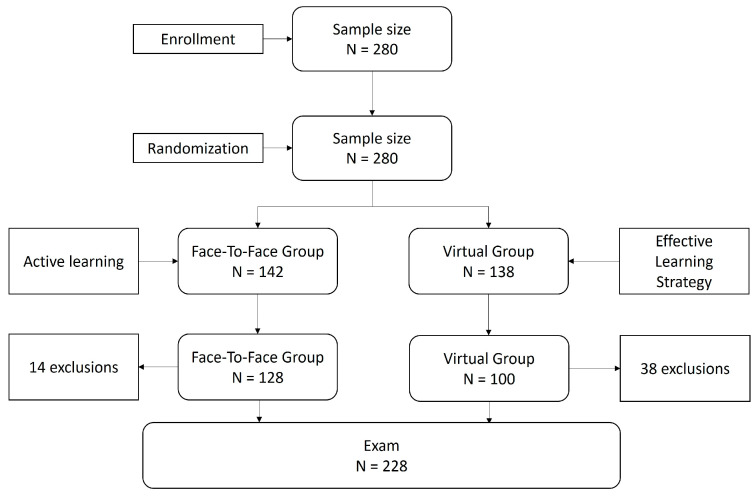
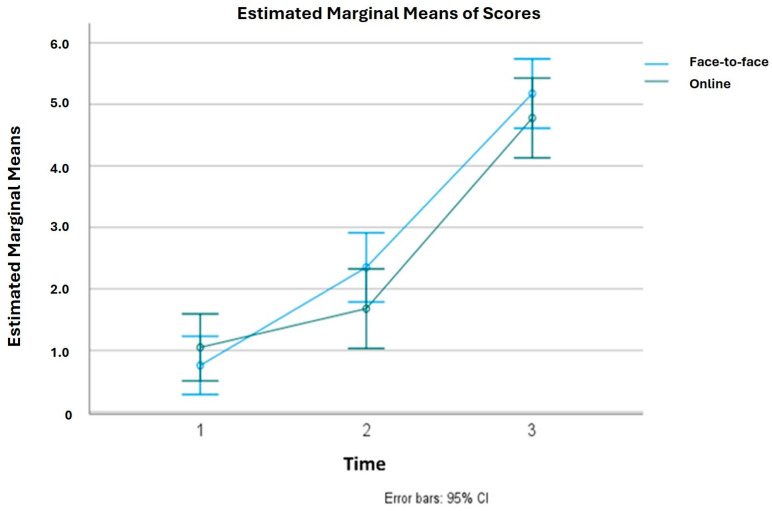
Results: A total of 280 students were randomized. No differences were found in students' scores at the end of the knowledge test or in their final grades in the subject. Having study habits (b = 0.12, p = 0.03) and social support from relevant people (b = 0.09; p = 0.03) were associated with better post-intervention scores, and inversely with social support from friends (b = -0.12, p < 0.01). Final grades were inversely associated with digital safety literacy (b = -0.101, p = 0.01). No factors were associated with the scores of each group separately.
Conclusions: The ELS virtual active learning model is as effective as face-to-face active learning methods for teaching psychology to first-year nursing students. This study was not registered.
Keywords: H5P; competencies; education; nursing; seminars; virtual campus.
Conflict of interest statement
The authors declare no conflicts of interest.
Figures
Similar articles
-
Clinical Virtual Simulation in Nursing Education: Randomized Controlled Trial.J Med Internet Res. 2019 Mar 18;21(3):e11529. doi: 10.2196/11529. J Med Internet Res. 2019. PMID: 30882355 Free PMC article. Clinical Trial.
-
Virtual Reflection Group Meetings as a Structured Active Learning Method to Enhance Perceived Competence in Critical Care: Focus Group Interviews With Advanced Practice Nursing Students.JMIR Med Educ. 2023 Mar 23;9:e42512. doi: 10.2196/42512. JMIR Med Educ. 2023. PMID: 36951919 Free PMC article.
-
Virtual versus face-to-face clinical simulation in relation to student knowledge, anxiety, and self-confidence in maternal-newborn nursing: A randomized controlled trial.Nurse Educ Today. 2016 Oct;45:179-84. doi: 10.1016/j.nedt.2016.08.004. Epub 2016 Aug 9. Nurse Educ Today. 2016. PMID: 27537670 Clinical Trial.
-
Effectiveness of virtual reality in nursing education: a systematic review and meta-analysis.BMC Med Educ. 2023 Sep 28;23(1):710. doi: 10.1186/s12909-023-04662-x. BMC Med Educ. 2023. PMID: 37770884 Free PMC article.
-
[Impact of Nurse Practitioners and Nursing Education on COVID-19 Pandemics: Innovative Strategies of Authentic Technology-Integrated Clinical Simulation].Hu Li Za Zhi. 2021 Oct;68(5):4-6. doi: 10.6224/JN.202110_68(5).01. Hu Li Za Zhi. 2021. PMID: 34549401 Review. Chinese.
Cited by
-
Identifying and Exploring Jean Watson's Theory of Human Caring in Nursing Approaches for Patients with Psychoactive Substance Dependence in Medical and Surgical Acute Wards.Nurs Rep. 2024 Aug 28;14(3):2179-2191. doi: 10.3390/nursrep14030162. Nurs Rep. 2024. PMID: 39311171 Free PMC article.
-
Perception of University Nursing Students and Faculty Members Regarding Simulated Practices: A Mixed Methods Study.Nurs Rep. 2024 Oct 14;14(4):2975-2989. doi: 10.3390/nursrep14040217. Nurs Rep. 2024. PMID: 39449454 Free PMC article.
-
Assessing the Accuracy, Completeness and Safety of ChatGPT-4o Responses on Pressure Injuries in Infants: Clinical Applications and Future Implications.Nurs Rep. 2025 Apr 14;15(4):130. doi: 10.3390/nursrep15040130. Nurs Rep. 2025. PMID: 40333050 Free PMC article.
-
How Do Nursing Students Perceive Care Towards the LGBTIQ+ Community? A Phenomenological Study on Sexual and Gender Diversity.Nurs Rep. 2025 Apr 30;15(5):155. doi: 10.3390/nursrep15050155. Nurs Rep. 2025. PMID: 40423189 Free PMC article.
-
Transcultural Perspectives in Nursing: Understanding the Role of Healers and the Evil Eye in Modern Healthcare.Nurs Rep. 2024 Sep 19;14(3):2443-2455. doi: 10.3390/nursrep14030181. Nurs Rep. 2024. PMID: 39311189 Free PMC article.
References
-
- Bonwell C.C., Eison J.A. Active Learning: Creating Excitement in the Classroom. ASHE-ERIC Higher Education Report No. 1. Washington University, School of Education and Human Development; Washington, DC, USA: 1991.
-
- Ledesma V. El Cambio de Paradigma Educativo y sus Repercusiones en las Instituciones De Educación Superior. [(accessed on 1 October 2023)];Rev. Electron. Desarro. Competencias. 2011 1:6–31. Available online: http://redec.utalca.cl/index.php/redec/article/view/56/59.
-
- Escobar-Castellanos B., Concha P.J. Filosofía de Patricia Benner, aplicación en la formación de enfermería: Propuestas de estrategias de aprendizaje. Educación. 2019;28:182–202. doi: 10.18800/educacion.201901.009. - DOI
LinkOut - more resources
Full Text Sources
