. 2024 Apr;24(2):351-367.
doi: 10.3758/s13415-023-01152-x. Epub 2024 Jan 22.

Development of a novel rodent rapid serial visual presentation task reveals dissociable effects of stimulant versus nonstimulant treatments on attentional processes

Affiliations

Development of a novel rodent rapid serial visual presentation task reveals dissociable effects of stimulant versus nonstimulant treatments on attentional processes

Abigail Benn et al. Cogn Affect Behav Neurosci. 2024 Apr.

Abstract

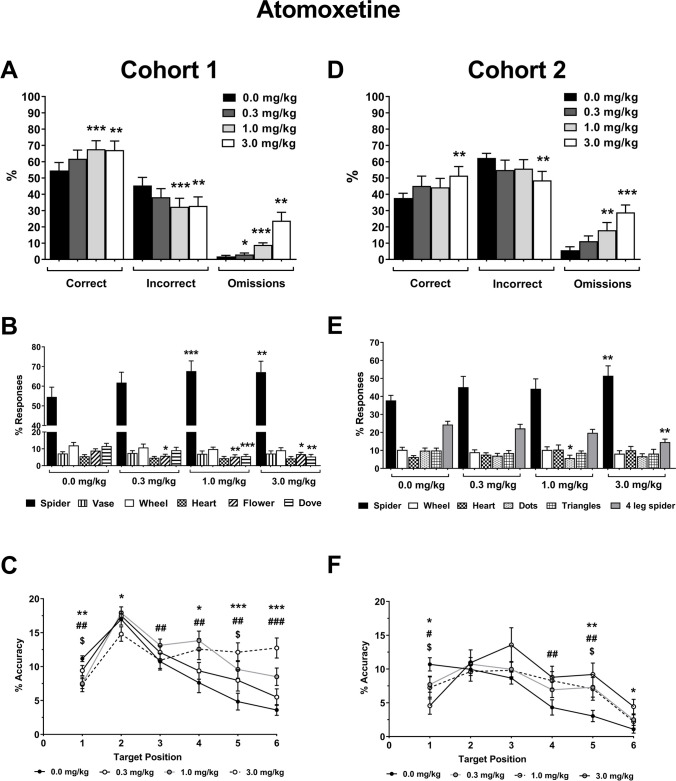
The rapid serial visual presentation (RSVP) task and continuous performance tasks (CPT) are used to assess attentional impairments in patients with psychiatric and neurological conditions. This study developed a novel touchscreen task for rats based on the structure of a human RSVP task and used pharmacological manipulations to investigate their effects on different performance measures. Normal animals were trained to respond to a target image and withhold responding to distractor images presented within a continuous sequence. In a second version of the task, a false-alarm image was included, so performance could be assessed relative to two types of nontarget distractors. The effects of acute administration of stimulant and nonstimulant treatments for ADHD (amphetamine and atomoxetine) were tested in both tasks. Methylphenidate, ketamine, and nicotine were tested in the first task only. Amphetamine made animals more impulsive and decreased overall accuracy but increased accuracy when the target was presented early in the image sequence. Atomoxetine improved accuracy overall with a specific reduction in false-alarm responses and a shift in the attentional curve reflecting improved accuracy for targets later in the image sequence. However, atomoxetine also slowed responding and increased omissions. Ketamine, nicotine, and methylphenidate had no specific effects at the doses tested. These results suggest that stimulant versus nonstimulant treatments have different effects on attention and impulsive behaviour in this rat version of an RSVP task. These results also suggest that RSVP-like tasks have the potential to be used to study attention in rodents.

Keywords: Amphetamine; Atomoxetine; Attention; Continuous performance tasks; Rapid serial visual presentation.


Conflict of interest statement

The authors have no conflicts of interest to declare in relation to the work presented in this manuscript. ESJR has current or previous research grant funding through PhD studentships, collaborative grants, and contract research from Boehringer Ingelheim, COMPASS Pathways, Eli Lilly, IRLab Therapeutics, MSD, Pfizer, and SmallPharma but in areas unrelated to the work presented.

Figures
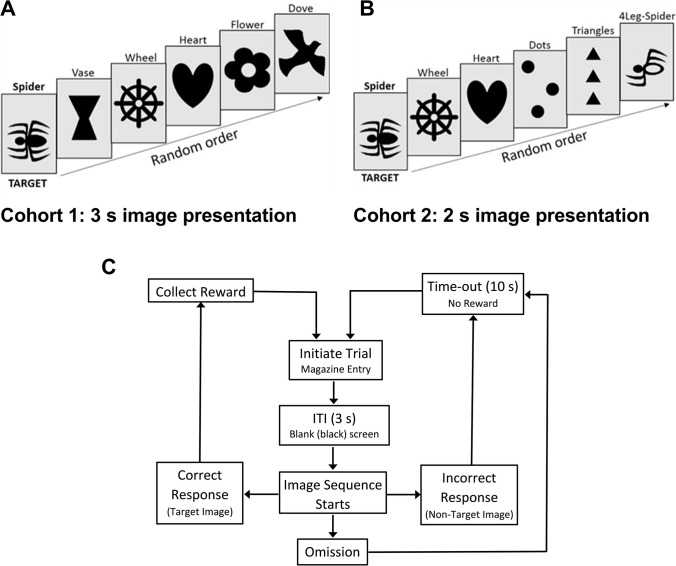
Fig. 1
Fig. 1
Images and trial outcomes for the rat-rapid serial visual presentation task (R-RSVP). Images used for cohort 1 (A) and cohort 2 (B) with presentation time of 3 s and 2 s, respectively. Cohort 2 images contained a false-alarm (4-leg spider) image. Flow chart representing all possible trial outcomes during task performance (C)
Fig. 2
Fig. 2
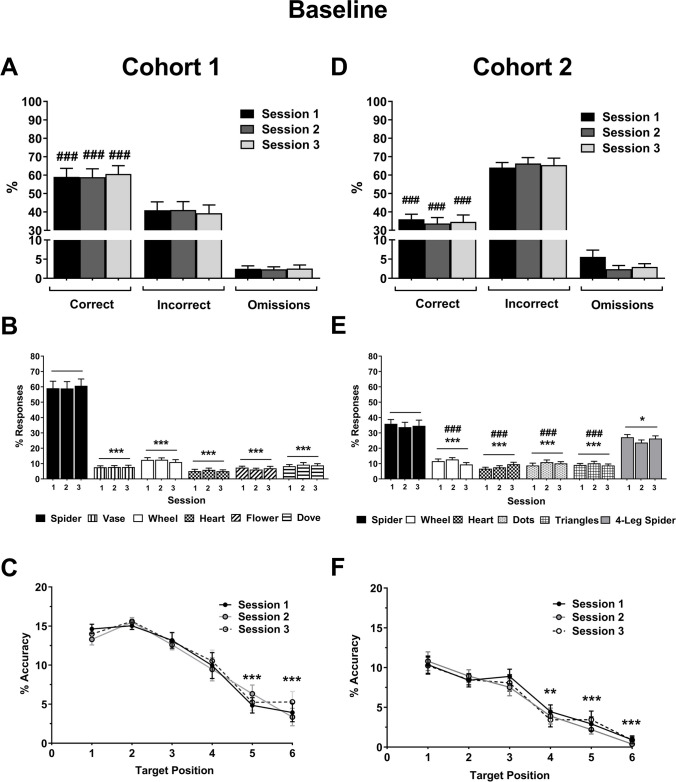
Performance data for cohort 1 (A–C) and cohort 2 (D–F) for the last three consecutive pretreatment baseline sessions. Response data for % correct, % incorrect, and % omissions for cohort 1 (A) and cohort 2 (D). Image responses for cohort 1 (B) and cohort 2 (E), spider is the target image (accuracy). The sum of distractor responses (all images except spider) is equivalent to incorrect responses in (A). Attention curves showing accuracy per target sequence position for cohort 1 (C) and cohort 2 (F). Results are shown for the total population, mean ± SEM, n = 12 animals per cohort, *p < 0.05, **p < 0.01, ***p < 0.001, versus target image (spider) or target sequence position (within-subject), ###p < 0.001 versus 4-leg spider (false alarm) or chance performance (17%, 1-sample t-test)
Fig. 3
Fig. 3
Effect of amphetamine on performance in the rat-rapid serial visual presentation task (R-RSVP). Performance data for cohort 1 (A–C) and cohort 2 (D–F), response data for % correct, % incorrect, and % omissions for cohort 1 (A) and cohort 2 (D). Image responses for cohort 1 (B) and cohort 2 (E), spider is the target image. The sum of distractor responses (all images except spider) is equivalent to incorrect responses for each dose in (A). Attention curves showing accuracy per target sequence position for cohort 1 (C) and cohort 2 (F). Results are shown for the total population, mean ± SEM, n = 12 animals per cohort. Response data (A, B, D, E); *p < 0.05, **p < 0.01, ***p < 0.001, versus vehicle (within-subject). Accuracy per target sequence position (C, F); #p < 0.05, ##p < 0.01, 0.3 mg/kg, *p < 0.05, **p < 0.01, ***p < 0.001, 1.0 mg/kg, vs. vehicle (within-subject)
Fig. 4
Fig. 4
Effect of atomoxetine on performance in the rat-rapid serial visual presentation task (R-RSVP). Performance data for cohort 1 (A–C) and cohort 2 (D–F), response data for % accuracy, % incorrect, and % omissions for cohort 1 (A) and cohort 2 (D). Image responses for cohort 1 (B) and cohort 2 (E), spider is the target image. The sum of the responses to the distractor images (all images except spider) is equivalent to incorrect responses in (A). Attention curves showing accuracy per target sequence position for cohort 1 (C) and cohort 2 (F). Results are shown for the total population, mean ± SEM, n = 12 animals per cohort. Response data (A, B, D, E); *p < 0.05, **p < 0.01, ***p < 0.001, vs. vehicle (within-subject). Accuracy per target sequence position (C, F); $p < 0.05, 0.3 mg/kg, #p < 0.05, ##p < 0.01, ###p < 0.001, 1.0 mg/kg, *p < 0.05, **p < 0.01, ***p < 0.001, 3.0 mg/kg, vs. vehicle (within-subject)

References

    1. Baarendse PJ, Vanderschuren LJ. Dissociable effects of monoamine reuptake inhibitors on distinct forms of impulsive behavior in rats. Psychopharmacology (Berl) 2012;219(2):313–326. doi: 10.1007/s00213-011-2576-x. - DOI - PMC - PubMed
    1. Bari A, Dalley JW, Robbins TW. The application of the 5-choice serial reaction time task for the assessment of visual attentional processes and impulse control in rats. Nature Protocols. 2008;3(5):759–767. doi: 10.1038/nprot.2008.41. - DOI - PubMed
    1. Barnes SA, Young JW, Neill JC. Rats tested after a washout period from sub-chronic PCP administration exhibited impaired performance in the 5-Choice Continuous Performance Test (5C-CPT) when the attentional load was increased. Neuropharmacology. 2012;62(3):1432–1441. doi: 10.1016/j.neuropharm.2011.04.024. - DOI - PMC - PubMed
    1. Bekker EM, Bocker KB, Van Hunsel F, van den Berg MC, Kenemans JL. Acute effects of nicotine on attention and response inhibition. Pharmacology Biochemistry and Behavior. 2005;82(3):539–548. doi: 10.1016/j.pbb.2005.10.009. - DOI - PubMed
    1. Benn A, Robinson ES. Investigating glutamatergic mechanism in attention and impulse control using rats in a modified 5-choice serial reaction time task. PLoS One. 2014;9(12):e115374. doi: 10.1371/journal.pone.0115374. - DOI - PMC - PubMed

Publication types

MeSH terms

LinkOut - more resources