


The Impact of Different Patterns of Residual Disease on Long-Term Oncological Outcomes in Breast Cancer Patients Treated with Neo-Adjuvant Chemotherapy
- PMID: 38254865
- PMCID: PMC10814808
- DOI: 10.3390/cancers16020376
The Impact of Different Patterns of Residual Disease on Long-Term Oncological Outcomes in Breast Cancer Patients Treated with Neo-Adjuvant Chemotherapy
Abstract
Backgrounds: The majority of breast cancer (BC) patients treated with neo-adjuvant chemotherapy (NAC) achieves a pathologic partial response with different patterns of residual disease. No clear correlation between these patterns and oncological results was described. Our aims were to define the predictive factors for different patterns of residual disease and compare the outcomes between the scattered versus the circumscribed pattern.
Methods: We reviewed 219 postoperative surgical specimens. Patients were divided into two groups: scattered versus circumscribed. Disease-free survival (DFS), distant DFS (DDFS), and overall survival (OS) were analyzed.
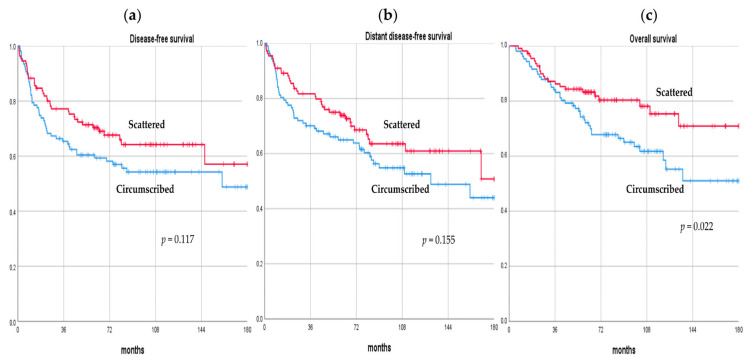
Results: The scattered and circumscribed patterns were assessed in 111 (50.7%) and 108 (49.3%) patients. Two independent predictive factors for the circumscribed pattern were identified: discontinuation of NAC cycles (p = 0.011), and tumor size post-NAC >18 mm (p = 0.022). No difference was observed in terms of DFS and DDFS. Patients with the scattered pattern exhibited a statistically significant better OS. Discontinuation of NAC cycles, tumor size >18 mm, triple-negative BC, and ypN+ were associated with increased recurrence and poorer survival.
Conclusions: Discontinuation of NAC cycles and tumor size are independent factors associated with patterns of residual disease. The scattered pattern presents better survival. Understanding the relationship between NAC, the residual pattern, and differences in survival outcomes offers the potential to optimize the therapeutic approaches.
Keywords: breast cancer; circumscribed; neo-adjuvant chemotherapy; scattered; surgery.
Conflict of interest statement
The authors declare no conflict of interest.
Figures
References
-
- Korde L.A., Somerfield M.R., Carey L.A., Crews J.R., Denduluri N., Hwang E.S., Khan S.A., Loibl S., Morris E.A., Perez A., et al. Neoadjuvant Chemotherapy, Endocrine Therapy, and Targeted Therapy for Breast Cancer: ASCO Guideline. J. Clin. Oncol. 2021;39:1485–1505. doi: 10.1200/JCO.20.03399. - DOI - PMC - PubMed
-
- Van Nes J.G.H., Putter H., Julien J.P., Tubiana-Hulin M., Van De Vijver M., Bogaerts J., De Vos M., Van De Velde C.J.H. Preoperative Chemotherapy Is Safe in Early Breast Cancer, Even after 10 Years of Follow-up; Clinical and Translational Results from the EORTC Trial 10902. Breast Cancer Res. Treat. 2009;115:101–113. doi: 10.1007/s10549-008-0050-1. - DOI - PubMed
LinkOut - more resources
Full Text Sources
