Review
. 2024 Jan 12;25(2):947.
doi: 10.3390/ijms25020947.

Targeting Innate Immunity in Glioma Therapy

Affiliations
Review

Targeting Innate Immunity in Glioma Therapy

Andrew G Gillard et al. Int J Mol Sci. .

Abstract

Currently, there is a lack of effective therapies for the majority of glioblastomas (GBMs), the most common and malignant primary brain tumor. While immunotherapies have shown promise in treating various types of cancers, they have had limited success in improving the overall survival of GBM patients. Therefore, advancing GBM treatment requires a deeper understanding of the molecular and cellular mechanisms that cause resistance to immunotherapy. Further insights into the innate immune response are crucial for developing more potent treatments for brain tumors. Our review provides a brief overview of innate immunity. In addition, we provide a discussion of current therapies aimed at boosting the innate immunity in gliomas. These approaches encompass strategies to activate Toll-like receptors, induce stress responses, enhance the innate immune response, leverage interferon type-I therapy, therapeutic antibodies, immune checkpoint antibodies, natural killer (NK) cells, and oncolytic virotherapy, and manipulate the microbiome. Both preclinical and clinical studies indicate that a better understanding of the mechanisms governing the innate immune response in GBM could enhance immunotherapy and reinforce the effects of chemotherapy and radiotherapy. Consequently, a more comprehensive understanding of the innate immune response against cancer should lead to better prognoses and increased overall survival for GBM patients.

Keywords: adaptive therapy; glioma; immunotherapy; innate immunity; virotherapy.


Conflict of interest statement

The authors declare no conflicts of interest.

Figures
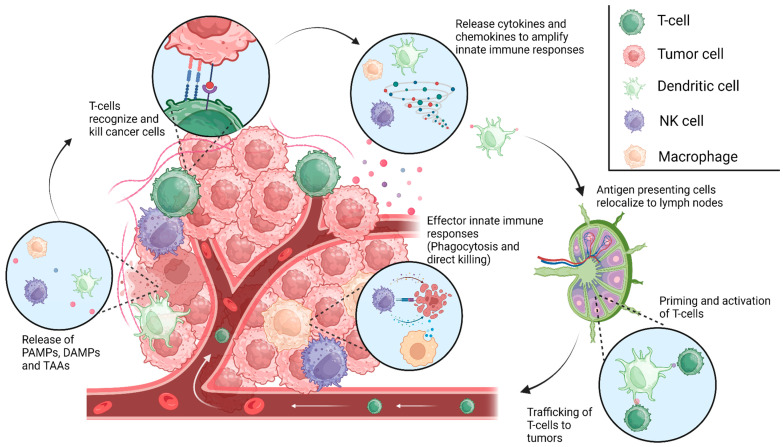
Figure 1
Figure 1
The cancer immunity cycle. Innate immune cells facilitate immune responses following the recognition of PAMPs, DAMPs, or other unique tumor-associated antigens (TAA), resulting in antigen presentation in the associated draining lymph nodes. This process allows for the priming and activation of T-cells and adaptive immunity, which aid in tumor elimination, producing more PAMPs, DAMPs, and TAAs to continue the cycle. Escape from these innate immune mechanisms might lead to the formation of gliomas and the malignant phenotype of these tumors. [Created with BioRender.com].
Figure 2
Figure 2
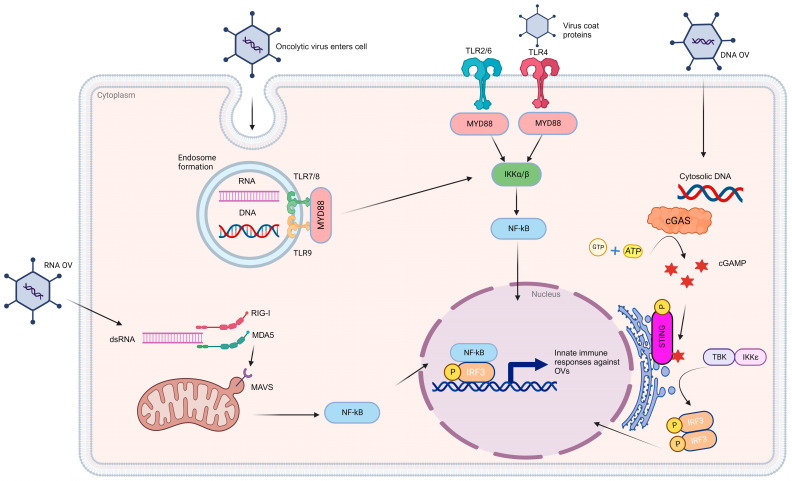
Oncolytic viroimmunotherapy induces innate immune responses. The delivery of oncolytic viruses (OVs) triggers a range of innate immune responses that are contingent on the species of origin. The detection of these viruses hinges on pattern recognition receptors, including Toll-like receptors (TLRs), retinoic acid-inducible gene I (RIG-I)-like receptors (RLRs), and nucleic acid sensors. TLR7/8 plays a key role in recognizing single-stranded ribonucleic acid (RNA), while TLR9 is responsible for identifying hypomethylated CpG deoxyribonucleic acid (DNA). Nevertheless, both of these pathways converge to activate the myeloid differentiation primary response 88 (MYD88) pathway, ultimately leading to the activation of nuclear factor kappa-light-chain-enhancer of activated B cells (NF-Kββ). Similarly, OVs detected through surface receptors such as TLR2/6 and TLR4 also initiate the MYD88 pathway. Within the cytosol, the presence of OV double-stranded RNA (dsRNA) is detected through the RIG-I and MDA5 receptors, which, in turn, activate mitochondrial antiviral-signaling protein (MAVS) located on the mitochondria. MAVS, in collaboration with the inhibitor of nuclear factor kappa-B kinase subunit epsilon (IKKε)/tank-binding kinase 1 (TBK1), leads to NF-Kβ-mediated immune activation. In the case of DNA-based OVs, their presence is recognized by cytosolic DNA sensors, particularly through the cGAS-STING pathway. OV DNA triggers enzymatic activation of cyclic GMP-AMP synthase (cGAS), which catalyzes the synthesis of cyclic GMP-AMP (cGAMP) using ATP and GTP as substrates. cGAMP subsequently binds to a stimulator of IFN genes (STING) and triggers the activation of the IKKε/TBK1 complex. This complex, in turn, phosphorylates IFN regulatory factor 3/7 (IRF3/7), leading to the expression of genes involved in the innate immune response. Once NF-Kβ and IRFs are activated, they translocate to the nucleus and induce the expression of proinflammatory cytokines, chemokines, and type I/III IFNs. These IFN-stimulated genes establish an antiviral state, which, in turn, plays a critical role in activating adaptive immunity. [Created with BioRender.com].

References

    1. Fernandes C., Costa A., Osório L., Lago R.C., Linhares P., Carvalho B., Caeiro C. Glioblastoma. Elsevier; Amsterdam, The Netherlands: 2017. Current Standards of Care in Glioblastoma Therapy. - DOI - PubMed
    1. Ostrom Q.T., Price M., Neff C., Cioffi G., Waite K.A., Kruchko C., Barnholtz-Sloan J.S. CBTRUS Statistical Report: Primary Brain and Other Central Nervous System Tumors Diagnosed in the United States in 2016–2020. Neuro-Oncology. 2023;25:IV1–IV99. doi: 10.1093/neuonc/noad149. - DOI - PMC - PubMed
    1. Schaff L.R., Mellinghoff I.K. Glioblastoma and Other Primary Brain Malignancies in Adults: A Review. J. Am. Med. Assoc. 2023;329:574–587. doi: 10.1001/jama.2023.0023. - DOI - PMC - PubMed
    1. Villa S., Manes A., Hostalot C., Capellades J., Costas E., Rosinol O., Sanz C., Rosell R., Balañà C. Short course of radiotherapy and concomitant temozolomide in patients affected with glioblastoma with V–VI prognostic classes: A pilot study. Neuro-Oncology. 2009;11:966–967.
    1. Sharma P., Allison J.P. The future of immune checkpoint therapy. Science. 2015;348:56–61. doi: 10.1126/science.aaa8172. - DOI - PubMed