Review
. 2024 Jan 13;25(2):1015.
doi: 10.3390/ijms25021015.

A Review of Numerical Models of Radiation Injury and Repair Considering Subcellular Targets and the Extracellular Microenvironment

Affiliations
Review

A Review of Numerical Models of Radiation Injury and Repair Considering Subcellular Targets and the Extracellular Microenvironment

Nousha Afshari et al. Int J Mol Sci. .

Abstract

Astronauts in space are subject to continuous exposure to ionizing radiation. There is concern about the acute and late-occurring adverse health effects that astronauts could incur following a protracted exposure to the space radiation environment. Therefore, it is vital to consider the current tools and models used to describe and study the organic consequences of ionizing radiation exposure. It is equally important to see where these models could be improved. Historically, radiobiological models focused on how radiation damages nuclear deoxyribonucleic acid (DNA) and the role DNA repair mechanisms play in resulting biological effects, building on the hypotheses of Crowther and Lea from the 1940s and 1960s, and they neglected other subcellular targets outside of nuclear DNA. The development of these models and the current state of knowledge about radiation effects impacting astronauts in orbit, as well as how the radiation environment and cellular microenvironment are incorporated into these radiobiological models, aid our understanding of the influence space travel may have on astronaut health. It is vital to consider the current tools and models used to describe the organic consequences of ionizing radiation exposure and identify where they can be further improved.

Keywords: DNA damage; DNA repair mechanisms; GCR; HZE; mitochondrial DNA; mitochondrion; nuclear DNA; organelles; radiation; radiobiology.


Conflict of interest statement

The authors declare no conflicts of interest.

Figures
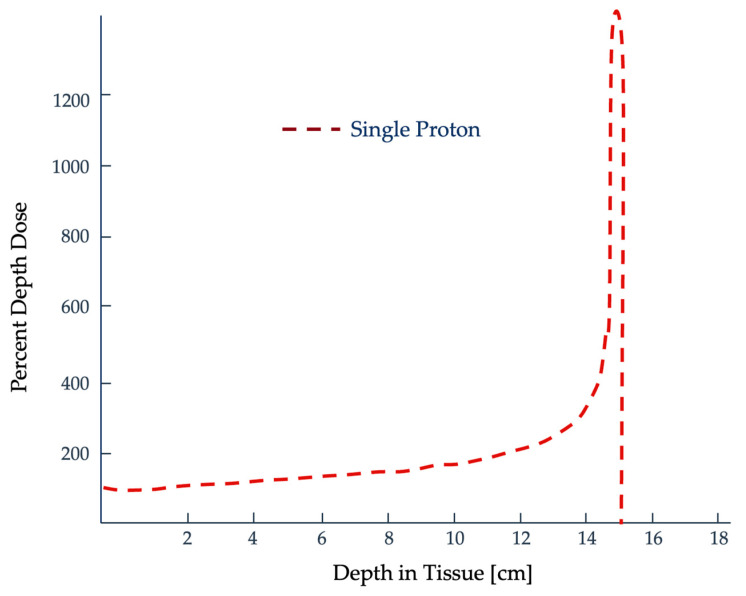
Figure 1
Figure 1
This maximum dose deposition is referred to as the Bragg peak, which is used advantageously when treating patients with heavy charged particles [13]. Graph adapted from Wilson [14].
Figure 2
Figure 2
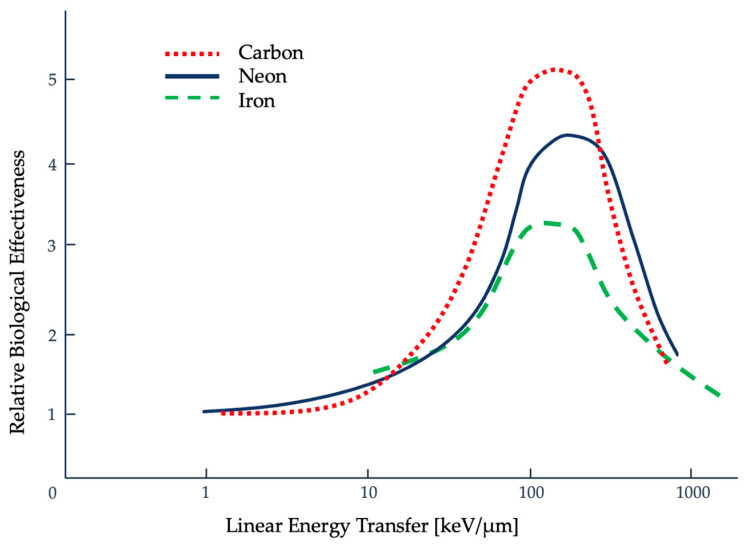
Relationship between relative biological effectiveness (RBE), clonogenic cell death, and LET for mammalian cells with carbon, neon, and iron [2,23,25]. Here, it can be seen that around 100 keV/micron, along the LET axis, there is a peak after which the RBE not only fails to increase but declines. Figure adapted from Sørenson [25].
Figure 3
Figure 3
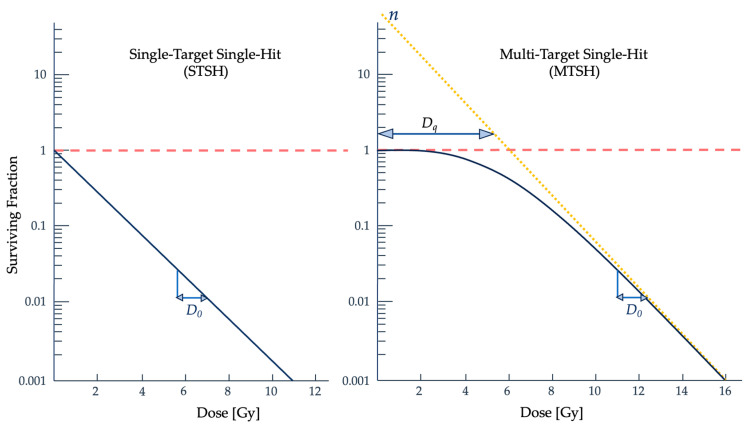
Comparison of the STSH and MTSH models [12]. D0 describes the slope of the curve’s linear portion, and Dq gives the approximate dose range, or width, of the curve’s shoulder. A linear slope on these semi-logarithmic graphs describes an exponential relationship. The STSH model, shown on the left, was expected to be seen, but a shoulder would appear in the data instead, depicted on the right. Graphs adapted from Joiner and Kogel [12].
Figure 4
Figure 4
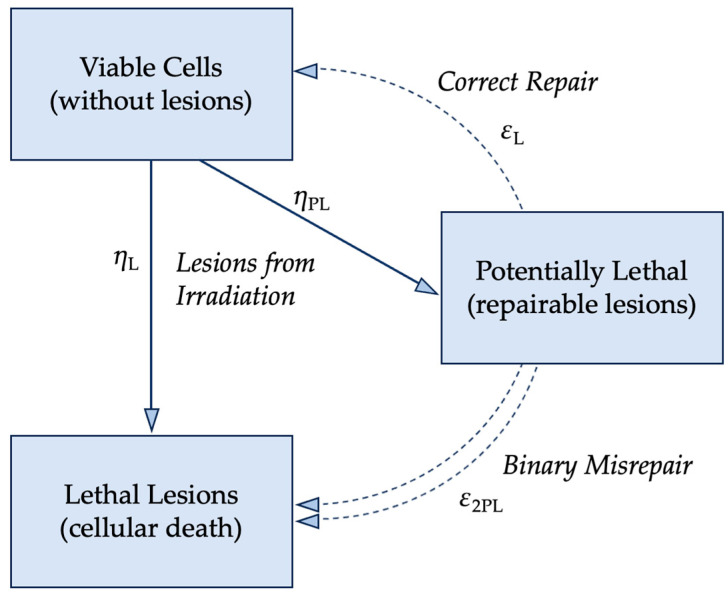
The LPL model was built on the assumption that the cell’s repair rate of DNA strand breaks is fixed and that the dose rate can be variable [40]. η represents the implicit dose rate and ε is the repair rate. Dose to the viable cells could produce potentially lethal (PL) lesions which could be repaired, but if misrepaired, or if the repair is not fast enough to combat the rate of lesion production, then the PL lesions can become lethal lesions and result in clonogenic cell death. If the repair rate is greater than the dose rate, and if any misrepairs do not impede the cell’s ability to proliferate, then the PL lesions are resolved, and the cell returns to its viable state [12]. Figure adapted from Joiner et al. [12].
Figure 5
Figure 5
The linearity of the curve on the logarithmic–linear scale represents an exponential relationship between the dose and the surviving fraction [12]. Densely ionizing radiation, or high LET particles such as α particles and neutrons, is the right-hand curve shown in red and is more likely to result in a linear curve. Sparsely ionizing radiation or low-LET particles such as x-rays will produce more of a shoulder to the curve, as described by Dq [2,12]. Figure adapted from Hall and Giaccia [2].
Figure 6
Figure 6
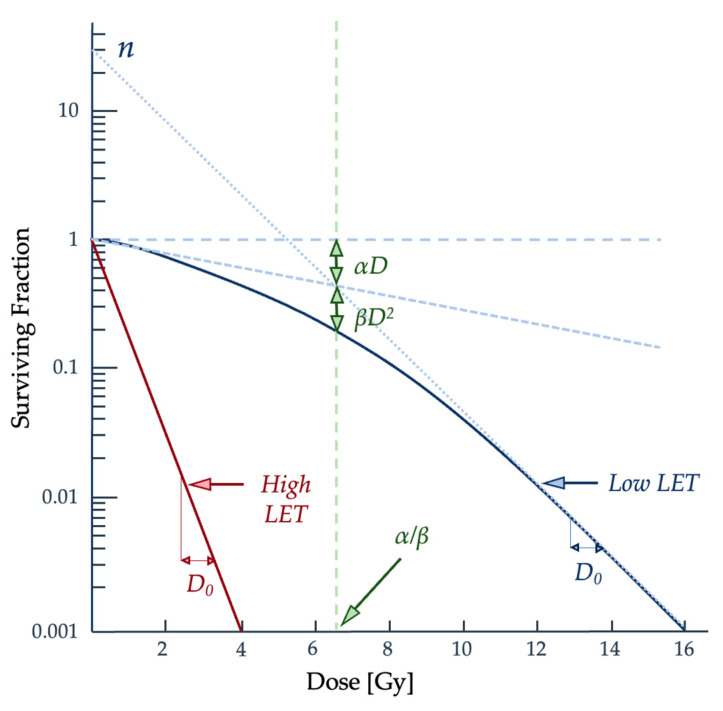
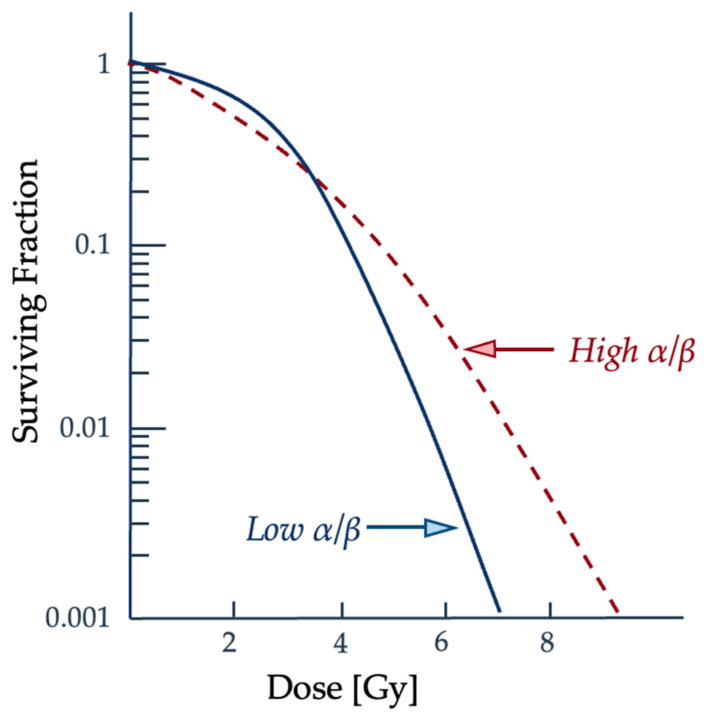
As the dose increases, the surviving fraction decreases, but the severity and concentration of double-strand breaks are variable between radiation types and cell lines. The lower an α/β ratio is, or higher the particle’s LET, the more likely double-strand breaks from a single particle interaction will occur when it traverses the biological medium [36]. Graph adapted from McMahon [36].
Figure 7
Figure 7
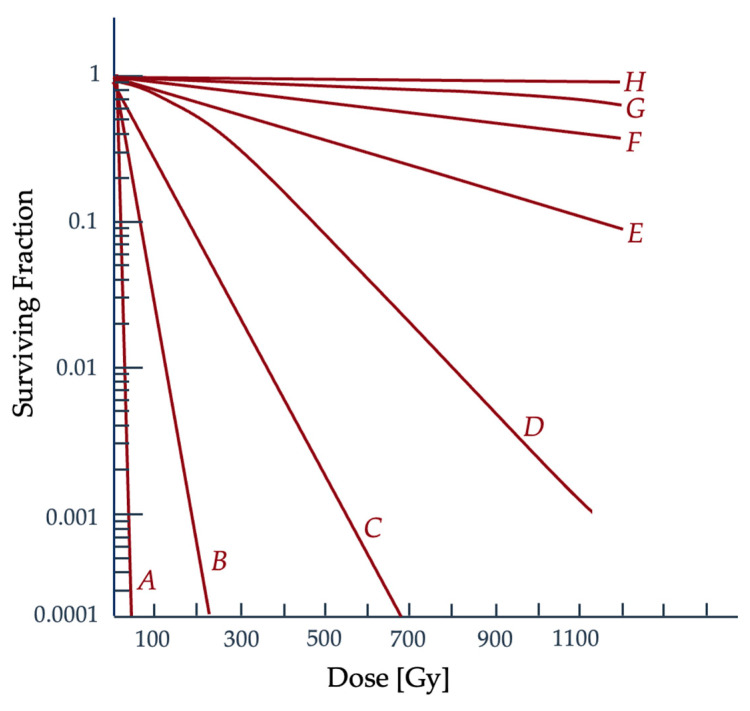
Comparison of different types of cells and their response to ionizing radiation. Shown is a comparison of (A) a mammalian cell line radiation response curve with that of (B) E. coli, (C) E. coli B/r (a mutation of E. coli), (D) yeast, (E) phage staph E, (F) bacillus megaterium (G) potato virus, and (H) M. radiodurans (one of the most radioresistant known organisms) [2,49]. Figure adapted from Hall and Giaccia [2].

References

    1. Chancellor J.C., Blue R.S., Cengel K.A., Auñón-Chancellor S.M., Rubins K.H., Katzgraber H.G., Kennedy A.R. Limitations in predicting the space radiation health risk for exploration astronauts. Npj Microgravity. 2018;4:8. doi: 10.1038/s41526-018-0043-2. - DOI - PMC - PubMed
    1. Hall E., Giaccia A. Radiobiology for the Radiologist. 7th ed. Volume 2. Wolters Kluwer Health; Lippincott Williams & Wilkins: Philadelphia, PA, USA: 2012. pp. 432–447.
    1. Warters R.L., Hofer K.G., Harris C.R., Smith J.M. Radionuclide toxicity in cultured mammalian cells: Elucidation of the primary site of radiation damage. Curr. Top. Radiat. Res. Q. 1978;12:389–407. - PubMed
    1. Okada S., Murakami K., Incerti S., Amako K., Sasaki T. MPEXS-DNA, a new GPU-based Monte Carlo simulator for track structures and radiation chemistry at sub-cellular scale. Med. Phys. 2019;46:1483–1500. doi: 10.1002/mp.13370. - DOI - PMC - PubMed
    1. Nomiya T. Discussions on target theory: Past and present. J. Radiat. Res. 2013;54:1161–1163. doi: 10.1093/jrr/rrt075. - DOI - PMC - PubMed