Review
. 2024 Jan 9;12(1):131.
doi: 10.3390/microorganisms12010131.

Gut Microbiome Disruption Following SARS-CoV-2: A Review

Affiliations
Review

Gut Microbiome Disruption Following SARS-CoV-2: A Review

Elda Righi et al. Microorganisms. .

Abstract

COVID-19 has been associated with having a negative impact on patients' gut microbiome during both active disease and in the post-acute phase. In acute COVID-19, rapid alteration of the gut microbiome composition was observed, showing on one side a reduction in beneficial symbionts (e.g., Roseburia, Lachnospiraceae) and on the other side an increase in opportunistic pathogens such as Enterococcus and Proteobacteria. Alpha diversity tends to decrease, especially initially with symptom onset and hospital admission. Although clinical recovery appears to align with improved gut homeostasis, this process could take several weeks, even in mild infections. Moreover, patients with COVID-19 post-acute syndrome showed changes in gut microbiome composition, with specific signatures associated with decreased respiratory function up to 12 months following acute disease. Potential treatments, especially probiotic-based therapy, are under investigation. Open questions remain on the possibility to use gut microbiome data to predict disease progression and on potential confounders that may impair result interpretation (e.g., concomitant therapies in the acute phase; reinfection, vaccines, and occurrence of novel conditions or diseases in the post-acute syndrome). Understanding the relationships between gut microbiome dynamics and disease progression may contribute to better understanding post-COVID syndrome pathogenesis or inform personalized treatment that can affect specific targets or microbiome markers.

Keywords: COVID-19; beneficial symbionts; microbiome; opportunistic pathogens; post-COVID-19 syndrome.


Conflict of interest statement

The authors declare no conflicts of interest.

Figures
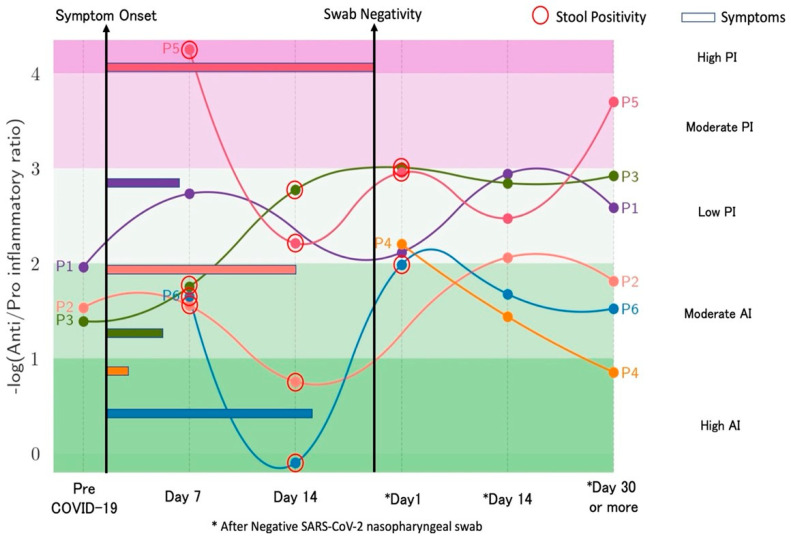
Figure 1
Figure 1
Clinical status and trends of inflammation ratio over time. Trajectories of study participants are shown prior (P1, 2, 3) and before/after (all patients) SARS-CoV-2 are shown. Swab negativity indicates no isolation of SARS-CoV-2 by nasopharyngeal swab. Red circles identify stool positivity and colored bars indicate the duration of COVID-19 related symptoms. The spectrum of colors (values between −0.2 and 4.4 according to the anti/proinflammatory ratio) identifies 5 levels of inflammation, namely highly anti-inflammatory (AI), moderately AI, low proinflammatory (PI), moderately PI, highly PI.
Figure 2
Figure 2
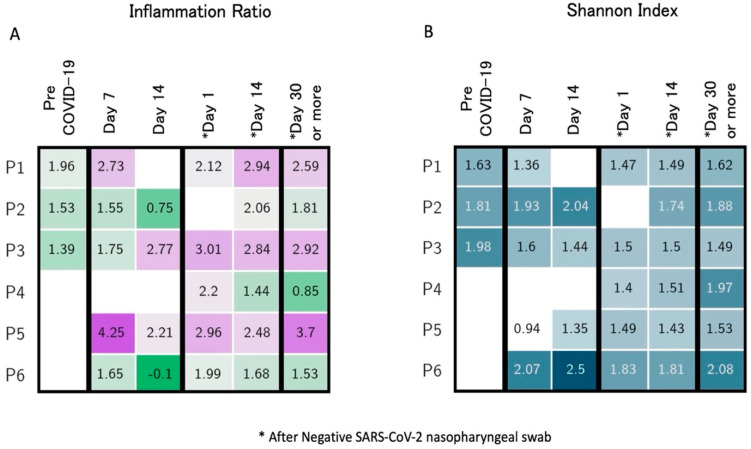
Inflammation ratio (A) and Shannon Diversity Index (B) longitudinal trends. (A). Lower coefficients corresponded to reduced inflammatory profiles. High inflammation levels (>3) are reported using dark purple color according to the color scale indicated in Figure 1. (B). Low diversity index is considered for value ≤1.5, with darker colors corresponding to increased values. The asterisks indicate stool collection after negativization of SARS-CoV-2 nasopharyngeal swab.
Figure 3
Figure 3
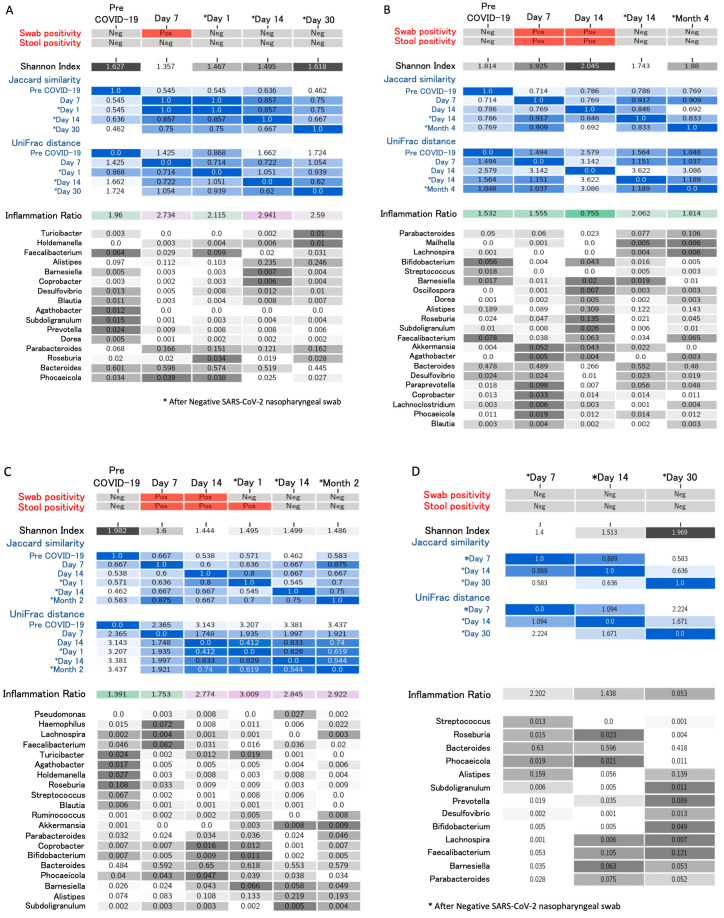
Virological characteristics, alpha and beta indexes, and bacteria relative abundance over time. (AF) correspond to patients P1 to P6, respectively. For each patient, swab positivity, stool positivity, Shannon index, Jaccard similarity, UniFrac distance, inflammation ratio, and pathogen relative abundance are reported over time. The asterisks on the days indicate stool collection after negativization of SARS-CoV-2 nasopharyngeal swab. Darker colors correspond to increased values.
Figure 3
Figure 3
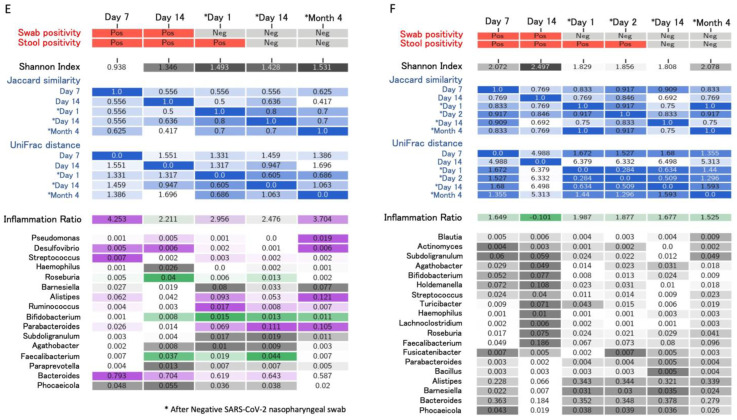
Virological characteristics, alpha and beta indexes, and bacteria relative abundance over time. (AF) correspond to patients P1 to P6, respectively. For each patient, swab positivity, stool positivity, Shannon index, Jaccard similarity, UniFrac distance, inflammation ratio, and pathogen relative abundance are reported over time. The asterisks on the days indicate stool collection after negativization of SARS-CoV-2 nasopharyngeal swab. Darker colors correspond to increased values.
Figure 4
Figure 4
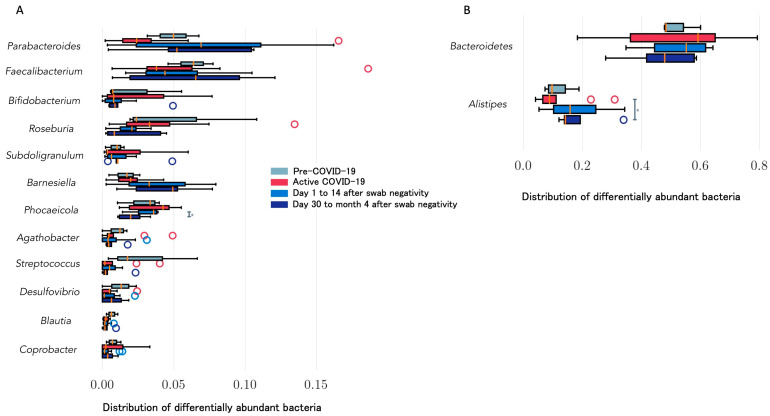
Comparison of bacterial relative abundances before and after SARS-CoV-2 infection according to low (A) and high (B) overall abundance. Relative abundance of pathogens with at least 3 values available for each time point are reported. Time points included pre-COVID assessment, active disease (e.g., day 7 and day 14 after symptom onset), post negativization (e.g., day 7 and day 14 following nasopharyngeal swab negativity for SARS-CoV-2), and follow-up (e.g., day 30, month 2, and month 4 following nasopharyngeal swab negativity). Asterisks indicate significant differences (p < 0.05).
Figure 5
Figure 5
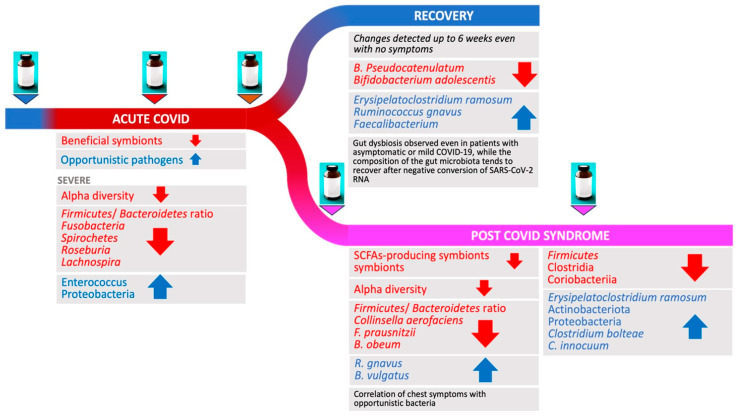
Most common gut microbiome changes (red arrow: increase; blue arrows: decrease) re-ported during SARS-CoV-2 infections, from acute disease to recovery or post-acute COVID syn-drome. The treatment icons represent the potential timing for intervention opportunities (e.g., before disease onset, as prevention; during acute disease; before and during post-acute syndrome).

References

    1. Zuo T., Zhan H., Zhang F., Liu Q., Tso E.Y.K., Lui G.C.Y., Chen N., Li A., Lu W., Francis K., et al. Alterations in Fecal Fungal Microbiome of Patients With COVID-19 During Time of Hospitalization until Discharge. Gastroenterology. 2020;159:1302–1310.e5. doi: 10.1053/j.gastro.2020.06.048. - DOI - PMC - PubMed
    1. Zhou B., Pang X., Wu J., Liu T., Wang B., Cao H. Gut microbiota in COVID-19: New insights from inside. Gut Microbes. 2023;15:2201157. doi: 10.1080/19490976.2023.2201157. - DOI - PMC - PubMed
    1. Zhang F., Lau R.I., Liu Q., Su Q., Chan F.K.L., Ng S.C. Gut microbiota in COVID-19: Key microbial changes, potential mechanisms and clinical applications. Nat. Rev. Gastroenterol. Hepatol. 2023;20:323–337. doi: 10.1038/s41575-022-00698-4. - DOI - PMC - PubMed
    1. Righi E., Lambertenghi L., Gorska A., Sciammarella C., Ivaldi F., Mirandola M. Assunta Sartor, Evelina Tacconelli. Impact of COVID-19 and Antibiotic Treatments on Gut Microbiome: A Role for Enterococcus spp. Biomedicines. 2022;10:2786. doi: 10.3390/biomedicines10112786. - DOI - PMC - PubMed
    1. Post COVID-19 Condition (Long COVID) [Internet] [(accessed on 3 October 2023)]. Available online: https://www.who.int/europe/news-room/fact-sheets/item/post-covid-19-cond....

LinkOut - more resources