


The Continuous Fragility Index of Statistically Significant Findings in Randomized Controlled Trials That Compare Interventions for Anterior Shoulder Instability
- PMID: 38258495
- PMCID: PMC11344964
- DOI: 10.1177/03635465231202522
The Continuous Fragility Index of Statistically Significant Findings in Randomized Controlled Trials That Compare Interventions for Anterior Shoulder Instability
Abstract
Background: Evidence-based care relies on robust research. The fragility index (FI) is used to assess the robustness of statistically significant findings in randomized controlled trials (RCTs). While the traditional FI is limited to dichotomous outcomes, a novel tool, the continuous fragility index (CFI), allows for the assessment of the robustness of continuous outcomes.
Purpose: To calculate the CFI of statistically significant continuous outcomes in RCTs evaluating interventions for managing anterior shoulder instability (ASI).
Study design: Meta-analysis; Level of evidence, 2.
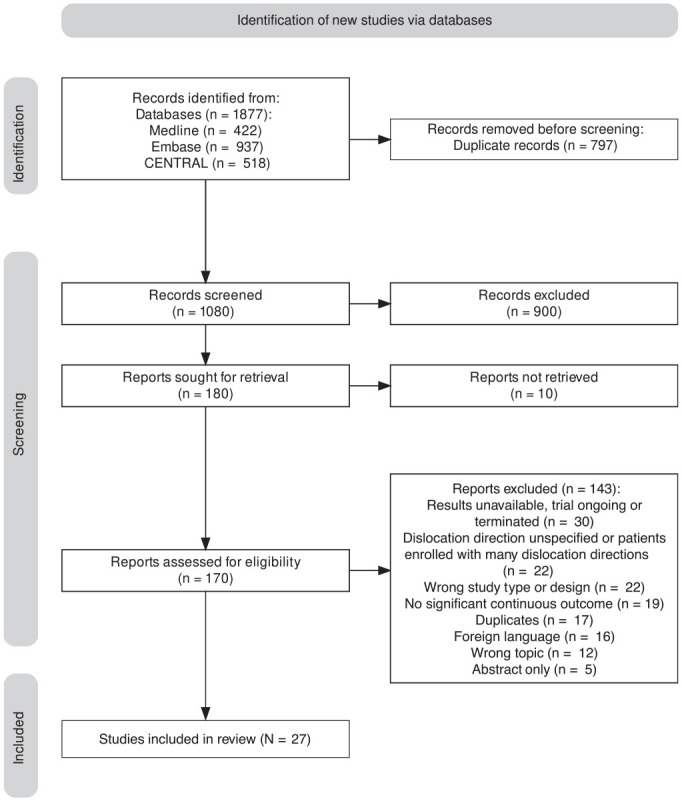
Methods: A search was conducted across the MEDLINE, Embase, and CENTRAL databases for RCTs assessing management strategies for ASI from inception to October 6, 2022. Studies that reported a statistically significant difference between study groups in ≥1 continuous outcome were included. The CFI was calculated and applied to all available RCTs reporting interventions for ASI. Multivariable linear regression was performed between the CFI and various study characteristics as predictors.
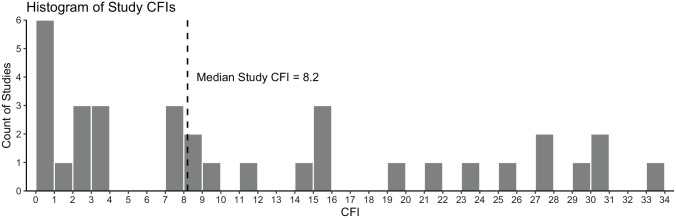
Results: There were 27 RCTs, with a total of 1846 shoulders, included. The median sample size was 61 shoulders (IQR, 43). The median CFI across 27 RCTs was 8.2 (IQR, 17.2; 95% CI, 3.6-15.4). The median CFI was 7.9 (IQR, 21; 95% CI, 1-22) for 11 studies comparing surgical methods, 22.6 (IQR, 16; 95% CI, 8.2-30.4) for 6 studies comparing nonsurgical reduction interventions, 2.8 for 3 studies comparing immobilization methods, and 2.4 for 3 studies comparing surgical versus nonsurgical interventions. Significantly, 22 of 57 included outcomes (38.6%) from studies with completed follow-up data had a loss to follow-up exceeding their CFI. Multivariable regression demonstrated that there was a statistically significant positive correlation between a trial's sample size and the CFI of its outcomes (r = 0.23 [95% CI, 0.13-0.33]; P < .001).
Conclusion: More than a third of continuous outcomes in ASI trials had a CFI less than the reported loss to follow-up. This carries the significant risk of reversing trial findings and should be considered when evaluating available RCT data. We recommend including the FI, CFI, and loss to follow-up in the abstracts of future RCTs.
Keywords: continuous fragility index; fragility index; shoulder general; shoulder instability; statistical significance; statistics.
Conflict of interest statement
One or more of the authors has declared the following potential conflict of interest or source of funding: O.R.A. has received speaking fees from Conmed and is a tier 2 Canada Research Chair in Joint Preservation Surgery. AOSSM checks author disclosures against the Open Payments Database (OPD). AOSSM has not conducted an independent investigation on the OPD and disclaims any liability or responsibility relating thereto.
Figures
References
-
- Abrams R, Akbarnia H. Shoulder dislocations overview. In: StatPearls. StatPearls Publishing; 2022. Accessed January 12, 2023. http://www.ncbi.nlm.nih.gov/books/NBK459125/ - PubMed
-
- Akcimen M, Bedel C. Comparison between new modified external rotation method and external rotation method for reduction of ASD. Am J Emerg Med. 2020;38(5):874-878. - PubMed
-
- Amar E, Maman E, Khashan M, et al. Milch versus Stimson technique for nonsedated reduction of anterior shoulder dislocation: a prospective randomized trial and analysis of factors affecting success. J Shoulder Elbow Surg. 2012;21(11):1443-1449. - PubMed
-
- Amrhein V, Greenland S, McShane B. Scientists rise up against statistical significance. Nature. 2019;567(7748):305-307. - PubMed
-
- Belk JW, Wharton BR, Houck DA, et al. Shoulder stabilization versus immobilization for first-time anterior shoulder dislocation: a systematic review and meta-analysis of level 1 randomized controlled trials. Am J Sports Med. 2023;51(6):1634-1643. - PubMed
Publication types
MeSH terms
LinkOut - more resources
Full Text Sources
Miscellaneous
