. 2024 Feb 21;90(2):e0175323.
doi: 10.1128/aem.01753-23. Epub 2024 Jan 23.

Identification and characterization of methoxy- and dimethoxyhydroquinone 1,2-dioxygenase from Phanerochaete chrysosporium

Affiliations

Identification and characterization of methoxy- and dimethoxyhydroquinone 1,2-dioxygenase from Phanerochaete chrysosporium

Hiroyuki Kato et al. Appl Environ Microbiol. .

Abstract

White-rot fungi, such as Phanerochaete chrysosporium, are the most efficient degraders of lignin, a major component of plant biomass. Enzymes produced by these fungi, such as lignin peroxidases and manganese peroxidases, break down lignin polymers into various aromatic compounds based on guaiacyl, syringyl, and hydroxyphenyl units. These intermediates are further degraded, and the aromatic ring is cleaved by 1,2,4-trihydroxybenzene dioxygenases. This study aimed to characterize homogentisate dioxygenase (HGD)-like proteins from P. chrysosporium that are strongly induced by the G-unit fragment of vanillin. We overexpressed two homologous recombinant HGDs, PcHGD1 and PcHGD2, in Escherichia coli. Both PcHGD1 and PcHGD2 catalyzed the ring cleavage in methoxyhydroquinone (MHQ) and dimethoxyhydroquinone (DMHQ). The two enzymes had the highest catalytic efficiency (kcat/Km) for MHQ, and therefore, we named PcHGD1 and PcHGD2 as MHQ dioxygenases 1 and 2 (PcMHQD1 and PcMHQD2), respectively, from P. chrysosporium. This is the first study to identify and characterize MHQ and DMHQ dioxygenase activities in members of the HGD superfamily. These findings highlight the unique and broad substrate spectra of PcHGDs, rendering them attractive candidates for biotechnological applications.IMPORTANCEThis study aimed to elucidate the properties of enzymes responsible for degrading lignin, a dominant natural polymer in terrestrial lignocellulosic biomass. We focused on two homogentisate dioxygenase (HGD) homologs from the white-rot fungus, P. chrysosporium, and investigated their roles in the degradation of lignin-derived aromatic compounds. In the P. chrysosporium genome database, PcMHQD1 and PcMHQD2 were annotated as HGDs that could cleave the aromatic rings of methoxyhydroquinone (MHQ) and dimethoxyhydroquinone (DMHQ) with a preference for MHQ. These findings suggest that MHQD1 and/or MHQD2 play important roles in the degradation of lignin-derived aromatic compounds by P. chrysosporium. The preference of PcMHQDs for MHQ and DMHQ not only highlights their potential for biotechnological applications but also underscores their critical role in understanding lignin degradation by a representative of white-rot fungus, P. chrysosporium.

Keywords: homogentisate dioxygenase; lignin; syringic acid; vanillic acid; white-rot fungus.


Conflict of interest statement

The authors declare no conflict of interest.

Figures
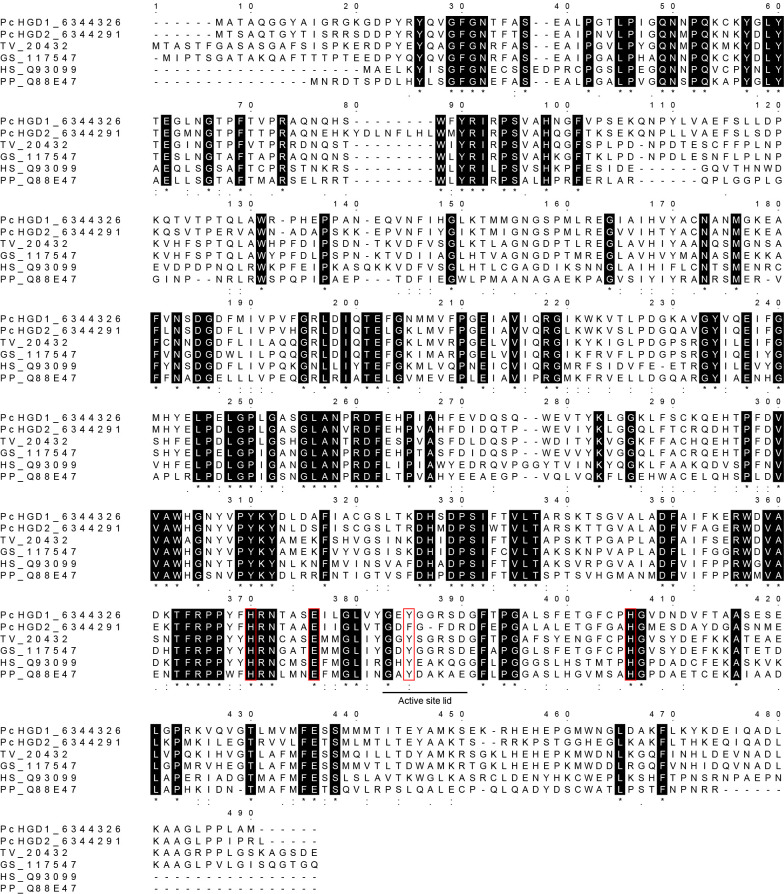
Fig 1
Fig 1
Amino acid sequence alignment of HGD homologs. Sequences of PcHGD1 (protein ID 6344326), PcHGD2 (6344291), and HGD from Trametes versicolor (TV_20432), Gelatoporia subvermispora (GS_117547), Homo sapiens (Q93099), and Pseudomonas putida (Q88E47) are shown. The protein IDs for H. sapiens and P. putida were obtained from the UniProt Knowledgebase (http://beta.uniprot.org), and those for the other species were obtained from the JGI Genome Portal (https://mycocosm.jgi.doe.gov/Phchr4_2/Phchr4_2.home.html). The residues in the red boxes are responsible for active-site non-heme ferric iron coordination and catalytic activity in HGD. The sequences were aligned using ClustalW program (https://www.genome.jp/tools-bin/clustalw). The active site lid is underlined.
Fig 2
Fig 2
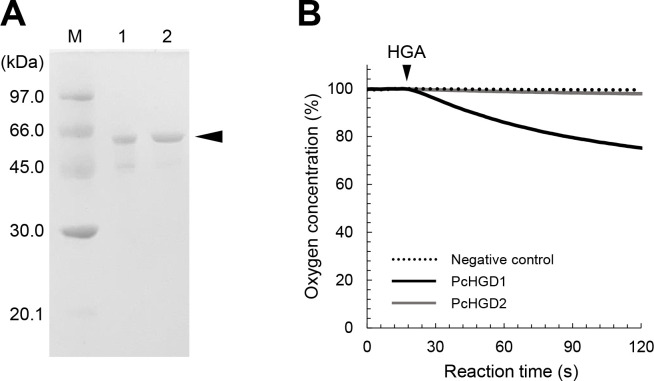
Preparation of recombinant PcHGD1 and PcHGD2 and oxygen consumption during HGD reactions with HGA as a substrate. (A) SDS-PAGE analysis of purified PcHGD1 (lane 1) and PcHGD2 (lane 2). (B) Oxygen consumption during HGD reactions with HGA. Consumption of oxygen was monitored using a Clark O2 electrode. The arrow indicates the addition of a substrate to the reaction mixture.
Fig 3
Fig 3
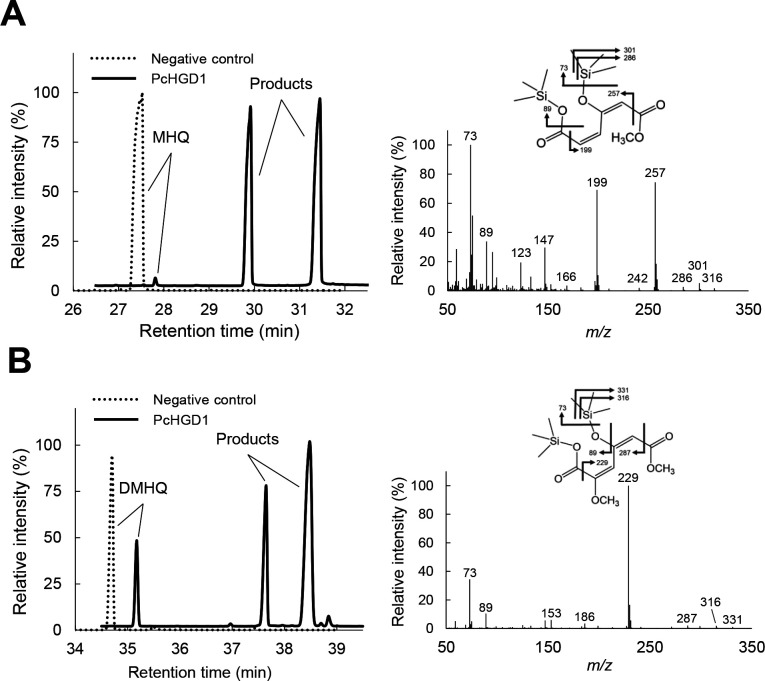
Total ion chromatograms and mass spectra of the reaction products generated by PcHGD1 from MHQ (A) and DMHQ (B) as substrates. The TMS-derivatized reaction products were analyzed using GC-MS. The mass spectra (A, 4-hydroxy-6-methoxy-6-oxohexa-2,4-dienoic acid; B, 4-hydroxy-2,6-dimethoxy-6-oxohexa-2,4-dienoic acid) of the reaction products were obtained from the GC peaks appearing at retention times 29.9 and 31.5 min (A) and 37.6 and 38.5 min (B). The experiment was performed three times, and representative results are shown.
Fig 4
Fig 4
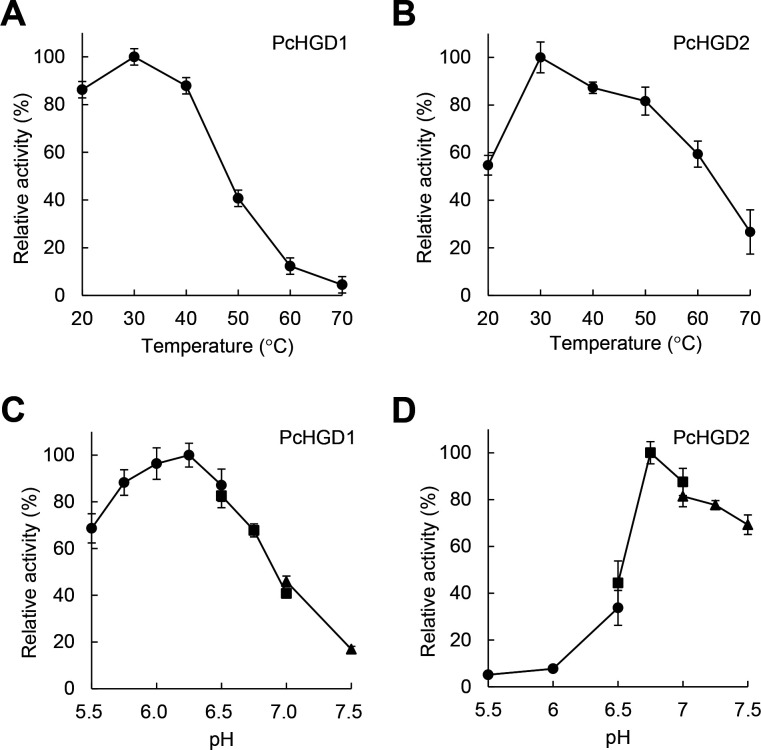
Optimal temperature and pH of PcHGD1 and PcHGD2. (A and B) Optimal temperatures for PcHGD1 and PcHGD2 determined using MHQ as the substrate. Enzyme reactions proceeded at temperatures ranging from 20°C to 70°C. (C and D) Optimal pH of PcHGD1 and PcHGD2. Enzyme reactions proceeded over a pH range of 5.5–8.0: in 50 mM MES (pH 5.0–6.5; ●), 50 mM MOPS (pH 6.5–7.0; ■), and 50 mM HEPES (pH 7.0–8.0; ▲). Data are presented as mean ± standard deviation of four independent experiments.
Fig 5
Fig 5
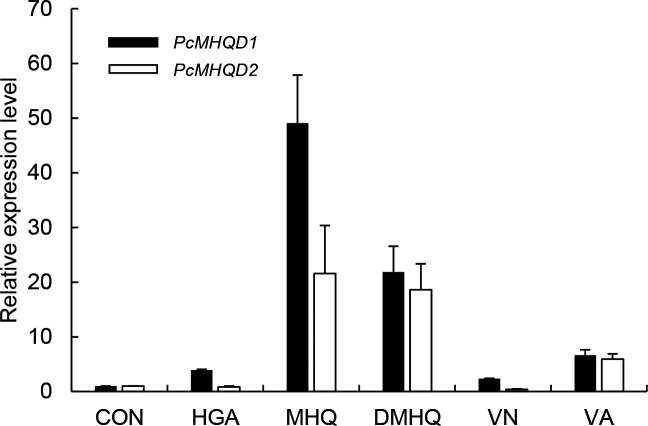
Gene expression profiles of PcMHQD1 and PcMHQD2 in P. chrysosporium in response to exogenous HGA, MHQ, DMHQ, VN, and VA. The abundance of amplified cDNA fragments of PcMHQD1 and PcMHQD2 transcripts was normalized using ACT1 as the reference gene. The normalized expression of each gene in the fungus upon 6 h exposure to HGA, MHQ, DMHQ, VN, and VA relative to the normalized expression in the absence of the substrate is shown. Data are presented as mean ± standard deviation (error bars) of three independent experiments.
Fig 6
Fig 6
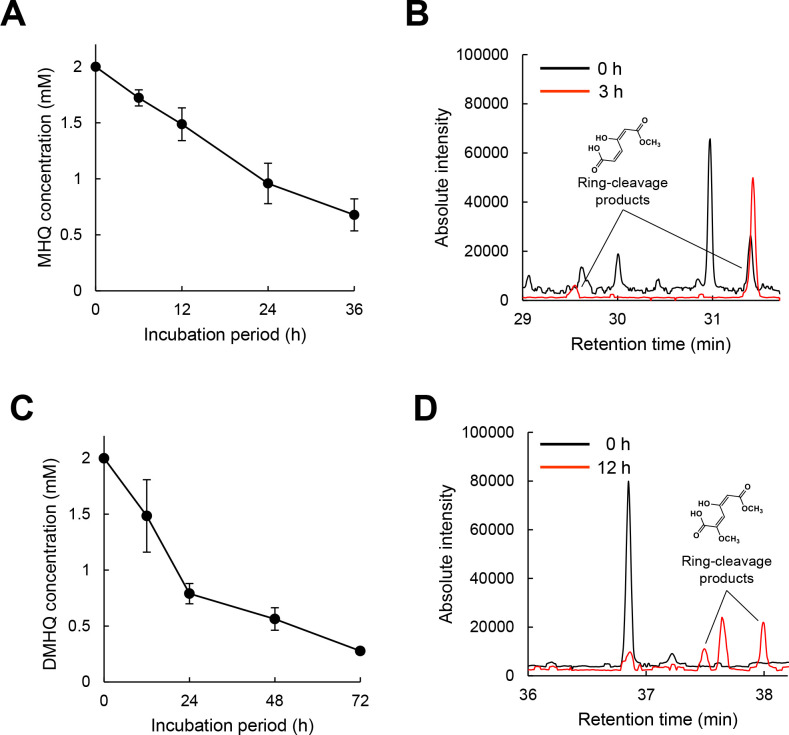
Fungal metabolism of methoxyhydroquinone and dimethoxyhydroquinone. The time course of MHQ and DMHQ (A and C) metabolisms was monitored. After a 2-day pre-incubation, MHQ and DMHQ were added to a final concentration of 2.0 mM. The ring-cleavage products of MHQ and DMHQ (B and D) were detected in the reaction solutions using the fungal cell lysate. MHQ and DMHQ were added to a final concentration of 2.0 mM. After 3 or 12 h of incubation with MHQ or DMHQ, reaction products were identified using GC-MS. Data are presented as mean ± standard deviation of three independent experiments.
Fig 7
Fig 7
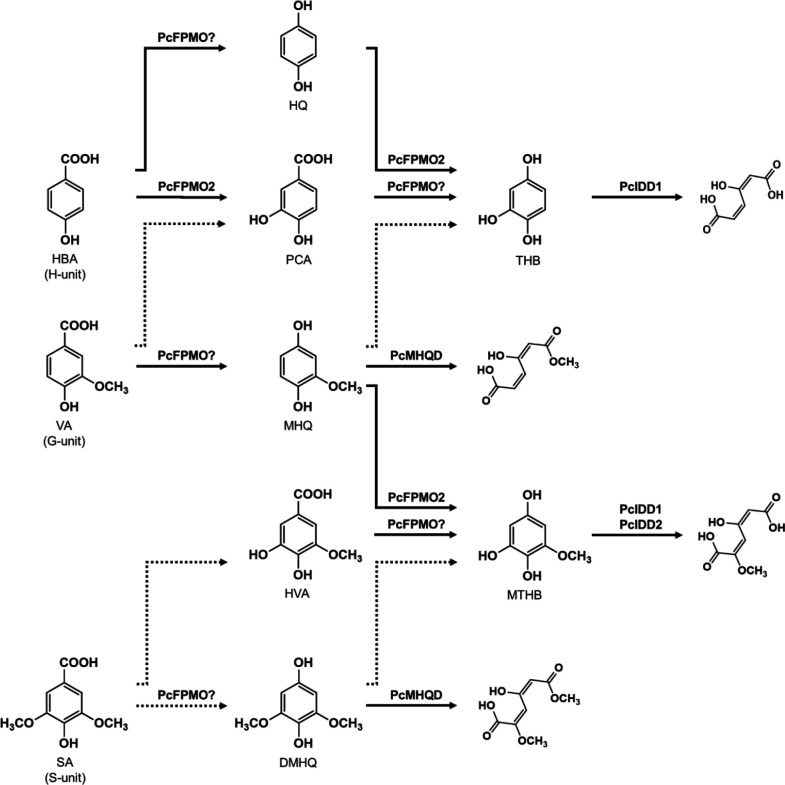
Metabolic pathways of HBA, VA, and SA in the white-rot fungus P. chrysosporium. HBA is estimated to convert to hydroquinone and protocatechuic acid (PCA). HQ is hydroxylated to THB by PcFPMO2 (12), while PCA is decarboxylated to THB, which is then ring cleaved by intradiol dioxygenase 1 (PcIDD1) (11, 13). VA is estimated to convert to PCA and MHQ. MHQ is ring cleaved (this study) or be converted to THB and MTHB, which are then cleaved (10–13). SA is estimated to convert to hydroxyl vanillic acid (HVA) and DMHQ. HVA is converted to MTHB, while DMHQ is ring cleaved (this study) or may be converted to MTHB. Dotted arrows indicate the estimated reactions; solid arrows indicate the reactions by identified enzymes: PcMHQD (this study), PcFPMO2 (12), PcIDD1(13), and PcIDD2 (13).

References

    1. Sugiarto S, Leow Y, Tan CL, Wang G, Kai D. 2022. How far is lignin from being a biomedical material? Bioact Mater 8:71–94. doi:10.1016/j.bioactmat.2021.06.023 - DOI - PMC - PubMed
    1. Sarkanen KV, Ludwig CH. 1971. Lignins: occurrence, formation, structure and reactions. J Polym Sci B Polym Phys 10:228–230.
    1. Crawford RL. 1982. Lignin biodegradation and transformation. Enzyme Microb Technol 4:285. doi:10.1016/0141-0229(82)90047-3 - DOI
    1. Tien M. 1987. Properties of ligninase from Phanerochaete chrysosporium and their possible applications. Crit Rev Microbiol 15:141–168. doi:10.3109/10408418709104456 - DOI - PubMed
    1. Kirk TK, Farrell RL. 1987. Enzymatic "combustion": the microbial degradation of lignin. Annu Rev Microbiol 41:465–505. doi:10.1146/annurev.mi.41.100187.002341 - DOI - PubMed

Publication types

MeSH terms

LinkOut - more resources