Review
. 2024 Jan 8:14:1304365.
doi: 10.3389/fimmu.2023.1304365. eCollection 2023.

Impact of structural modifications of IgG antibodies on effector functions

Affiliations
Review

Impact of structural modifications of IgG antibodies on effector functions

Timon Damelang et al. Front Immunol. .

Abstract

Immunoglobulin G (IgG) antibodies are a critical component of the adaptive immune system, binding to and neutralizing pathogens and other foreign substances. Recent advances in molecular antibody biology and structural protein engineering enabled the modification of IgG antibodies to enhance their therapeutic potential. This review summarizes recent progress in both natural and engineered structural modifications of IgG antibodies, including allotypic variation, glycosylation, Fc engineering, and Fc gamma receptor binding optimization. We discuss the functional consequences of these modifications to highlight their potential for therapeutical applications.

Keywords: FcγR; IgG; allotypes; antibodies; complement; glycosylation; subclasses.


Conflict of interest statement

TD, JS, and AL were employed by and/or own warrants and/or stocks in Genmab. The work of MB was funded by argenx. JS and AL are inventors of patents/pending patent applications on technologies and mutations mentioned in this review. GV serves as a consultant for argenx. Genmab and argenx are both biotechnology companies that develop therapeutic antibodies. The remaining authors declare that the research was conducted in the absence of any commercial or financial relationships that could be construed as a potential conflict of interest.

Figures
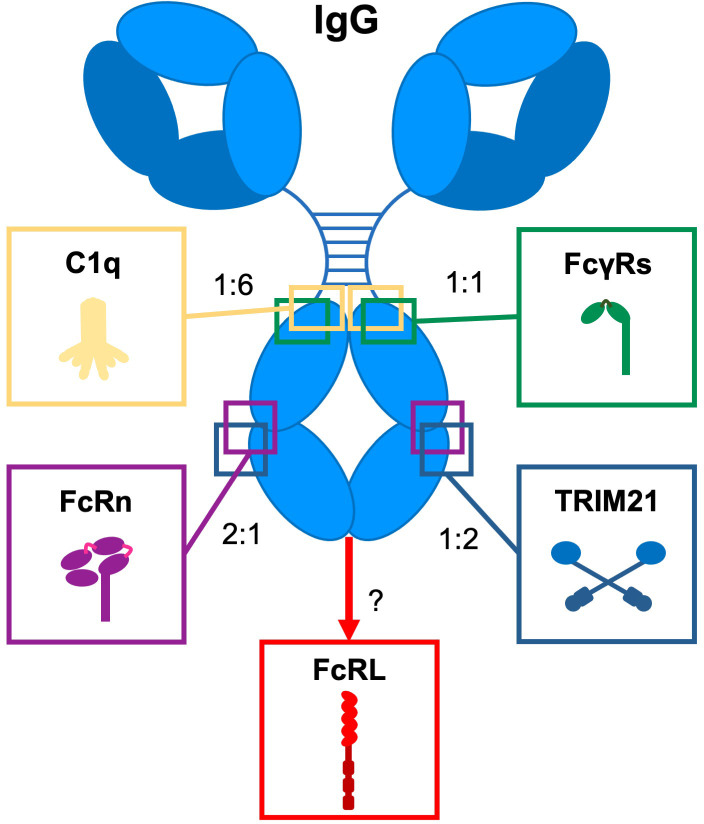
Figure 1
Figure 1
Interaction of IgG with Fc effector molecules. Schematic representation of IgG and its Fc-engaging molecules (complement component (C1q), Fc gamma receptors (FcγRs), the neonatal Fc receptor (FcRn), Tripartite motif 21 (TRIM21), and Fc receptor-like (FcRL) molecules through which antibodies exert their biological activity. For each ligand, the binding site on IgG and the stoichiometry of the interaction with IgG is indicated. Adapted from (3).
Figure 2
Figure 2
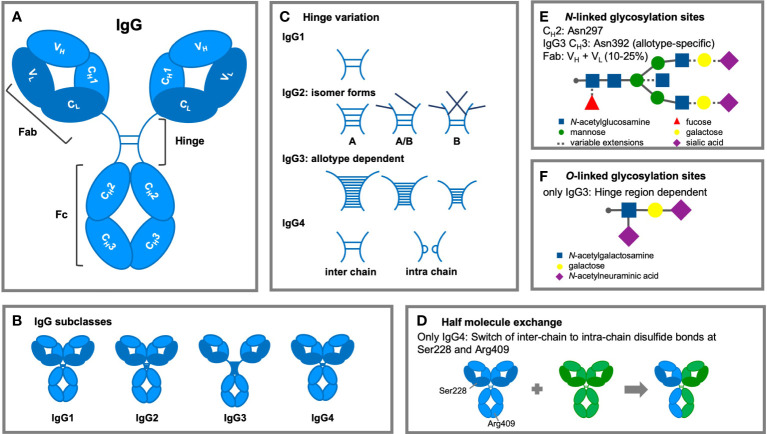
Structural modifications of IgG antibodies. (A) IgG1-4 antibodies consist of four polypeptide chains, composed of two identical heavy (H; light blue) chains of 50 kDa and two identical light (L; dark blue) chains of 25 KDa, linked together by interchain disulfide bonds. Each H chain consists of an N-terminal variable domain (VH) and three constant domains (CH1, CH2, and CH3). IgG molecules are joined by a flexible stretch of polypeptide chain between CH1 and CH2, known as the hinge region. The VH and CH1 domains and the L chains form the fragment antigen binding (Fab) region. The lower hinge region and the CH2/CH3 domains form the fragment crystalline (Fc) region, which interacts with effector molecules and cells. (B) The length (IgG1: 15 amino acid residues, IgG2: 12 residues, IgG3: 32-64 residues, and IgG4: 12 residues) and flexibility of the hinge region varies among the IgG subclasses. (C) Subclass differences in hinge flexibility are also impacted by differential number of inter-chain disulfide bonds (IgG3: 11 bonds; IgG1 & IgG4: two bonds; IgG2: four bonds), both IgG2 and IgG4 are found as several isomers. Darker disulfide bonds indicate that they are linked to the light chain due to light chain reshuffling of the C-C bonds. (D) IgG4 antibodies can split into two half-molecules (one H chain + one L chain) that can then randomly form complete monovalent-bispecific Abs, which is either termed half molecule exchange or Fab arm exchanged. (E) Within the CH2 region is one N-linked glycosylation site containing carbohydrate groups attached to asparagine 297. The highly conserved glycan has a heptasaccharide core and variable extensions, such as fucose, galactose and/or sialic acid (dashed line). Additional N-linked sites have been reported in the antigen-binding region and allotypic variants of IgG3 at position asparagine 392. (F) The hinge region of IgG3 exhibits O-linked glycosylation sites.
Figure 3
Figure 3
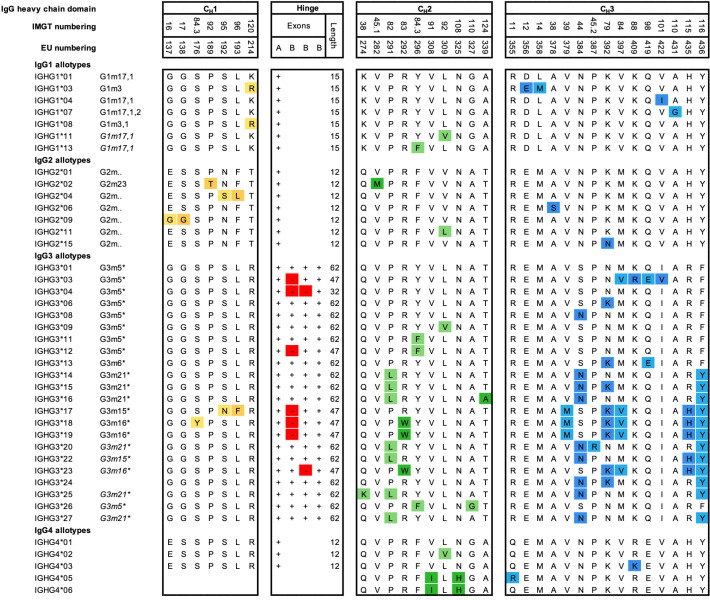
Amino acid variation between IgG allotypes. Variation at the amino acid level between IgG allotypes within the IgG1, IgG2, IgG3, and IgG4 subclasses according to the Reference to ImMunoGeneTics information system (IMGT). For each domain, CH1, hinge, CH2 and CH3, amino acid differences between polymorphic variants are indicated. Polymorphisms in the hinge region are identified by the presence or absence of hinge exons (A, B) (3). Additional ‘silent’ mutations exist but are only visible on the genetic level. Historical nomenclature (Gm), based on serology, are included, but indicated in italics for new alleles, that have not been assigned a name to in accordance with Gm system.
Figure 4
Figure 4
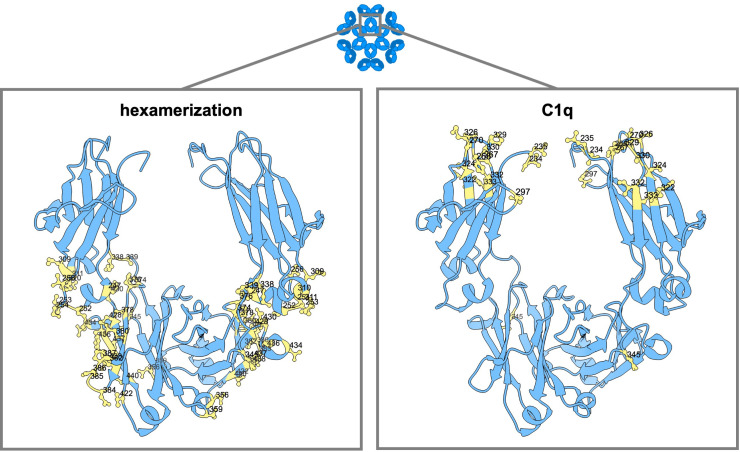
Amino acid mutation sites with impact on IgG hexamerization and C1q binding. Ribbon structure of dimeric IgG-Fc regions with highlighted amino acids involved in antibody hexamerization and Fc interaction with complement (C1q).
Figure 5
Figure 5
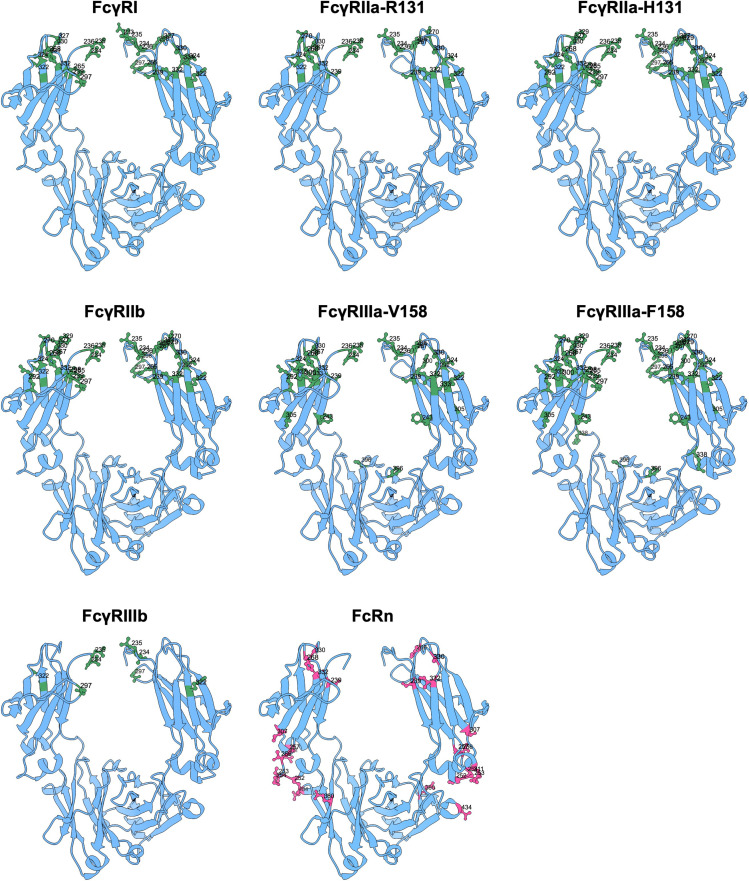
Amino acid mutation sites with impact on FcγR and FcRn binding. Ribbon structure of dimeric IgG-Fc regions with highlighted amino acids involved in FcγR and FcRn binding.

References

    1. Rogentine GN, Rowe DS, Bradley J.A., Waldmann TA, Fahey JL. Metabolism of human immunoglobulin D (IgD). J Clin Invest (1966) 45:1467–78. doi: 10.1172/JCI105454 - DOI - PMC - PubMed
    1. Waldmann TA, Iio A, Ogawa M, McIntyre OR, Strober W. The metabolism of IgE: studies in normal individuals and in a patient with IgE myeloma. J Immunol (1976) 117:1139–44. doi: 10.4049/jimmunol.117.4.1139 - DOI - PubMed
    1. de Taeye S, Bentlage AEH, Mebius MM, Meesters JI, Lissenberg-Thunnissen S, Falck D, et al. FcγR binding and ADCC activity of human IgG allotypes. Front Immunol (2020) 11:740–0. doi: 10.3389/fimmu.2020.00740 - DOI - PMC - PubMed
    1. de Taeye SW, Rispens T, Vidarsson G. The ligands for human IgG and their effector functions. Antibodies (2019) 8:30–0. doi: 10.3390/antib8020030 - DOI - PMC - PubMed
    1. Michaelsen TE, Sandlie I, Bratlie DB, Sandin RH, Ihle O. Structural difference in the complement activation site of human IgG1 and IgG3. Scandinavian J Immunol (2009) 70:553–64. doi: 10.1111/j.1365-3083.2009.02338.x - DOI - PubMed

Publication types

LinkOut - more resources