


Risk of Death and Cardiovascular Events Following an Exacerbation of COPD: The EXACOS-CV US Study
- PMID: 38259591
- PMCID: PMC10802125
- DOI: 10.2147/COPD.S438893
Risk of Death and Cardiovascular Events Following an Exacerbation of COPD: The EXACOS-CV US Study
Abstract
Purpose: This study estimated the magnitude and duration of risk of cardiovascular events and mortality following acute exacerbations of chronic obstructive pulmonary disease (AECOPD), and whether risks varied by number and severity of exacerbation in a commercially insured population in the United States.
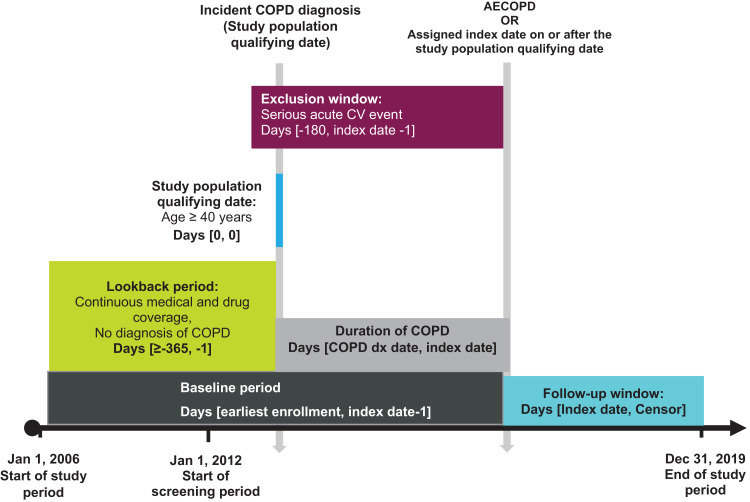
Methods: This was a retrospective cohort study of newly diagnosed COPD patients ≥40 years old in the Healthcare Integrated Research Database from 2012 to 2019. Patients experiencing exacerbations comprised the "exacerbation cohort". Moderate exacerbations were outpatient visits with contemporaneous antibiotic or glucocorticoid administration; severe exacerbations were emergency department visits or hospitalizations for AECOPD. Follow-up started on the exacerbation date. Distribution of time between diagnosis and first exacerbation was used to assign index dates to the "unexposed" cohort. Cox proportional hazards models estimated risks of a cardiovascular event or death following an exacerbation adjusted for medical and prescription history and stratified by follow-up time, type of cardiovascular event, exacerbation severity, and rank of exacerbation (first, second, or third).
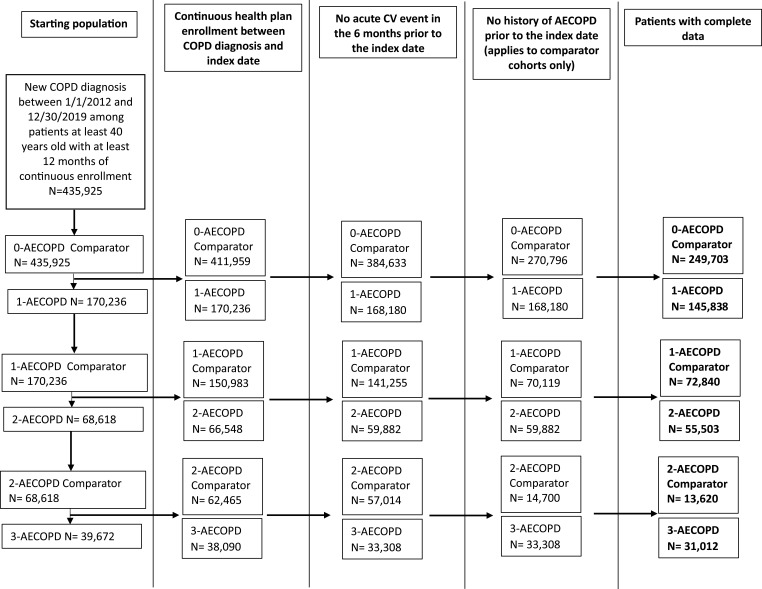
Results: Among 435,925 patients, 170,236 experienced ≥1 exacerbation. Risk of death was increased for 2 years following an exacerbation and was highest during the first 30 days (any exacerbation hazard ratio (HR)=1.79, 95% CI=1.58-2.04; moderate HR=1.22, 95% CI=1.04-1.43; severe HR=5.09, 95% CI=4.30-6.03). Risks of cardiovascular events were increased for 1 year following an AECOPD and highest in the first 30-days (any exacerbation HR=1.34, 95% CI=1.23-1.46; moderate HR=1.23 (95% CI 1.12-1.35); severe HR=1.93 (95% CI=1.67-2.22)). Each subsequent AECOPD was associated with incrementally higher rates of both death and cardiovascular events.
Conclusion: Risk of death and cardiovascular events was greatest in the first 30 days and rose with subsequent exacerbations. Risks were elevated for 1-2 years following moderate and severe exacerbations, highlighting a sustained increased cardiopulmonary risk associated with exacerbations.
Keywords: COPD; cardiac events; cardiopulmonary; epidemiology; longitudinal studies.
© 2024 Daniels et al.
Conflict of interest statement
KD, SL, AT, and AN are employees of Carelon Research, Inc., which received funding for the conduct of this study from AstraZeneca. KD and SL are stockholders of Elevance Health. MP, KR CN, and NF are employees and stockholders of AstraZeneca. DM has received payment for consultant services from AstraZeneca and GSK; personal fees from Up to Date, personal fees from Genentech; and has been an expert witness for the Schlesinger Law Firm. GC has received research grant funding and payment for consultant services from AstraZeneca, GSK, and Chiesi Farmaceutici, and received payment or honoraria for lectures, presentations, speakers bureaus, manuscript writing, or educational events from Pulmonx. The authors report no other conflicts on interest in this work.
Figures
References
-
- Hacker K. COPD Death Rates in the United States. Centers for disease control and prevention. Chronic Obstructive Pulmonary Disease (COPD) Web site; 2021. Available from: https://www.cdc.gov/copd/data.html. Accessed October 18, 2021.
Publication types
MeSH terms
Substances
LinkOut - more resources
Full Text Sources
Medical
