[Preprint]. 2025 May 29:2024.01.08.23300523.
doi: 10.1101/2024.01.08.23300523.

Heterozygous variants in PLCG1 affect hearing, vision, cardiac, and immune function

Affiliations

Heterozygous variants in PLCG1 affect hearing, vision, cardiac, and immune function

Mengqi Ma et al. medRxiv. .

Update in

  • Heterozygous variants in PLCG1 affect hearing, vision, cardiac, and immune function.
    Ma M, Zheng Y, Deng M, Lu S, Pan X, Luo X, Etoundi M, Li-Kroeger D, Worley KC, Burrage LC, Blieden LS, Allworth A, Chen WL, Merla G, Mandriani B, Otten CE, Blanc P, Rosenfeld JA, Dutta D, Yamamoto S, Wangler MF, Glass IA, Chen J, Blue E, Prontera P, Rosain J, Marlin S, Lalani SR, Bellen HJ; Undiagnosed Diseases Network. Ma M, et al. Elife. 2025 Aug 27;13:RP95887. doi: 10.7554/eLife.95887. Elife. 2025. PMID: 40862571 Free PMC article.

Abstract

Phospholipase C isozymes (PLCs) hydrolyze phosphatidylinositol 4,5-bisphosphate (PIP2) into inositol 1,4,5-trisphosphate (IP3) and diacylglycerol (DAG), important signaling molecules involved in many cellular processes including Ca2+ release from the endoplasmic reticulum (ER). PLCG1 encodes the PLCγ1 isozyme that is broadly expressed. Hyperactive somatic mutations of PLCG1 are observed in multiple cancers, but only one germline variant has been reported. Here we describe seven individuals with heterozygous missense variants in PLCG1 [p.(Asp1019Gly), p.(His380Arg), p.(Asp1165Gly), and p.(Leu597Phe)] who present with hearing impairment (5/7), ocular pathology (4/7), cardiac septal defects (3/6), and various immunological issues (5/7). To model these variants in vivo, we generated the analogous variants in the Drosophila ortholog, small wing (sl). We created a null allele sl T2A and assessed its expression pattern. sl is broadly expressed, including wing discs, eye discs, and a subset of neurons and glia. sl T2A mutant flies exhibit wing size reductions, ectopic wing veins, and supernumerary photoreceptors. We document that mutant flies also exhibit a reduced lifespan and age-dependent locomotor defects. Expressing wild-type sl in sl T2A mutant flies rescues the loss-of-function phenotypes, whereas the variants increase lethality. Ectopic expression of an established hyperactive PLCG1 variant, p.(Asp1165His) in the wing pouch causes elevated Ca2+ activity and severe wing phenotypes. These phenotypes are also observed when the p.(Asp1019Gly) or p.(Asp1165Gly) variants are overexpressed in the wing pouch, arguing that these are gain-of-function variants. However, the wing phenotypes associated with p.(His380Arg) or p.(Leu597Phe) overexpression are either mild or only partially penetrant. Our data suggest that the heterozygous missense variants reported here affect protein function differentially and contribute to the clinical features observed in the affected individuals.

Keywords: Drosophila; Phospholipase C; phenotypic heterogeneity.


Conflict of interest statement

Conflict of Interest Statement The Department of Molecular and Human Genetics at Baylor College of Medicine receives revenue from clinical genetic testing completed at Baylor Genetics Laboratories.

Figures

Figure 1.
Figure 1.. The PLCG1 ortholog is small wing (sl) in Drosophila
(A) Schematic of human PLCG1 and fly Sl protein domains and positions of the variants identified in the affected individuals. Domain prediction is based on annotation from NCBI. (B) Alignment of protein domains near variants of PLCG1 and PLCG2 with PLCG1 from other species. The variants are marked with boxes. All the variants affect conserved amino acids (labeled in red). Isoforms for alignment: Human PLCG1 NP_877963.1; Human PLCG2 NP_002652.2; Mouse Plcg1 NP_067255.2; Zebrafish plcg1 NP_919388.1; Fly sl NP_476726.2. (C) Schematic of fly sl genomic span, transcript, alleles and the 92kb genomic rescue (GR) construct. Loss-of-function alleles of sl including sl2 (13bp deletion (Thackeray et al. 1998)), slKO (CRISPR-mediated deletion of the gene span (Trivedi et al. 2020)), and slT2A (T2A cassette inserted in the first intron, (Lee et al. 2018)) are indicated. The T2A cassette in slT2A is flanked by FRT sites and can be excised by Flippase to revert loss-of-function phenotypes. GAL4 expression in slT2A is driven by the endogenous sl promoter, allowing assessment of sl gene expression pattern with a UAS-mCherry.nls reporter line. This system also allows in vivo modeling of proband-associated variants by crossing with human PLCG1 cDNAs or corresponding fly sl cDNAs. The primer pair used for real-time PCR is indicated.
Figure 2.
Figure 2.. slT2A is a loss-of-function allele that affect fly wing and eye development
(A) sl expression in wing and eye dises. Expression of UAS-mcherry.nls (red) was driven by slT2A to label the nuclei of the cells that expressed sl. sl is expressed in the 3rd instar larval wing disc (left) and eye disc (right). Higher magnification image of the wing disc pouch region indicated by dashed rectangle is shown. The posterior/anterior and dorsal/ventral compartment boundaries are indicated by dashed lines in yellow. Scale bars, 100μm (B) slT2A causes a wing size reduction and ectopic veins (arrowhead) in hemizygous mutant male flies. The wing phenotypes can be rescued by introduction of a genomic rescue (GR) construct or the expression of Flippase. Scale bars, 0.5mm. The quantification of adult wing size is shown in the right panel. Each dot represents the measurement of one adult wing sample. Unpaired t test, ****p < 0.0001, mean ± SEM. (C) slT2A causes extra photoreceptors (arrows) in the hemizygous mutant flies. The eye phenotype can be rescued by introduction of a genomic rescue (GR) construct. The photoreceptor rhabdomeres stain positive for phalloidin labeling F-actin. Scale bars, 10μm. The quantification is shown in the right panel. Each dot represents the measurement of one retina sample. Unpaired t test, ****p < 0.0001, mean ± SEM.
Figure 3.
Figure 3.
sl is expressed in a subset of neurons and glia in the CNS, and loss of sl causes behavioral defects (A) Expression pattern of sl in the central nervous system observed by slT2A-driven expression of UAS-mCherry.nls reporter (red). In either larval or adult brain, sl is expressed in a subset of fly neurons and glia, which were labeled by pan-neuronal marker Elav (green, upper panel) and pan-glia marker Repo (green, lower panel). Higher magnification images of the regions indicated by dashed rectangles are shown. Scale bars, 20μm in the magnified images, 50μm in other images. (B) Loss of sl causes defects in longevity and locomotion. slT2A hemizygous flies have a shorter lifespan than w1118 control flies. The median lifespan of slT2A and w1118 flies is 40 days and 62 days respectively. The shorter lifespan of slT2A flies can be rescued by a UAS transgene that expresses the wild-type sl cDNA (slWT). Fly locomotion was assessed by climbing assay (see methods). slT2A flies at the age of 7 days show reduced locomotion and become almost immotile at the age of 35 days. The reduced locomotion ability in slT2A flies can be fully rescued by slWT. For lifespan assay, Longrank test, ****p<0.0001. For climbing assay, each dot represents measurement of one vial containing 18–22 flies for test. Unpaired t test, ****p<0.0001.
Figure 4.
Figure 4.. The human and corresponding fly variants are toxic when expressed in flies
(A) Summary of the viability associated with expression of sl cDNAs in slT2A mutant or heterozygous flies. Cross strategy: heterozygous slT2A female flies were crossed to male flies carrying UAS-cDNAs or control (UAS-Empty) constructs, or crossed to the y w males as an extra control. The percentages of hemizygous slT2A/Y male progeny (red) or slT2A/yw heterozygous female progeny (blue) that express different UAS-cDNA constructs were calculated. The expected Mendelian ratio is 0.25 (indicated by the green line in the graph). The fly analogue variants of the proband-associated variants were tested. Each dot represents one independent replicate. Unpaired t test, *p<0.05, **p < 0.01, ****p < 0.0001, ns: not significant, mean ± SEM. (B) Summary of the viability associated with the expression of PLCG1 cDNAs in slT2A mutant (red, males) or heterozygous (blue, females) flies. The same cross strategy and progeny ratio measurement described in (A) were applied. The proband-associated variants as well as three previously reported PLCG1 variants were assessed. We also included the PLCG2 reference cDNA. Each dot represents one independent replicate. Unpaired t test, *p<0.05, **p < 0.01, ns: not significant, mean ± SEM.
Figure 5.
Figure 5.. Ectopic expression of PLCG1 variants causes variable phenotypes
(A) The Ca2+ reporter CaLexA.GFP was expressed in the wing disc pouch, simultaneously with the PLCG1 cDNAs. Expression of PLCG1D1019G or PLCG1D1165G caused elevated CaLexA.GFP signal (green), indicating increased intracellular Ca2+ levels indicating that these variants are hyperactive. Nuclei were labeled with DAPI (blue). Scale bars, 100μm. (B) Representative images of the adult wing blades showing the morphological phenotypes caused by wing-specific expression of PLCG1 cDNAs. Expression of PLCG1D1019G or PLCG1D1165G caused severe wing morphology defects including notched margin (arrows) and fused/thickened veins (arrowheads). Expression of PLCG1L597F exhibited partial penetrance (penetration ratio indicated). Expression of PLCG1H380R exhibited very mild phenotypes, comparable to PLCG1Reference. Scale bars, 0.5mm. (C) Representative images showing that eye-specific expression of PLCG1Reference or PLCG1H380R causes a ~15% eye size reduction compared to the UAS-Empty control construct, and expression of PLCG1L597F further reduced eye size. Expression of PLCG1D1019G or PLCG1D1165G causes a severe size reduction by ~30%. Each dot in the quantification graph represents the measurement of one adult eye. Unpaired t test, *p<0.05, ****p < 0.0001, ns: not significant, mean ± SEM. Scale bars, 100μm.
Figure 6.
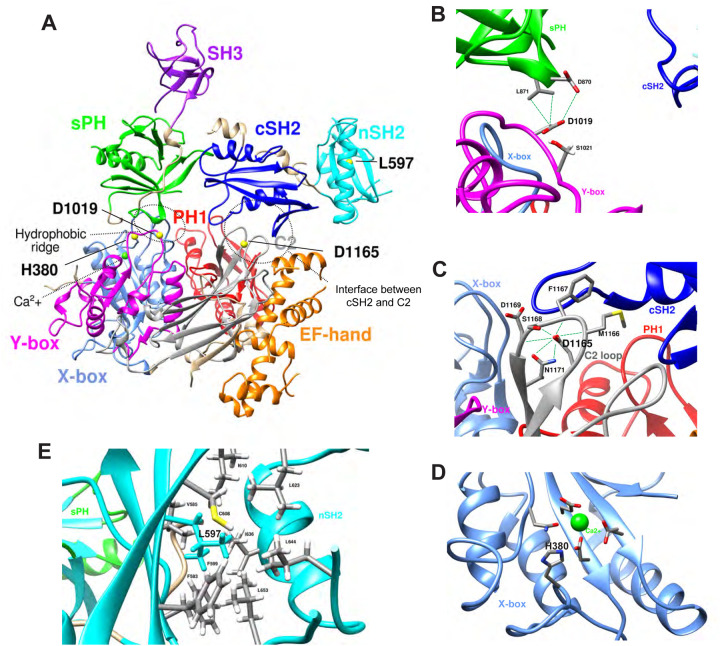
Figure 6.. PLCG1 variants affect important residues
(A) 3D structure of full-length rat Plcg1 (rat Plcg1 shares 97% amino acid identity with human PLCG1). The conserved protein domains are labeled with different colors. Two major intracellular interfaces are circled by dashed lines: 1-The hydrophobic ridge between the sPH domain and the catalytic core (X-box and Y-box); and 2-The interface between the cSH2 domain and the C2 domain. The four amino acids affected by the variants are shown as bolded black and indicated by yellow balls. (B) Enlarged views of the Asp1019 residue within the autoinhibition interface between sPH domain and the Y box. The potential interactions with nearby residues are indicated. (C) Enlarged view of the Asp1165 residue within the autoinhibition interface between the cSH2 domain and the C2 domain. The potential interactions with nearby residues are indicated. (D) Enlarged view of the His380 residue within the X-box catalytic domain, in proximity to the Ca2+ cofactor. (E) Enlarged view of the Leu597 and nearby residues in the nSH2 domain. Structural analysis was performed via UCSF Chimera (Pettersen et al. 2004)

References

    1. Arteaga CL, Johnson MD, Todderud G, Coffey RJ, Carpenter G, Page DL (1991) Elevated content of the tyrosine kinase substrate phospholipase C-gamma 1 in primary human breast carcinomas. Proc Natl Acad Sci U S A 88:10435–10439 - PMC - PubMed
    1. Asano S, Maetani Y, Ago Y, Kanematsu T (2022) Phospholipase C-related catalytically inactive protein enhances cisplatin-induced apoptotic cell death. Eur J Pharmacol 933:175273. - PubMed
    1. Bae JH, Lew ED, Yuzawa S, Tome F, Lax I, Schlessinger J (2009) The selectivity of receptor tyrosine kinase signaling is controlled by a secondary SH2 domain binding site. Cell 138:514–524 - PMC - PubMed
    1. Balla T (2013) Phosphoinositides: tiny lipids with giant impact on cell regulation. Physiol Rev 93:1019–1137 - PMC - PubMed
    1. Baysac K, Sun G, Nakano H, Schmitz EG, Cruz AC, Fisher C, Bailey AC, Group PL-IDW, Mace E, Milner JD, Ombrello MJ (2024) PLCG2-associated immune dysregulation (PLAID) comprises broad and distinct clinical presentations related to functional classes of genetic variants. J Allergy Clin Immunol 153:230–242 - PMC - PubMed

Publication types