Review
. 2024 Jan 23;17(1):4.
doi: 10.1186/s13041-024-01077-7.

The brain cytokine orchestra in multiple sclerosis: from neuroinflammation to synaptopathology

Affiliations
Review

The brain cytokine orchestra in multiple sclerosis: from neuroinflammation to synaptopathology

Roberta Amoriello et al. Mol Brain. .

Abstract

The central nervous system (CNS) is finely protected by the blood-brain barrier (BBB). Immune soluble factors such as cytokines (CKs) are normally produced in the CNS, contributing to physiological immunosurveillance and homeostatic synaptic scaling. CKs are peptide, pleiotropic molecules involved in a broad range of cellular functions, with a pivotal role in resolving the inflammation and promoting tissue healing. However, pro-inflammatory CKs can exert a detrimental effect in pathological conditions, spreading the damage. In the inflamed CNS, CKs recruit immune cells, stimulate the local production of other inflammatory mediators, and promote synaptic dysfunction. Our understanding of neuroinflammation in humans owes much to the study of multiple sclerosis (MS), the most common autoimmune and demyelinating disease, in which autoreactive T cells migrate from the periphery to the CNS after the encounter with a still unknown antigen. CNS-infiltrating T cells produce pro-inflammatory CKs that aggravate local demyelination and neurodegeneration. This review aims to recapitulate the state of the art about CKs role in the healthy and inflamed CNS, with focus on recent advances bridging the study of adaptive immune system and neurophysiology.

Keywords: Chemokines; Cytokines; Experimental autoimmune encephalomyelitis; Multiple Sclerosis; Neuroinflammation; Neuromodulation; Synaptopathy.


Conflict of interest statement

The authors declare that they have no competing interests.

Figures

Fig. 1
Fig. 1
TNFα and IL-1β action at the glutammatergic synapse. Cytokines modulate synaptic function binding to their receptors presynaptically promoting ( +) the release of synaptic vesicles, and postsynaptically modulating receptors activity through phosphorylation. IL-1β is also known to promote astrocytic glutamate release enhancing ( +) the function of Xc (cystine/glutamate antiporter), while impairing (−) the glutammate reuptake by EAAT2 (mod. form 28)
Fig. 2
Fig. 2
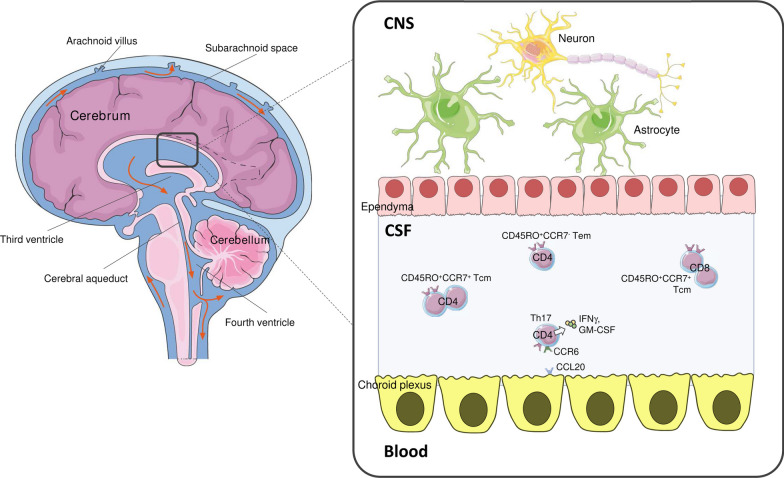
T lymphocytes in the healthy CSF. CSF is produced by ependymal cells in the choroid plexus within brain ventricles and circulates in the subarachnoid space around the brain and spinal cord. CSF provides mechanical protection and supports the flow of nutrients and neurotransmitters. In healthy condition, CSF contains only 1000–3000 cells/mL, including T cells that contribute to immunosurveillance. These are mainly CD4 + , with a ratio of 4:1 versus CD8 + and exhibit a memory phenotype: 90% are CD45RO + CCR7 + central memory T cells (Tcm), and 10% are CDR45RO + CCR7− effector memory T cells (Tem) [47]. Among CD4 + T cells, Th17 are usually present expressing receptors that interact with the choroid plexus, allowing Th17 cell trafficking in the CSF: a main example is CCR6, that binds CCL20 on the choroid plexus [53]. CSF Th17 also may produce low levels of CKs, such as IFN-γ and GM-CSF [52]. Parts of the figure were drawn by using pictures from Servier Medical Art. Servier Medical Art by Servier is licensed under a Creative Commons Attribution 3.0 Unported License (https://creativecommons.org/licenses/by/3.0/)
Fig. 3
Fig. 3
EAE pathogenesis. EAE can be induced in mice by active immunization with encephalitogenic peptide antigen such as the myelin oligodendrocyte glycoprotein 35–55 (MOG35–55). Peripheral dendritic cells (DCs) present the antigen to naïve T lymphocytes that are primed to differentiate into T helper 1 (Th1) and Th17 phenotypes, upon interleukin-12 (IL-12) and IL-23, respectively. Monocytes are also recruited and stimulated to differentiate into macrophages upon macrophage inflammatory protein-1 (MIP-1). Activated cells express adhesion molecules and pass through the blood–brain barrier (BBB) endothelium entering the central nervous system (CNS). Local CNS-antigen presenting cells (APCs) reinforce myelin-specific Th1 and Th17 effector and macrophages response. Activated cells produce pro-inflammatory cytokines (CKs) and chemokines that fuel myelin damage [69, 70]. Parts of the figure were drawn by using pictures from Servier Medical Art. Servier Medical Art by Servier is licensed under a Creative Commons Attribution 3.0 Unported License (https://creativecommons.org/licenses/by/3.0/)

References

    1. Kany S, Vollrath JT, Relja B. Cytokines in inflammatory disease. Int J Mol Sci. 2019;20(23):6008. doi: 10.3390/ijms20236008. - DOI - PMC - PubMed
    1. Geginat J, Sallusto F, Lanzavecchia A. Cytokine-driven proliferation and differentiation of human naive, central memory, and effector memory CD4(+) T cells. J Exp Med. 2001;194(12):1711–1719. doi: 10.1084/jem.194.12.1711. - DOI - PMC - PubMed
    1. Grunnet LG, Aikin R, Tonnesen MF, Paraskevas S, Blaabjerg L, Størling J, et al. Proinflammatory cytokines activate the intrinsic apoptotic pathway in beta-cells. Diabetes. 2009;58(8):1807–1815. doi: 10.2337/db08-0178. - DOI - PMC - PubMed
    1. Shabab T, Khanabdali R, Moghadamtousi SZ, Kadir HA, Mohan G. Neuroinflammation pathways: a general review. Int J Neurosci. 2017;127(7):624–633. doi: 10.1080/00207454.2016.1212854. - DOI - PubMed
    1. Schetters STT, Gomez-Nicola D, Garcia-Vallejo JJ, Van Kooyk Y. Neuroinflammation: microglia and T cells get ready to tango. Front Immunol. 2018;25(8):1905. doi: 10.3389/fimmu.2017.01905. - DOI - PMC - PubMed