


Dual-modal radiomics nomogram based on contrast-enhanced ultrasound to improve differential diagnostic accuracy and reduce unnecessary biopsy rate in ACR TI-RADS 4-5 thyroid nodules
- PMID: 38263209
- PMCID: PMC10807093
- DOI: 10.1186/s40644-024-00661-3
Dual-modal radiomics nomogram based on contrast-enhanced ultrasound to improve differential diagnostic accuracy and reduce unnecessary biopsy rate in ACR TI-RADS 4-5 thyroid nodules
Abstract
Background: American College of Radiology (ACR) Thyroid Imaging Reporting and Data System (TI-RADS, TR) 4 and 5 thyroid nodules (TNs) demonstrate much more complicated and overlapping risk characteristics than TR1-3 and have a rather wide range of malignancy possibilities (> 5%), which may cause overdiagnosis or misdiagnosis. This study was designed to establish and validate a dual-modal ultrasound (US) radiomics nomogram integrating B-mode ultrasound (BMUS) and contrast-enhanced ultrasound (CEUS) imaging to improve differential diagnostic accuracy and reduce unnecessary fine needle aspiration biopsy (FNAB) rates in TR 4-5 TNs.
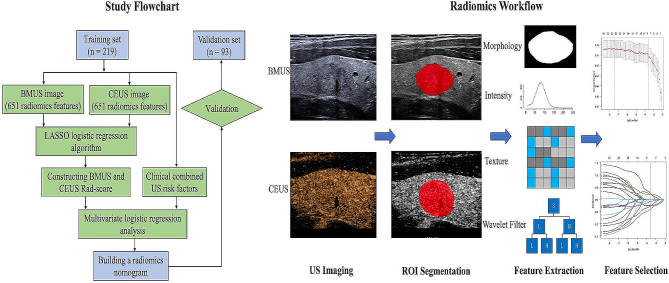
Methods: A retrospective dataset of 312 pathologically confirmed TR4-5 TNs from 269 patients was collected for our study. Data were randomly divided into a training dataset of 219 TNs and a validation dataset of 93 TNs. Radiomics characteristics were derived from the BMUS and CEUS images. After feature reduction, the BMUS and CEUS radiomics scores (Rad-score) were built. A multivariate logistic regression analysis was conducted incorporating both Rad-scores and clinical/US data, and a radiomics nomogram was subsequently developed. The performance of the radiomics nomogram was evaluated using calibration, discrimination, and clinical usefulness, and the unnecessary FNAB rate was also calculated.
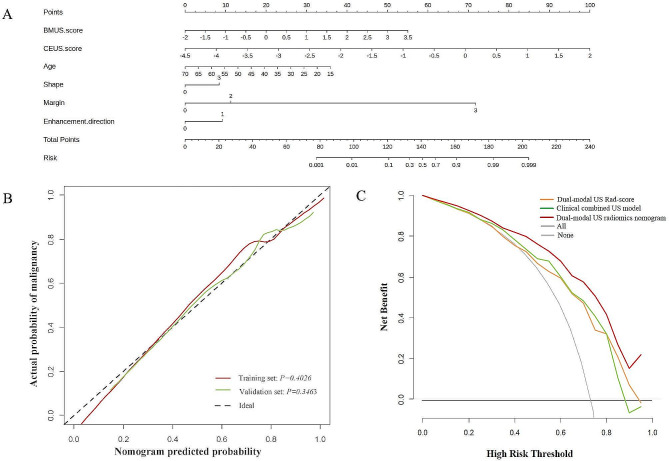
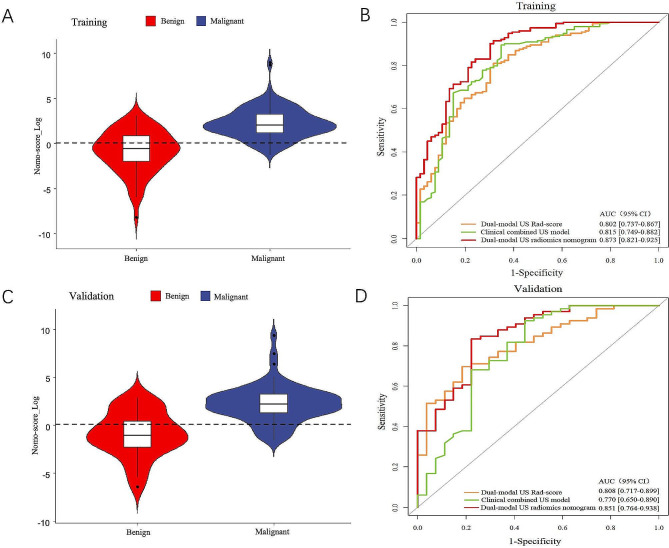
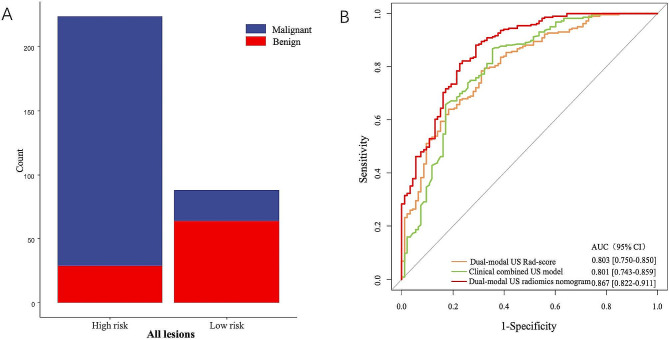
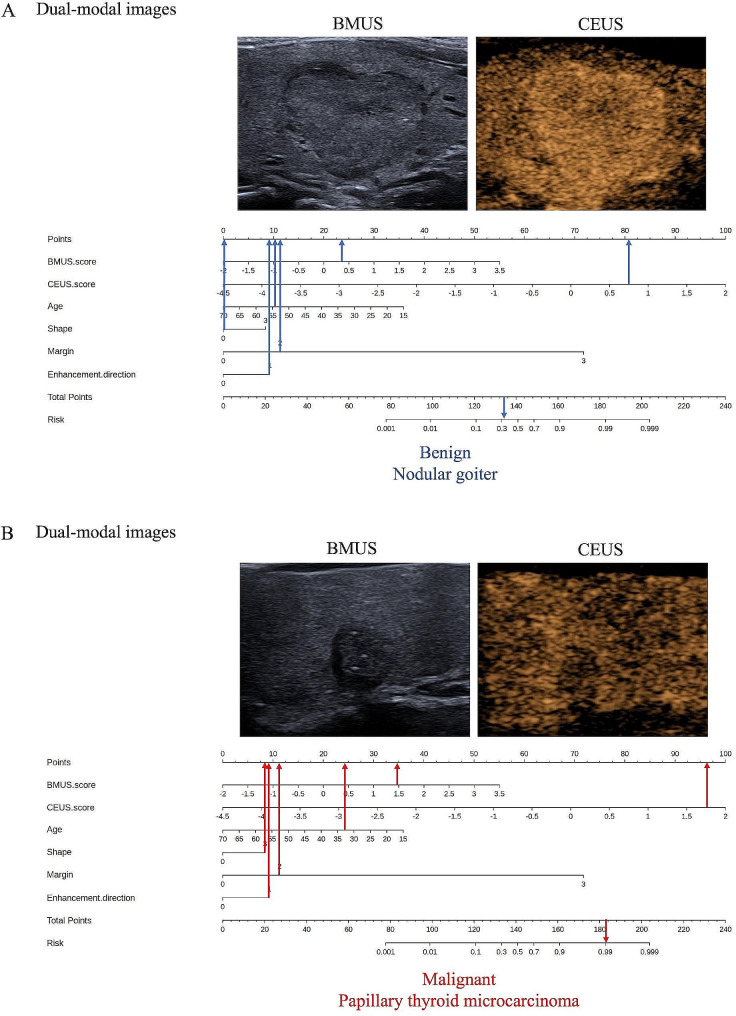
Results: BMUS Rad-score, CEUS Rad-score, age, shape, margin, and enhancement direction were significant independent predictors associated with malignant TR4-5 TNs. The radiomics nomogram involving the six variables exhibited excellent calibration and discrimination in the training and validation cohorts, with an AUC of 0.873 (95% CI, 0.821-0.925) and 0.851 (95% CI, 0.764-0.938), respectively. The marked improvements in the net reclassification index and integrated discriminatory improvement suggested that the BMUS and CEUS Rad-scores could be valuable indicators for distinguishing benign from malignant TR4-5 TNs. Decision curve analysis demonstrated that our developed radiomics nomogram was an instrumental tool for clinical decision-making. Using the radiomics nomogram, the unnecessary FNAB rate decreased from 35.3 to 14.5% in the training cohort and from 41.5 to 17.7% in the validation cohorts compared with ACR TI-RADS.
Conclusion: The dual-modal US radiomics nomogram revealed superior discrimination accuracy and considerably decreased unnecessary FNAB rates in benign and malignant TR4-5 TNs. It could guide further examination or treatment options.
Keywords: ACR TI-RADS 4–5; Contrast-enhanced ultrasound; Nomogram; Radiomics; Thyroid nodules.
© 2024. The Author(s).
Conflict of interest statement
The authors declare that they have no competing interests.
Figures
References
-
- Haugen BR, Alexander EK, Bible KC, Doherty GM, Mandel SJ, Nikiforov YE, et al. 2015 American Thyroid Association Management Guidelines for adult patients with thyroid nodules and differentiated thyroid Cancer: the American Thyroid Association Guidelines Task Force on thyroid nodules and differentiated thyroid Cancer. Thyroid. 2016;26:1–133. doi: 10.1089/thy.2015.0020. - DOI - PMC - PubMed
MeSH terms
Grants and funding
LinkOut - more resources
Full Text Sources
