


Prevalence of post-traumatic stress disorder risk post-COVID-19 in 12 countries in Latin America: a cross-sectional survey
- PMID: 38264243
- PMCID: PMC10804613
- DOI: 10.3389/fpubh.2023.1302694
Prevalence of post-traumatic stress disorder risk post-COVID-19 in 12 countries in Latin America: a cross-sectional survey
Abstract
Introduction: Latin America was the region most affected by COVID-19 in the second quarter of 2020, and consequently, the impact on mental health requires evaluation. The aim of this study was to assess the risk of post-traumatic stress disorder (PTSD) caused by bereavement due to COVID-19 in 12 countries in Latin America.
Methods: The current study was an analytical cross-sectional study. Validated tests were applied for PTSD, depression, anxiety, and stress (DASS-21), questions about the respondent's condition or their environment, and demographic questions, as well as the length of the mourning period of suffering.
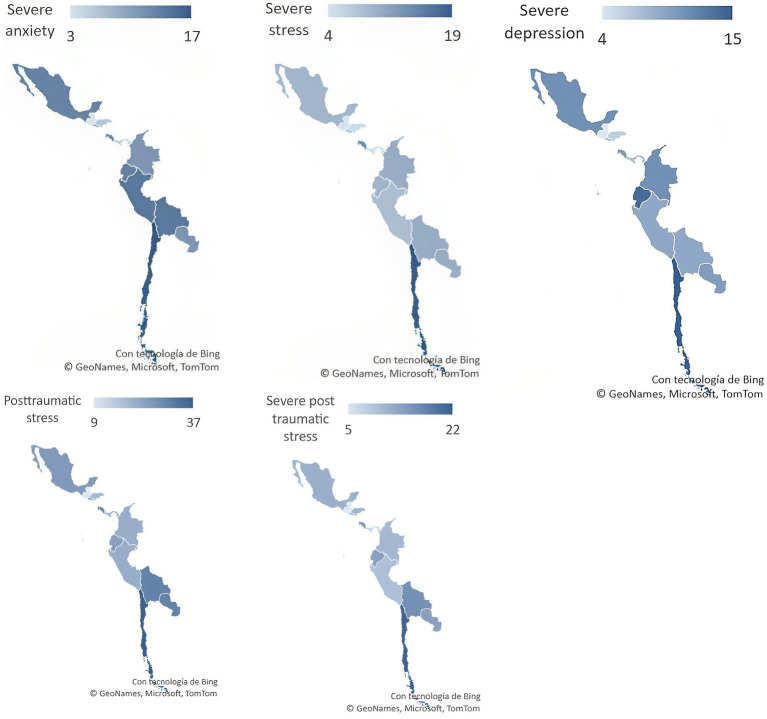
Results: The outcomes demonstrated that the PTSD risk increased for women (p < 0.001), when a friend or acquaintance had COVID-19 (p = 0.002), when a close relative died from COVID-19 (p = 0.010), having severe depression (p <0.001), severe anxiety (p <0.001), severe stress (p <0.001), residing in Chile (p <0.001), Paraguay (p <0.001), Bolivia (p <0.001), Costa Rica (p <0.001) or El Salvador (p = 0.005). On the other hand, there was less risk of PTSD at an older age (p <0.001) or if respondents had a sentimental partner (p = 0.025). In the case of severe PTSD, there was a greater gender risk for women (p <0.001), a close relative dying from COVID-19 (p = 0.017), having severe depression (p <0.001), severe anxiety (p <0.001), severe stress (p <0.001), residing in Chile (p <0.001), Paraguay (p <0.001), Bolivia (p <0.001) and Costa Rica (p = 0.002). It was also observed that there was less risk of severe PTSD at an older age demographic (p <0.001).
Discussion: It can be concluded that the percentages of PTSD are high in its clinical presentation as severe, especially among Latin American women.
Keywords: COVID-19; Latin America; PTSD; Peru; mental health; post-traumatic stress disorder.
Copyright © 2024 Mejia, Serna-Alarcón, Vilela-Estrada, Armada, Ubillus, Beraún-Barrantes, Álvarez-Risco, Del-Aguila-Arcentales, Davies and Yáñez.
Conflict of interest statement
The authors declare that the research was conducted in the absence of any commercial or financial relationships that could be construed as a potential conflict of interest.
Figures
References
-
- WHO . (2022). "Coronavirus disease (COVID-19)." Available at: https://www.who.int/health-topics/coronavirus#tab=tab_1 (Accessed Nov 11, 2023).
-
- Humphries MO. Paths of infection: the first world war and the origins of the 1918 influenza pandemic. War Hist. (2014) 21:55–81. doi: 10.1177/0968344513504525 - DOI
-
- Chan JF-W, Yuan S, Kok K-H, Kelvin Kai-Wang To. Chu H, Yang J, et al. . A familial cluster of pneumonia associated with the 2019 novel coronavirus indicating person-to-person transmission: a study of a family cluster. Lancet. (2020) 395:514–23. doi: 10.1016/S0140-6736(20)30154-9, PMID: - DOI - PMC - PubMed
-
- Alifano M, Attanasi G, Iannelli F, Cherikh F, Iannelli A. COVID-19 pandemic: a European perspective on health economic policies. J Behav Econ Pol. (2020) 4:35–43.
MeSH terms
LinkOut - more resources
Full Text Sources
Medical
