


Value of Electronic Health Records Measured Using Financial and Clinical Outcomes: Quantitative Study
- PMID: 38265848
- PMCID: PMC10851116
- DOI: 10.2196/52524
Value of Electronic Health Records Measured Using Financial and Clinical Outcomes: Quantitative Study
Abstract
Background: The Health Information Technology for Economic and Clinical Health Act of 2009 was legislated to reduce health care costs, improve quality, and increase patient safety. Providers and organizations were incentivized to exhibit meaningful use of certified electronic health record (EHR) systems in order to achieve this objective. EHR adoption is an expensive investment, given the resources and capital that are invested. Due to the cost of the investment, a return on the EHR adoption investment is expected.
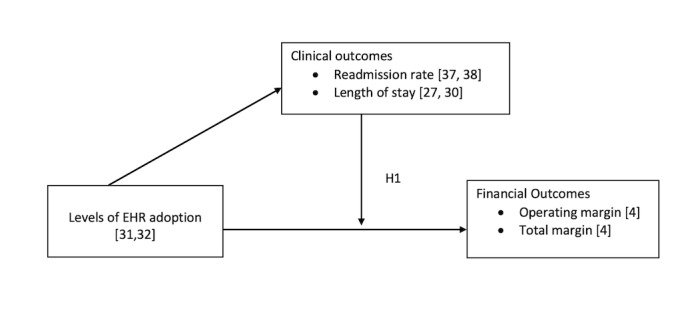
Objective: This study performed a value analysis of EHRs. The objective of this study was to investigate the relationship between EHR adoption levels and financial and clinical outcomes by combining both financial and clinical outcomes into one conceptual model.
Methods: We examined the multivariate relationships between different levels of EHR adoption and financial and clinical outcomes, along with the time variant control variables, using moderation analysis with a longitudinal fixed effects model. Since it is unknown as to when hospitals begin experiencing improvements in financial outcomes, additional analysis was conducted using a 1- or 2-year lag for profit margin ratios.
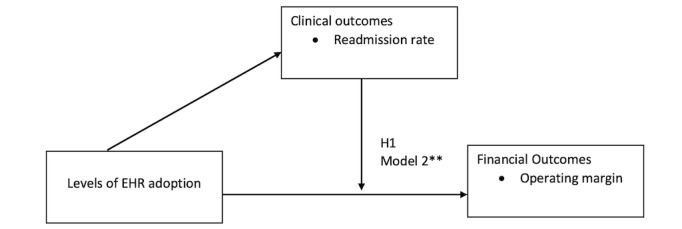
Results: A total of 5768 hospital-year observations were analyzed over the course of 4 years. According to the results of the moderation analysis, as the readmission rate increases by 1 unit, the effect of a 1-unit increase in EHR adoption level on the operating margin decreases by 5.38%. Hospitals with higher readmission payment adjustment factors have lower penalties.
Conclusions: This study fills the gap in the literature by evaluating individual relationships between EHR adoption levels and financial and clinical outcomes, in addition to evaluating the relationship between EHR adoption level and financial outcomes, with clinical outcomes as moderators. This study provided statistically significant evidence (P<.05), indicating that there is a relationship between EHR adoption level and operating margins when this relationship is moderated by readmission rates, meaning hospitals that have adopted EHRs could see a reduction in their readmission rates and an increase in operating margins. This finding could further be supported by evaluating more recent data to analyze whether hospitals increasing their level of EHR adoption would decrease readmission rates, resulting in an increase in operating margins. Hospitals would incur lower penalties as a result of improved readmission rates, which would contribute toward improved operating margins.
Keywords: EHR; EHR adoption; acceptance; admission; adoption; clinical outcome; cost; economic; electronic health record; finance; financial; financial outcome; health outcome; health record; hospital; hospitalization; length of stay; margin; moderation analysis; multivariate; operating; operating margin; operation; operational; profit; project management; readmission; readmission rate; total margin; value analysis; value engineering; value management.
©Shikha Modi, Sue S Feldman, Eta S Berner, Benjamin Schooley, Allen Johnston. Originally published in JMIR Medical Informatics (https://medinform.jmir.org), 24.01.2024.
Conflict of interest statement
Conflicts of Interest: Not applicable.
Figures
References
-
- Collum TH, Menachemi N, Sen B. Does electronic health record use improve hospital financial performance? Evidence from panel data. Health Care Manage Rev. 2016;41(3):267–274. doi: 10.1097/HMR.0000000000000068. https://journals.lww.com/hcmrjournal/abstract/2016/07000/does_electronic... - DOI - PubMed
-
- Jang Y, Lortie MA, Sanche S. Return on investment in electronic health records in primary care practices: a mixed-methods study. JMIR Med Inform. 2014 Oct 29;2(2):e25. doi: 10.2196/medinform.3631. https://medinform.jmir.org/2014/2/e25/ v2i2e25 - DOI - PMC - PubMed
LinkOut - more resources
Full Text Sources
Miscellaneous
