


Four novel Pleurocordyceps (Polycephalomycetaceae) species from China
- PMID: 38268701
- PMCID: PMC10807425
- DOI: 10.3389/fmicb.2023.1256967
Four novel Pleurocordyceps (Polycephalomycetaceae) species from China
Abstract
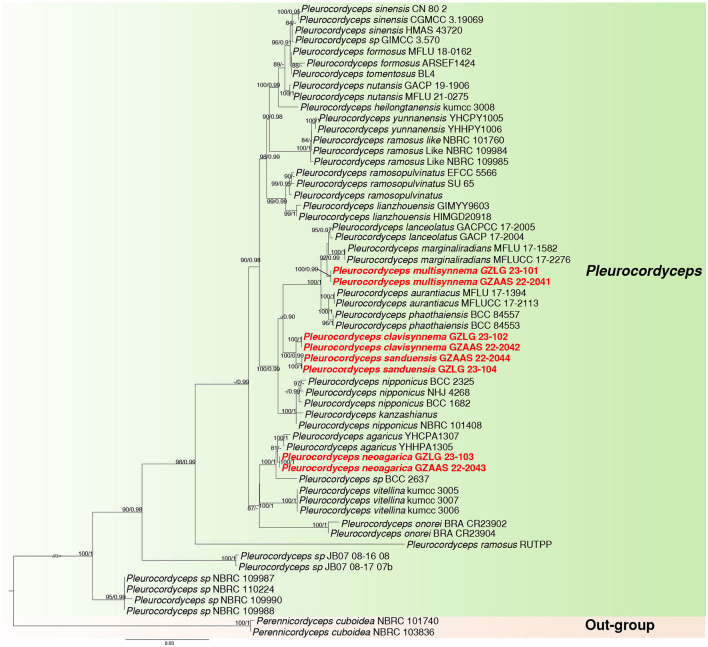
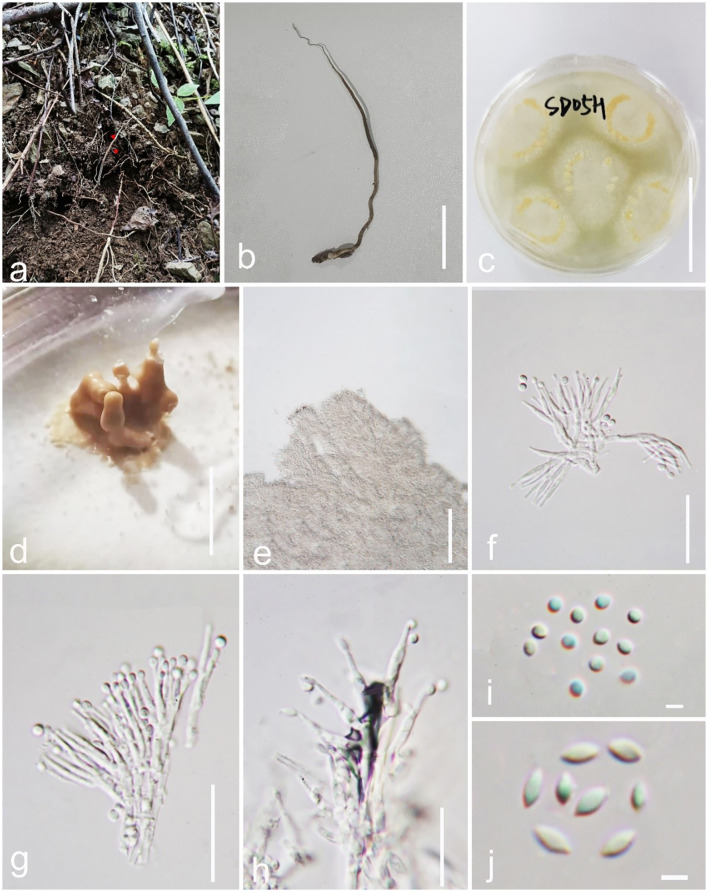
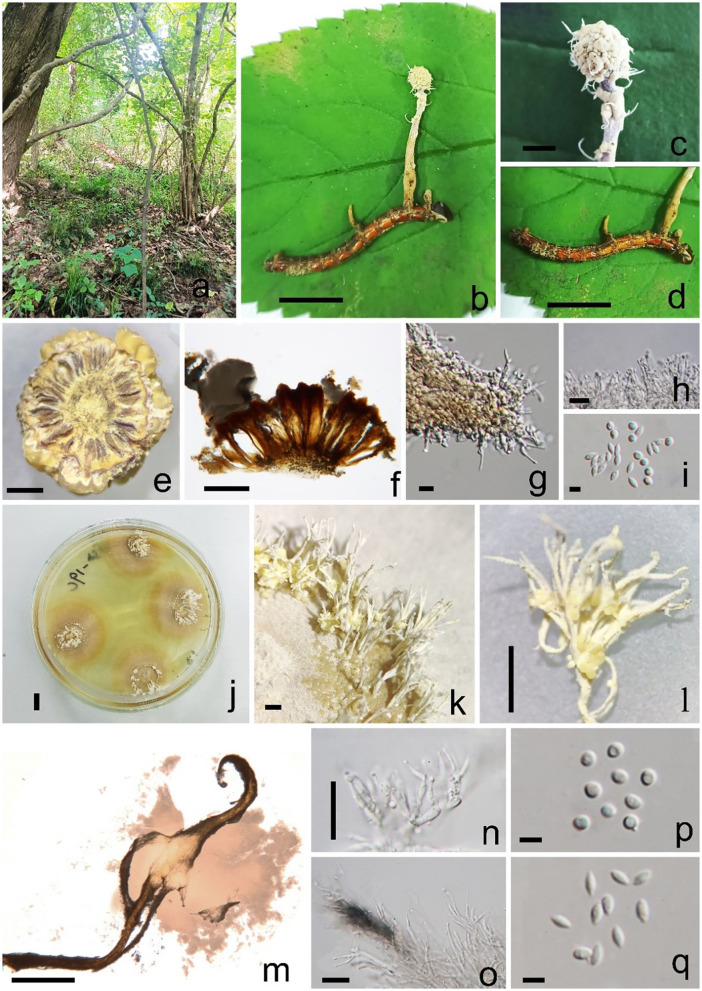
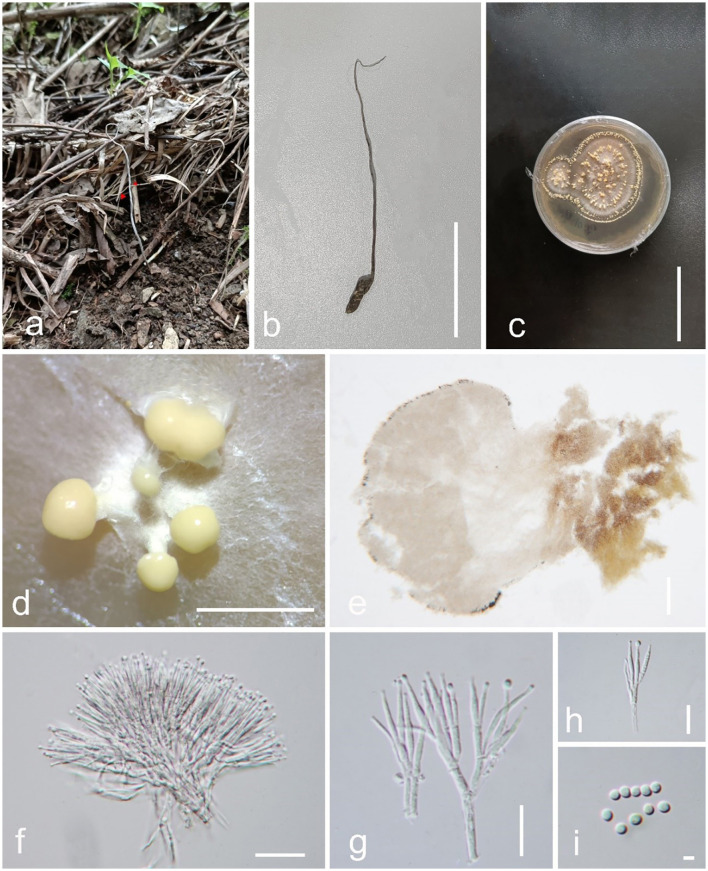
Entomopathogenic fungi comprise an ecologically important group of specialized pathogens infecting other fungi, invertebrates, and plants. These fungi are species-rich with high diversity and broad distribution worldwide. The majority of entomopathogenic fungi belong to clavicipitoids, which consist of the hypocrealean families, Clavicipitaceae, Cordycipitaceae, Ophiocordycipitaceae, and Polycephalomycetaceae. The latter is a newly established entomopathogenic family that recently separated from the family Ophiocordycipitaceae to accommodate the genera, Perennicordyceps, Pleurocordyceps, and Polycephalomyces. In recent years, Polycephalomycetaceae has been enriched with parasitic and hyperparasitic fungi. With 16 species spread across China, Ecuador, Japan, and Thailand, Pleurocordyceps is the most speciose genus in the family. In this study, we expand the number of taxa in the genus by introducing four new Pleurocordyceps species from China, namely, P. clavisynnema, P. multisynnema, P. neoagarica, and P. sanduensis. We provide detailed descriptions and illustrations and infer genus-level phylogenies based on a combined 6-loci gene sequence dataset comprising the internal transcribed spacer gene region (ITS), small subunit ribosomal RNA gene region (SSU), large subunit rRNA gene region (LSU), translation elongation factor 1-alpha gene region (TEF-1α), RNA polymerase II largest subunit gene region (RPB1), and RNA polymerase II second largest subunit (RPB2). This study contributes to knowledge with regard to the diversity of Pleurocordyceps specifically and entomopathogenic Hypocreales more broadly.
Keywords: Polycephalomycetaceae; entomopathogenic fungi; morphology; phylogeny; taxonomy.
Copyright © 2024 Xiao, Yang, Jayawardena, Gentekaki, Peng, Luo and Lu.
Conflict of interest statement
The authors declare that the research was conducted in the absence of any commercial or financial relationships that could be construed as a potential conflict of interest.
Figures
References
-
- Acuña Jiménez M., García Gutiérrez C., Rosas García N. M., López Meyer M., Saínz Hernández J. C. (2015). Formulation of Metarhizium anisopliae (Metschnikoff) Sorokin with biodegradable polymers and their virulence against Heliothis virescens (Fabricius). Rev. Int. Contam. Ambie. 31, 219–226.
-
- Ban S., Sakane T., Toyama K., Nakagiri A. (2009). Teleomorph-anamorph relationships and reclassification of Cordyceps cuboidea and its allied species. Mycoscience 50, 261–272. 10.1007/S10267-008-0480-Y - DOI
-
- Bischoff J. F., Sullivan R. F., Struwe L., Hywel-Jones N. L., White J. F. (2003). Resurrection of Blistum tomentosum and its exclusion from Polycephalomyces (Hyphomycetes, Deuteromycota) based on 28S rDNA sequence data. Mycotaxon 86, 433–444.
LinkOut - more resources
Full Text Sources
