Evidence of Zika Virus Reinfection by Genome Diversity and Antibody Response Analysis, Brazil

Marcia da Costa Castilho et al. Emerg Infect Dis. 2024 Feb.

Abstract

We generated 238 Zika virus (ZIKV) genomes from 135 persons in Brazil who had samples collected over 1 year to evaluate virus persistence. Phylogenetic inference clustered the genomes together with previously reported ZIKV strains from northern Brazil, showing that ZIKV has been remained relatively stable over time. Temporal phylogenetic analysis revealed limited within-host diversity among most ZIKV-persistent infected associated samples. However, we detected unusual virus temporal diversity from >5 persons, uncovering the existence of divergent genomes within the same patient. All those patients showed an increase in neutralizing antibody levels, followed by a decline at the convalescent phase of ZIKV infection. Of interest, in 3 of those patients, titers of neutralizing antibodies increased again after 6 months of ZIKV infection, concomitantly with real-time reverse transcription PCR re-positivity, supporting ZIKV reinfection events. Altogether, our findings provide evidence for the existence of ZIKV reinfection events.

Keywords: Brazil; Zika virus; epidemiology; evolution; genetic diversity; reinfection; vector-borne infections; viruses.


Figures
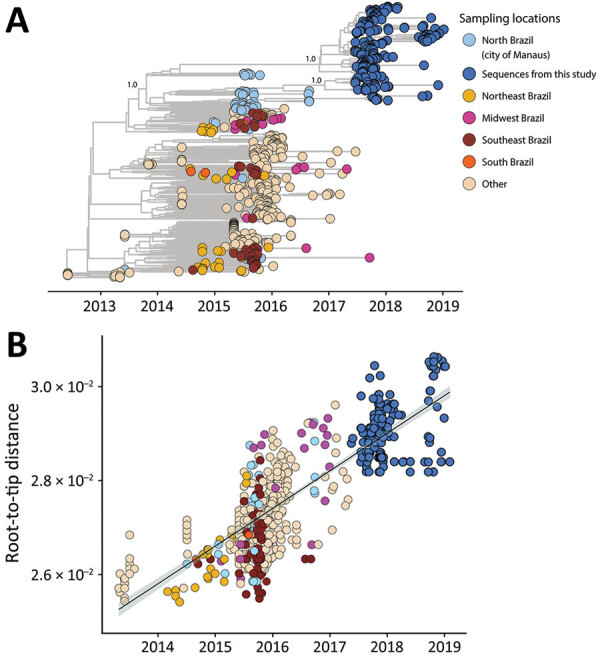
Figure 1
Figure 1
Genomic epidemiology of Zika virus strains obtained from study participants in northern Brazil and reference sequences. A) Time-scaled maximum clade credibility tree of Zika virus Asian lineage in Brazil, including the 238 new genomes generated in this study (dark blue) plus 481 reference strains sampled worldwide. Tips are colored according to the sample source location. Values at nodes represent posterior probability support of the tree nodes inferred under Bayesian evolutionary analysis using a relaxed molecular clock approach. B) Root-to-tip regression of sequence sampling date against genetic divergence from the root of the outbreak clade.
Figure 2
Figure 2
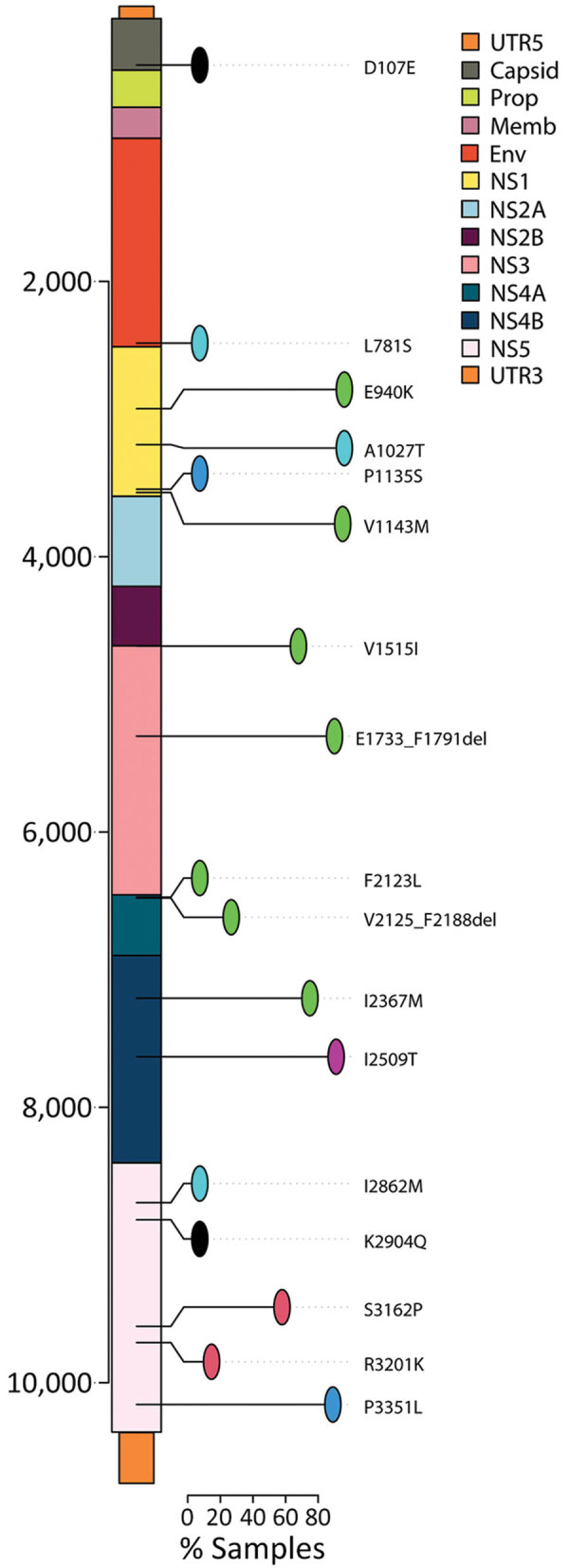
Single-nucleotide variants per gene for Zika virus strains obtained from study participants in northern Brazil. Amino acid changes in the polyprotein are allocated along the genome. Only mutations that appear in >10% (lines) of sequences are shown. Env, envelope; Prop, propeptide; Memb, membrane; NS, nonstructural; UTR, untranslated region.
Figure 3
Figure 3
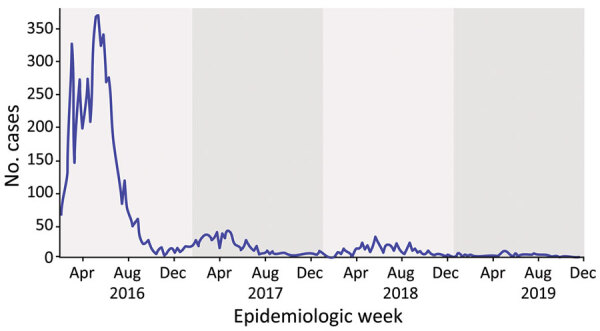
Notified Zika virus cases per week in Manaus municipality, Brazil, 2016–2019, from the Brazilian Ministry of Health. Shading reflects each epidemic year. Data source: https://datasus.saude.gov.br/informacoes-de-saude-tabnet.
Figure 4
Figure 4
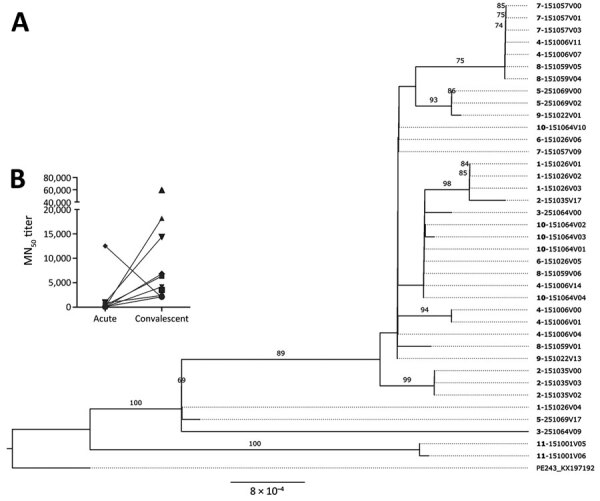
Phylogenetic analysis of study participants persistently infected with Zika virus, Brazil. A) Maximum-likelihood phylogenetic tree of persistent samples. The phylogenetic tree shows all 10 participants with confirmed persistent infection. Boldface indicates participant identification numbers; visit numbers (V) are indicated. Multiple identification numbers represent multiple genomes obtained from the same participant at different time points. Scale bar indicates number of nucleotide substitutions per site. Numbers on the branches indicate Shimodaira–Hasegawa approximate likelihood ratio test after 1,000 replicates. B) Neutralizing antibody titers from acute and convalescent samples, as analyzed from persistently infected participants. MN50, 50% microneutralization.
Figure 5
Figure 5
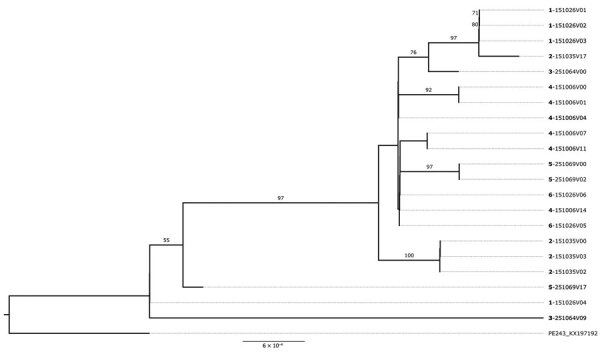
Maximum-likelihood phylogenetic tree supporting Zika virus reinfection among study participants in northern Brazil. The tree shows the 5 participants with divergent samples in which coinfection by different ZIKV genomes was inferred by phylogenetic reconstruction. Divergent samples from the same participant were grouped separately in the tree. Boldface indicates participant identification numbers; visit numbers (V) are indicated. Scale bar indicates number of nucleotide substitutions per site. Numbers on the branches indicate Shimodaira–Hasegawa approximate likelihood ratio test after 1,000 replicates.
Figure 6
Figure 6
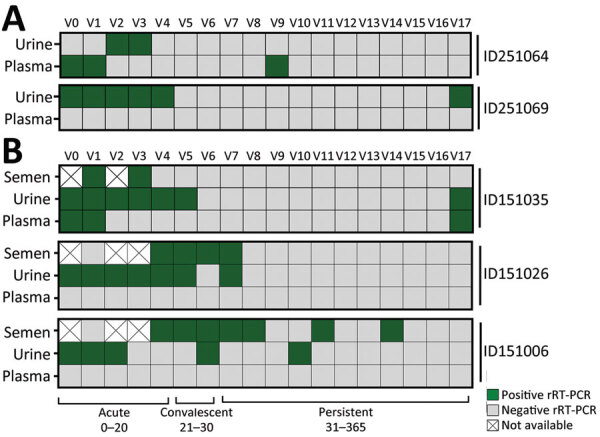
Zika virus rRT-PCR results from plasma, urine, and semen (when applicable) specimens supporting reinfection among female (A) and male (B) study participants in northern Brazil. Each square represents an analyzed specimen according to the schedule from study visits (Table 2). ID, participant identification; r-RT-PCR, real-time reverse transcription PCR; V, visit number.
Figure 7
Figure 7
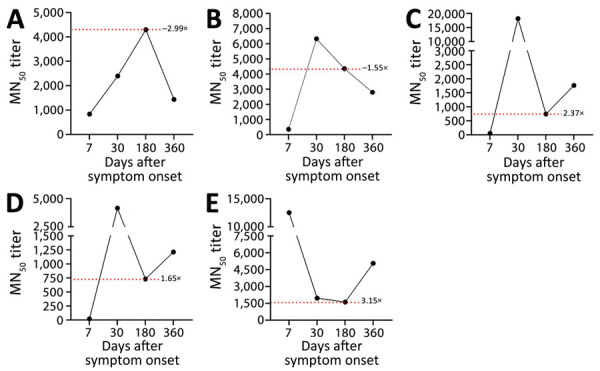
Zika virus neutralizing antibody titers from acute and convalescent serum samples supporting reinfection among 5 study participants in northern Brazil. A) Participant ID151006; B) participant ID151026; C) participant ID151035; D) participant ID251064; E) participant ID251069. Dotted lines and red numbers represent fold changes in titers as calculated from the 180-day and 360-day intervals. MN50, 50% percent microneutralization assay.

References

    1. Kuno G, Chang GJ. Full-length sequencing and genomic characterization of Bagaza, Kedougou, and Zika viruses. Arch Virol. 2007;152:687–96. 10.1007/s00705-006-0903-z - DOI - PubMed
    1. Bogoch II, Brady OJ, Kraemer MUG, German M, Creatore MI, Kulkarni MA, et al. Anticipating the international spread of Zika virus from Brazil. Lancet. 2016;387:335–6. 10.1016/S0140-6736(16)00080-5 - DOI - PMC - PubMed
    1. Miranda-Filho DB, Martelli CM, Ximenes RA, Araújo TV, Rocha MA, Ramos RC, et al. Initial description of the presumed congenital Zika syndrome. Am J Public Health. 2016;106:598–600. 10.2105/AJPH.2016.303115 - DOI - PMC - PubMed
    1. Mlakar J, Korva M, Tul N, Popović M, Poljšak-Prijatelj M, Mraz J, et al. Zika virus associated with microcephaly. N Engl J Med. 2016;374:951–8. 10.1056/NEJMoa1600651 - DOI - PubMed
    1. Yakob L. Zika virus after the public health emergency of international concern period, Brazil. Emerg Infect Dis. 2022;28:837–40. 10.3201/eid2804.211949 - DOI - PMC - PubMed

Substances