


The Effectiveness of Dance Interventions on Psychological and Cognitive Health Outcomes Compared with Other Forms of Physical Activity: A Systematic Review with Meta-analysis
- PMID: 38270792
- PMCID: PMC11127814
- DOI: 10.1007/s40279-023-01990-2
The Effectiveness of Dance Interventions on Psychological and Cognitive Health Outcomes Compared with Other Forms of Physical Activity: A Systematic Review with Meta-analysis
Abstract
Background: Physical activity is known to improve psychological and cognitive outcomes. Learning dance sequences may challenge cognition, partnered or group dance may benefit social interactions, and the artistic aspect may improve psychological wellbeing. Dance is an equally effective form of physical activity compared with other structured physical activities to improve physical health, but it is unclear how effective dance could be for psychological and cognitive outcome measures.
Objective: To systematically review the literature on the effectiveness of structured dance interventions, compared with structured exercise programmes, on psychological and cognitive outcomes across the lifespan.
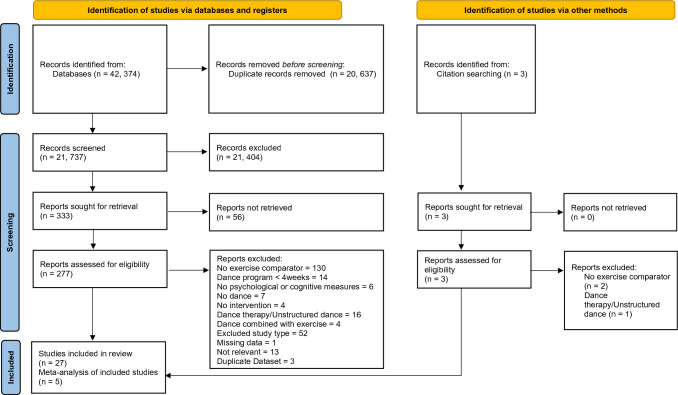
Methods: Eight databases were searched from earliest records to July 2022. Studies investigating a dance intervention lasting ≥ 4 weeks, including psychological and/or cognitive health outcomes, and having a structured exercise comparison group were included. Screening and data extraction were performed by two independent reviewers at all stages. All reviewer disagreements were resolved by the primary author. Where appropriate, meta-analysis was performed, or an effect size estimate generated.
Results: Of 21,737 records identified, 27 studies met the inclusion criteria. Total sample size of included studies was 1392 (944 females, 418 males, 30 unreported). Dance was equally as effective as other physical activity interventions in improving quality of life for people with Parkinson's disease [mean difference 3.09; 95% confidence interval (CI) - 2.13 to 8.30; p = 0.25], reducing anxiety (standardised mean difference 2.26; 95% CI - 2.37 to 6.90; p = 0.34), and improving depressive symptoms (standardised mean difference 0.78; 95% CI - 0.92 to 2.48; p = 0.37). Preliminary evidence found dance to be superior to other physical activity interventions to improve motivation, aspects of memory, and social cognition and to reduce distress. Preliminary evidence found dance to be inferior to other physical activity interventions to improve stress, self-efficacy and language fluency.
Conclusion: Undertaking structured dance of any genre is generally equally and occasionally more effective than other types of structured exercise for improving a range of psychological and cognitive outcomes.
Trial registration: PROSPERO: CRD42018099637.
© 2024. The Author(s).
Conflict of interest statement
All authors declare that they have no conflict of interest relevant to the content in this article.
Figures



References
Publication types
MeSH terms
LinkOut - more resources
Full Text Sources
Medical
Miscellaneous
