


Incidence of catheter-associated urinary tract infections by Gram-negative bacilli and their ESBL and carbapenemase production in specialized hospitals of Bahir Dar, northwest Ethiopia
- PMID: 38273339
- PMCID: PMC10809431
- DOI: 10.1186/s13756-024-01368-7
Incidence of catheter-associated urinary tract infections by Gram-negative bacilli and their ESBL and carbapenemase production in specialized hospitals of Bahir Dar, northwest Ethiopia
Abstract
Background: Catheter-associated urinary tract infections (CAUTIs) due to multidrug-resistant Gram-negative bacilli (GNB) is a common concern globally. Investigating the incidence of CAUTI and associated antibiotic resistance has paramount importance from the health care associated infections perspective. This study therefore assessed the incidence of CAUTIs due to GNB and the production of extended-spectrum beta-lactamase (ESBL) and carbapenemase among inpatients in specialized hospitals of Northwest, Ethiopia.
Methods: A total of 363 patients with indwelling urinary catheters who were admitted in the hospital for > 48 h were consecutively enrolled and followed from 3 to 18 days. Data were collected through interviewing and review of medical records. Patients who developed at least one of the following: fever (> 38 OC), suprapubic tenderness, or costovertebral angle pain, coupled with a GNB positive urine culture of ≥ 103 CFU/mL with no more than two bacterial species were defined as CAUTI. The ESBL and carbapenemase production were detected and identified by chromogenic medium. Logistic regression analysis was done to identify associated factors.
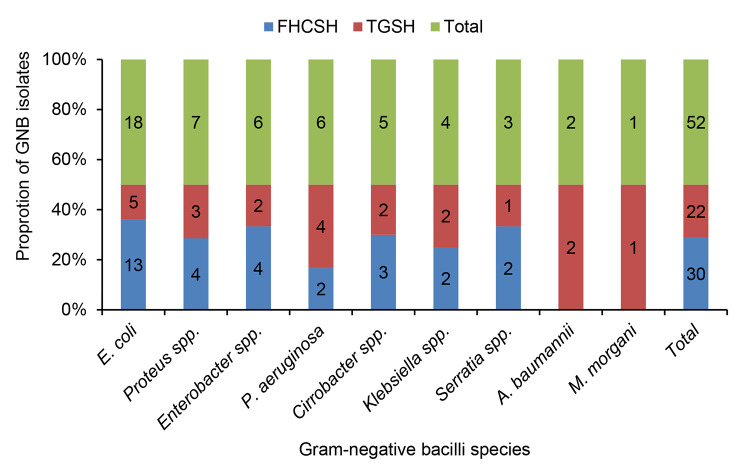
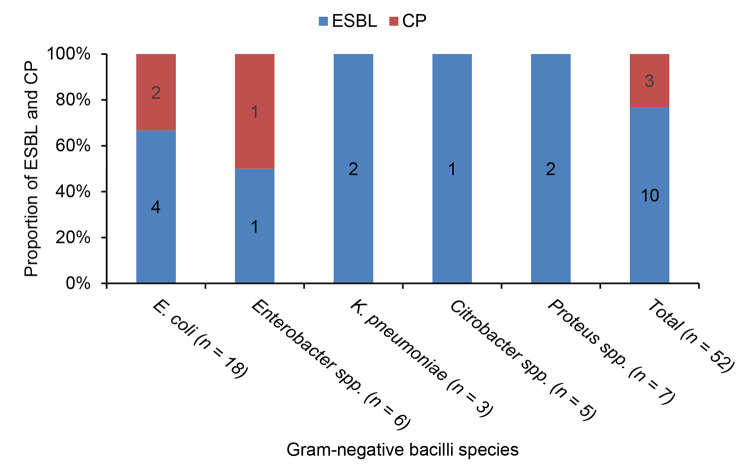
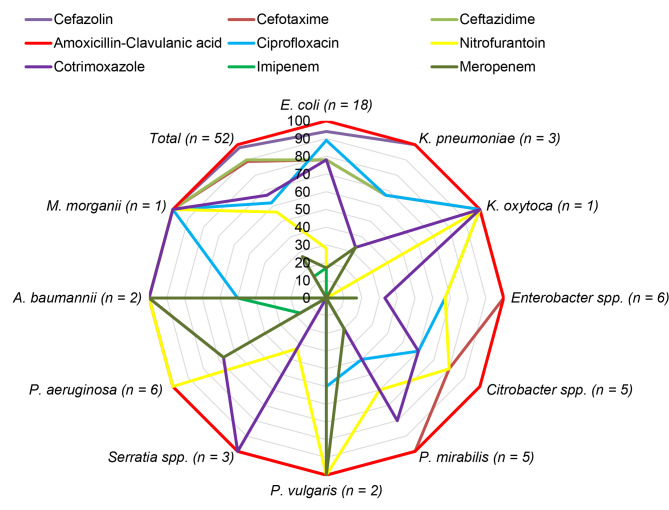
Results: From 363 patients followed, the incidence rate of CAUTI was 27.8 per 1000 catheter days. Catheterization for ≥ 8 days (AOR = 10.6, 95%CI:1.8-62.1) and hospitalization for > 10 days (AOR = 8.1, 95%CI: 2.4-27.2) were the factors significantly associated with CAUTIs. E. coli (n = 18, 34.6%), Proteus species (n = 7, 13.5%), and P. aeruginosa (n = 6, 11.5%) were the most frequent GNB. Isolates revealed high rates of resistance to amoxicillin-clavulanic acid (100%), cefazolin (n = 51, 98%), ceftazidime (n = 47, 90%) and cefotaxime (n = 46, 88%). Most of the GNB isolates (86.5%) were multidrug-resistant. Overall, 19.2% and 5.8% of GNB isolates were ESBL and carbapenemase producers, respectively.
Conclusions: Incidence of CAUTI with Gram-negative bacilli is high. As most of the GNB isolates are MDR and showed a super high rate of resistance to amoxicillin-clavulanic and third-generation cephalosporins, empirical treatment with these substances is virtually ineffective in patients with suspected GNB infection in Ethiopia. The expression of ESBL and carbapenemase among GNB isolates is also a concern. Therefore, improved infection prevention and control measures, careful use of catheters and third generation of cephalosporins are needed to improve patient outcomes and reduce the burden of CAUTIs and the spreading of antimicrobial resistance.
Keywords: CAUTIs; Chromogenic medium; ESBL; Ethiopia; FHCSH; GNB; MDR; Patients; TGSH.
© 2024. The Author(s).
Conflict of interest statement
The authors declare no competing interests.
Figures
References
-
- WHO. Report on the burden of endemic health care-associated infection worldwide. 2011.
-
- Peng D, Li X, Liu P, Luo M, Chen S, Su K, et al. Epidemiology of pathogens and antimicrobial resistanceof catheter-associated urinary tract infections in intensivecare units: a systematic review and meta-analysis. Am J Infect Control. 2018;46(12):e81–e90. doi: 10.1016/j.ajic.2018.07.012. - DOI - PubMed
Publication types
MeSH terms
Substances
LinkOut - more resources
Full Text Sources
Medical
Research Materials
