


A2 milk consumption and its health benefits: an update
- PMID: 38274187
- PMCID: PMC10806982
- DOI: 10.1007/s10068-023-01428-5
A2 milk consumption and its health benefits: an update
Abstract
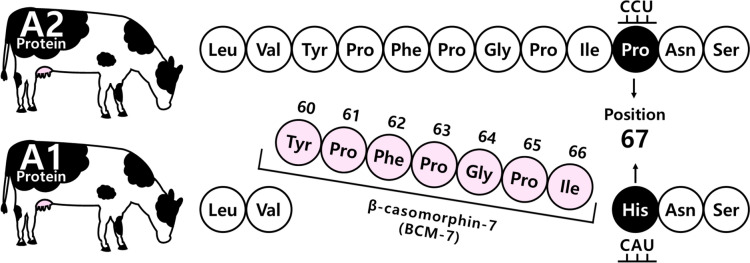
Milk is a widely consumed nutrient-rich food containing protein variants such as casein A2 and A1. A1 differs from A2 in an amino acid at position 67 (Pro67 to His67). The breakdown of β-casein yields β-casomorphins (BCM), among which BCM-7 is extensively studied for its effects on the human body. Animal studies have shown that A1 β-casein milk increases digestive transit time and enhances myeloperoxidase activity. Individuals with lactose intolerance prefer A2 milk to conventional A1 milk, as BCM-7 in A1 milk can lead to inflammation and discomfort in sensitive individuals. A2 milk, which contains A2 β-casein, is believed to be more easily digestible than A1 β-casein. Its popularity has grown owing to reports linking A1 casein to diseases such as type 1 diabetes, heart disease, and autism. A2 milk has gained popularity as an alternative to A1 milk, primarily because of its potential benefits for individuals with certain diseases. This review aims to provide an updated understanding of A2 milk consumption and its health benefits. This review aims to provide an updated understanding of A2 milk consumption and its health benefits.
Keywords: A2 milk; Health benefit; Inflammation; Lactose intolerance; β-casomorphin-7.
© The Korean Society of Food Science and Technology 2023. Springer Nature or its licensor (e.g. a society or other partner) holds exclusive rights to this article under a publishing agreement with the author(s) or other rightsholder(s); author self-archiving of the accepted manuscript version of this article is solely governed by the terms of such publishing agreement and applicable law.
Conflict of interest statement
Conflict of interestThe authors declare no conflict of interest.
Figures
References
-
- Allison AJ, Clarke AJ. Further research for consideration in 'the A2 milk case'. European Journal of Clinical Nutrition. 60: 921-924; reply 924-925 (2006) - PubMed
-
- Bisutti V, Pegolo S, Giannuzzi D, Mota LFM, Vanzin A, Toscano A, Trevisi E, Ajmone Marsan P, Brasca M, Cecchinato A. The beta-casein (CSN2) A2 allelic variant alters milk protein profile and slightly worsens coagulation properties in Holstein cows. Journal of Dairy Science. 2022;105:3794–3809. doi: 10.3168/jds.2021-21537. - DOI - PubMed
Publication types
LinkOut - more resources
Full Text Sources
Research Materials