. 2024 Jan 20;12(1):215.
doi: 10.3390/microorganisms12010215.

Methanobrevibacter massiliense and Pyramidobacter piscolens Co-Culture Illustrates Transkingdom Symbiosis

Affiliations

Methanobrevibacter massiliense and Pyramidobacter piscolens Co-Culture Illustrates Transkingdom Symbiosis

Virginie Pilliol et al. Microorganisms. .

Abstract

Among oral microbiota methanogens, Methanobrevibacter massiliense (M. massiliense) has remained less studied than the well-characterised and cultivated methanogens Methanobrevibacter oralis and Methanobrevibacter smithii. M. massiliense has been associated with different oral pathologies and was co-isolated with the Synergistetes bacterium Pyramidobacter piscolens (P. piscolens) in one case of severe periodontitis. Here, reporting on two additional necrotic pulp cases yielded the opportunity to characterise two co-cultivated M. massiliense isolates, both with P. piscolens, as non-motile, 1-2-µm-long and 0.6-0.8-µm-wide Gram-positive coccobacilli which were autofluorescent at 420 nm. The two whole genome sequences featured a 31.3% GC content, gapless 1,834,388-base-pair chromosome exhibiting an 85.9% coding ratio, encoding a formate dehydrogenase promoting M. massiliense growth without hydrogen in GG medium. These data pave the way to understanding a symbiotic, transkingdom association with P. piscolens and its role in oral pathologies.

Keywords: Archaea; Methanobrevibacter massiliense; Pyramidobacter piscolens; Synergistetes; dental pulp; hydrogen-free culture; methanogen.


Conflict of interest statement

V.P., G.A., E.T. and G.G. are co-inventors of a patented culture medium referred to as GG culture medium in this report (patent FR 23 01404).

Figures
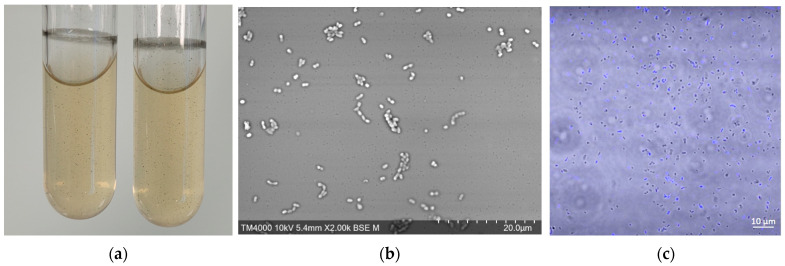
Figure 1
Figure 1
Macroscopic and microscopic features of Methanobrevibacter massiliense. (a) Macroscopic observation of M. massiliense and P. piscolens co-cultures, dark deposits are visible. (b) Electron microscopy (TM4000 HITACHI, 10 KV, × 1.500), coccobacilli are visible, but no morphologic features made it possible to distinguish between M. massiliense and P. piscolens. (c) Confocal microscopy merged view of autofluorescence at 420 nm and brightfill mode; autofluorescent coccobacilli are visible as well as non-autofluorescent coccobacilli (LSM 900 (Carl Zeiss Microscopy GmbH)).
Figure 2
Figure 2
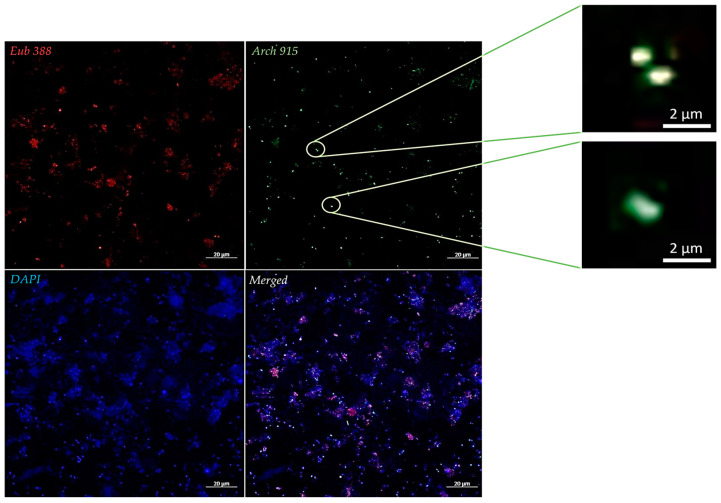
Fluorescence in situ hybridization (FISH) representative detection of M. massiliense and bacteria in a direct necrotic pulp sample. Eub 388 probe staining bacteria 16S rRNA gene in red. Arch 915 probe staining the archaeal 16S rRNA gene in green. Universal DNA DAPI staining in blue. Merged. Scale bar, 20 μm.
Figure 3
Figure 3
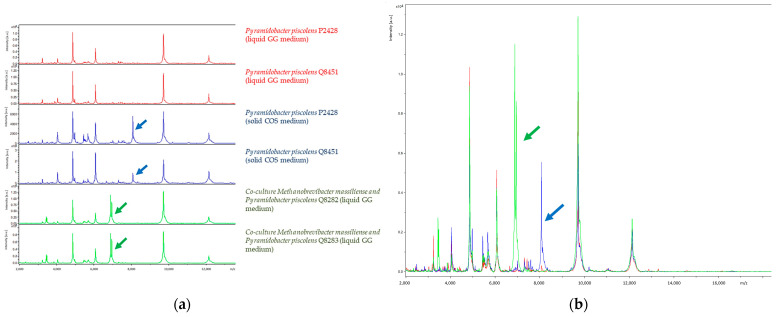
MALDI-TOF spectra and superposition of spectra from co-cultures Q8282 and Q8283 with spectra from P. piscolens cultivated on COS and in liquid GG medium. (a) MALDI-TOF spectra of P. piscolens cultivated on COS (in red), MALDI-TOF spectra of P. piscolens cultivated in liquid GG medium (in blue), MALDI-TOF spectra of co-cultures Q8282 and Q8283 (in green), smoothed and baseline substrated. (b) Superposition of the six spectra. All the spectra are superimposable, with one missing peak in the co-culture of M. massiliense and P. piscolens, the same as that absent in the liquid medium spectra (blue arrow), and two additional peaks in the co-cultures with M. massiliense (green arrow). The superposition of the spectra reveals a significant correlation between co-cultures Q8282 and Q8283 with strains of P. piscolens cultivated on COS, as well as in liquid GG medium. These observations suggest a specific spectrum associated with M. massiliense in the co-cultures.
Figure 4
Figure 4
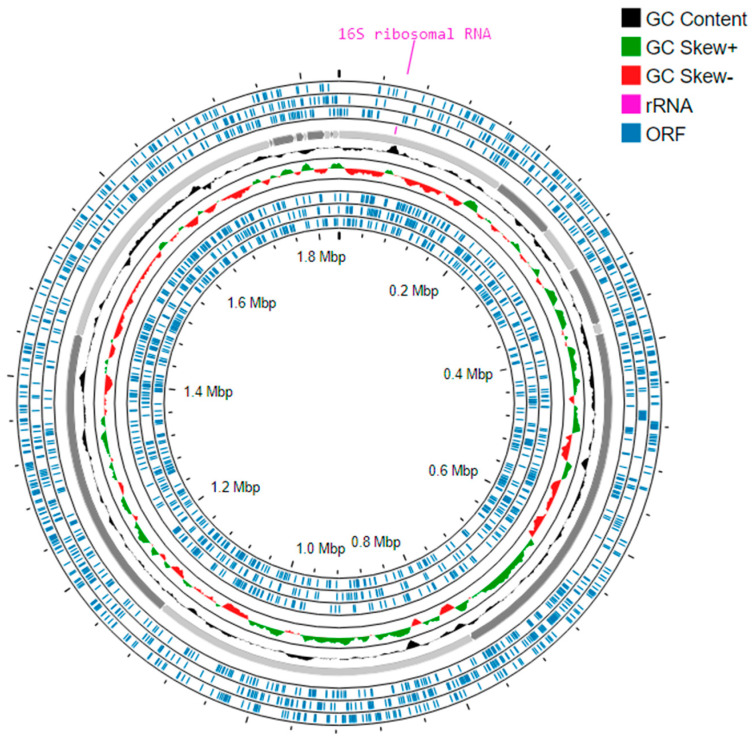
Circular representation of the Methanobrevibacter massiliense reference genome. The genome was visualised using the Proksee platform with default settings (version 1.0.0), available at https://proksee.ca/, accessed on 1 March 2023. The 19 contigs are displayed with colour-coded highlights, allowing for the identification of key genomic elements, and providing insight into the composition and structure of the M. massiliense genome. Open-reading frames are shown in blue, GC content is represented in black, while positive and negative GC skew are depicted in green and red, respectively. The rRNA regions are highlighted in pink. This analysis provides an overview of the distribution of protein-coding genes and reveals variations in GC content throughout the genome.
Figure 5
Figure 5
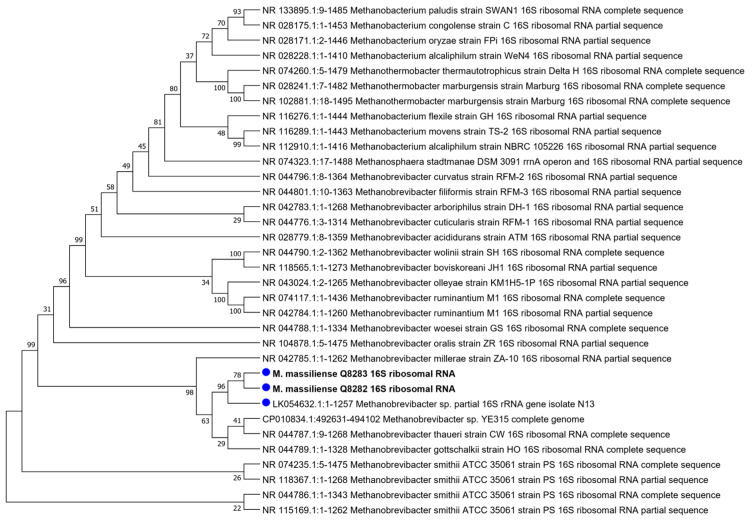
Maximum Likelihood phylogenetic tree based on 16S rRNA sequence analysis of M. massiliense and the first 35 hit blasts downloaded from NCBI GenBank Database (3 January 2023).
Figure 6
Figure 6
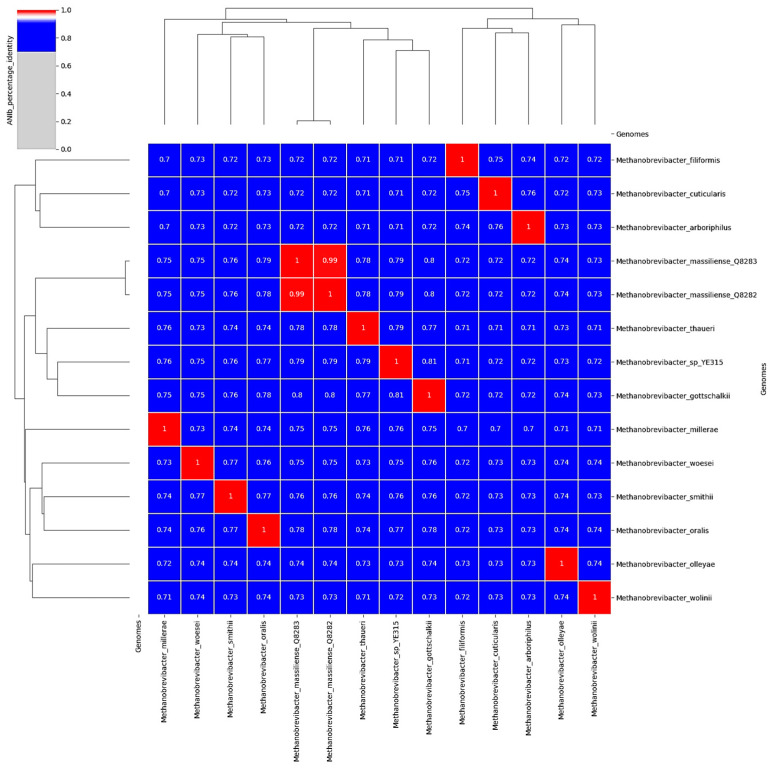
Heat map phylogeny generated with ANI values using PYANI software version (0.2.7) with standard parameters of M. massiliense and closely related methanogen species.

References

    1. Gaci N., Borrel G., Tottey W., O’Toole P.W., Brugère J.-F. Archaea and the Human Gut: New Beginning of an Old Story. World J. Gastroenterol. WJG. 2014;20:16062–16078. doi: 10.3748/wjg.v20.i43.16062. - DOI - PMC - PubMed
    1. Belmok A., de Cena J.A., Kyaw C.M., Damé-Teixeira N. The Oral Archaeome: A Scoping Review. J. Dent. Res. 2020;99:630–643. doi: 10.1177/0022034520910435. - DOI - PubMed
    1. Togo A.H., Grine G., Khelaifia S., des Robert C., Brevaut V., Caputo A., Baptiste E., Bonnet M., Levasseur A., Drancourt M., et al. Culture of Methanogenic Archaea from Human Colostrum and Milk. Sci. Rep. 2019;9:18653. doi: 10.1038/s41598-019-54759-x. - DOI - PMC - PubMed
    1. Sereme Y., Guindo C.O., Filleron A., Corbeau P., Tran T.A., Drancourt M., Vitte J., Grine G. Meconial Methanobrevibacter Smithii Suggests Intrauterine Methanogen Colonization in Preterm Neonates. Curr. Res. Microb. Sci. 2021;2:100034. doi: 10.1016/j.crmicr.2021.100034. - DOI - PMC - PubMed
    1. Grine G., Boualam M.A., Drancourt M.M. Methanobrevibacter smithii, a methanogen consistently colonising the newborn stomach. Eur. J. Clin. Microbiol. Infect. Dis. 2017;36:2449–2455. doi: 10.1007/s10096-017-3084-7. - DOI - PubMed

LinkOut - more resources