Review
. 2023 Dec 19;16(1):7.
doi: 10.3390/pharmaceutics16010007.

Nano-Drug Delivery Systems in Oral Cancer Therapy: Recent Developments and Prospective

Affiliations
Review

Nano-Drug Delivery Systems in Oral Cancer Therapy: Recent Developments and Prospective

Yun Zhang et al. Pharmaceutics. .

Abstract

Oral cancer (OC), characterized by malignant tumors in the mouth, is one of the most prevalent malignancies worldwide. Chemotherapy is a commonly used treatment for OC; however, it often leads to severe side effects on human bodies. In recent years, nanotechnology has emerged as a promising solution for managing OC using nanomaterials and nanoparticles (NPs). Nano-drug delivery systems (nano-DDSs) that employ various NPs as nanocarriers have been extensively developed to enhance current OC therapies by achieving controlled drug release and targeted drug delivery. Through searching and analyzing relevant research literature, it was found that certain nano-DDSs can improve the therapeutic effect of drugs by enhancing drug accumulation in tumor tissues. Furthermore, they can achieve targeted delivery and controlled release of drugs through adjustments in particle size, surface functionalization, and drug encapsulation technology of nano-DDSs. The application of nano-DDSs provides a new tool and strategy for OC therapy, offering personalized treatment options for OC patients by enhancing drug delivery, reducing toxic side effects, and improving therapeutic outcomes. However, the use of nano-DDSs in OC therapy still faces challenges such as toxicity, precise targeting, biodegradability, and satisfying drug-release kinetics. Overall, this review evaluates the potential and limitations of different nano-DDSs in OC therapy, focusing on their components, mechanisms of action, and laboratory therapeutic effects, aiming to provide insights into understanding, designing, and developing more effective and safer nano-DDSs. Future studies should focus on addressing these issues to further advance the application and development of nano-DDSs in OC therapy.

Keywords: nano-drug delivery system; nanomaterial; nanoparticle; oral cancer; targeting.


Conflict of interest statement

The authors declare no conflict of interest.

Figures
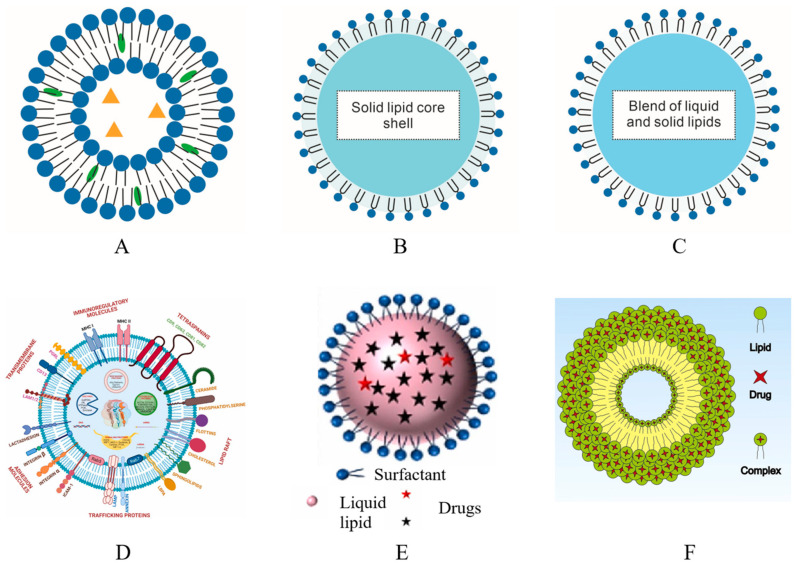
Figure 4
Figure 4
Various types of LBNPs. (A) Liposomes: liposomes can encapsulate hydrophobic drugs (green ovals) in the hydrophobic region and hydrophilic ones (orange triangles) in the interior aqueous region. (B) SLNs consisting of matrix materials and surface stabilizers. (C) NLCs composed of solid lipids, liquid lipids, and surfactants. (D) Elemental composition of salivary exosomes. Reproduced with permission from ref. [153] (Copyright 2022 Elsevier). (E) Elemental composition of NEs. Reproduced with permission from ref. [158] (Copyright 2023 Elsevier). (F) Elemental composition of PLC-NPs. Reproduced with permission from ref. [160] (Copyright 2013 Elsevier).
Figure 5
Figure 5
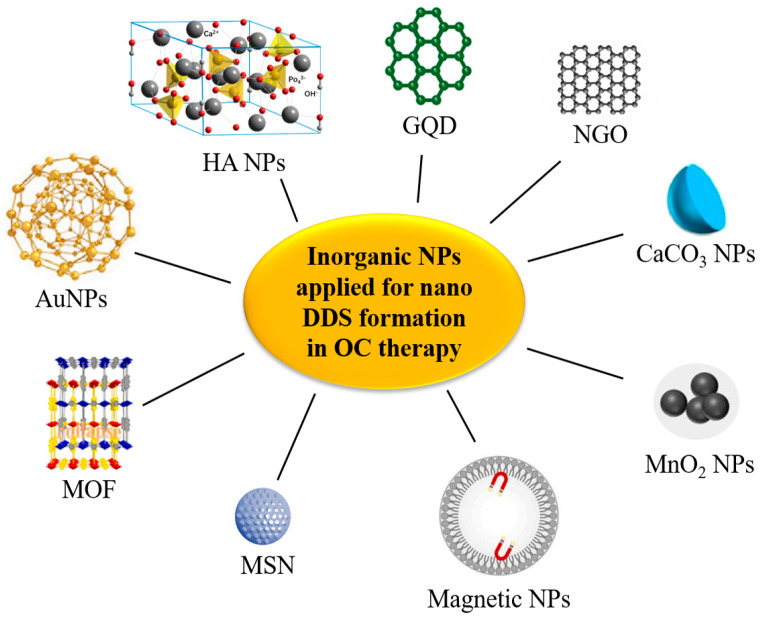
Inorganic NPs applied for nano-DDS formation in OC therapy. Reproduced with permission from ref. [185] (opyright 2023 Elsevier), ref. [42] (Copyright 2023 Elsevier), ref. [186] (Copyright 2023 Elsevier), ref. [21] (Copyright 2019 Elsevier), and ref. [102] (Copyright 2023 Elsevier).
Figure 1
Figure 1
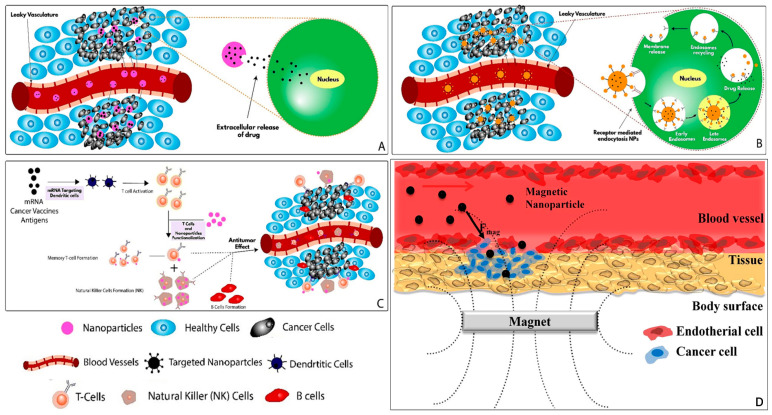
(A) Passive targeting refers to releasing drugs into tumor cells from nanoparticles (NPs) by the enhanced permeability and retention (EPR) effect through leaky vasculature. The drugs are released into the extracellular matrix from NPs and penetrate the tumor cells. (B) Active targeting: receptors on tumor cells can be targeted and bound with a specific targeting ligand on the surface of NPs, allowing the drugs to be released directly into the tumor cells. This method leads to a more significant accumulation of the drugs and uptake by the cells through the receptor-mediated endocytosis pathway. (C) Immune targeting: instead of administering drugs directly to the tumor, new immune-based therapy induces antitumor T cells, natural killer cells, and B cells. The treatment involves nucleic acid-based nano-vaccines that target dendritic cells, activating antibody cells and programming tumor cell death in turn. Reproduced with permission from ref. [5] (Copyright 2023 Elsevier). (D) Magnetic drug targeting with an external magnet. Reproduced with permission from ref. [45]. (Copyright 2010 Elsevier).
Figure 2
Figure 2
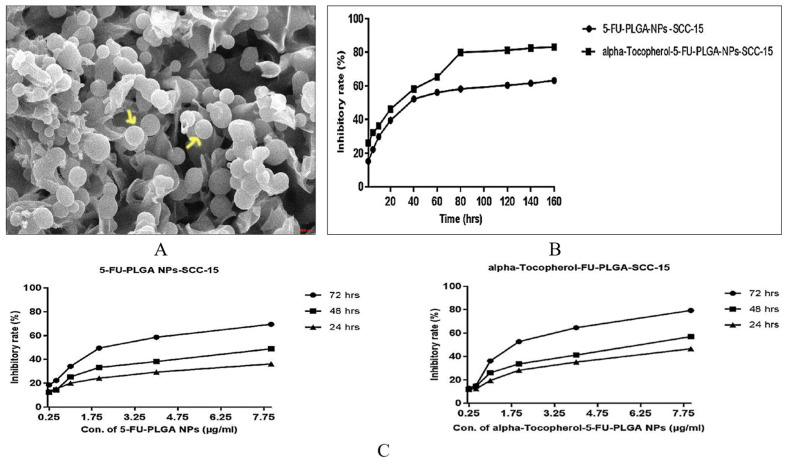
(A) Scanning electron microscope of α-t-FU-PLGA/5-FU-PLGA NPs with spherical shape (yellow arrow) and no adherence between the particles. (B) Inhibition rate of α-t-FU-PLGA NPs and 5-FU-PLGA NPs on SCC-15 cells over time. (C) Inhibition rate of 5-FU-PLGA NPs (left) and α-t-FU-PLGA NPs (right) on SCC-15 cells at different concentrations. Reproduced with permission from ref. [68] (Copyright 2019 Medknow).
Figure 3
Figure 3
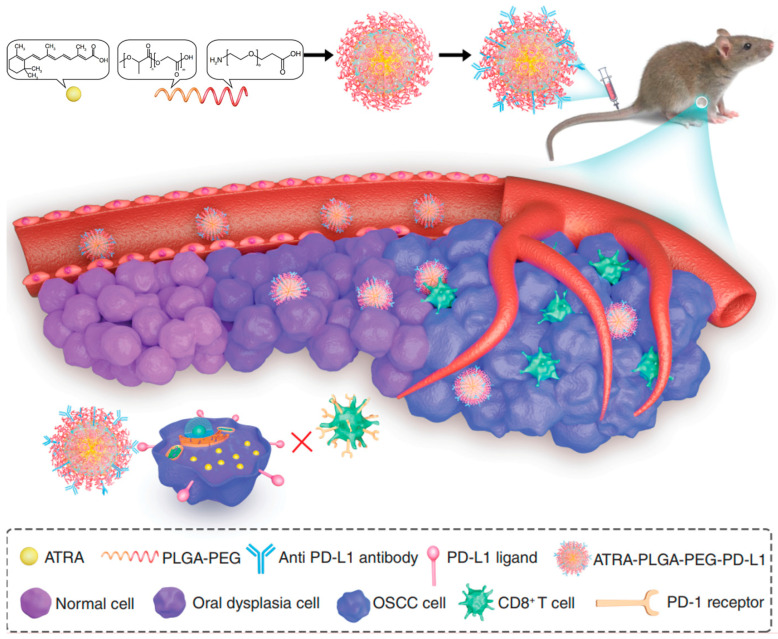
Fabrication of ATRA-PLGA-PEG-PD-L1 nanomedicines. Reproduced with permission from ref. [66] (Copyright 2020 Future Medicine).
Figure 6
Figure 6
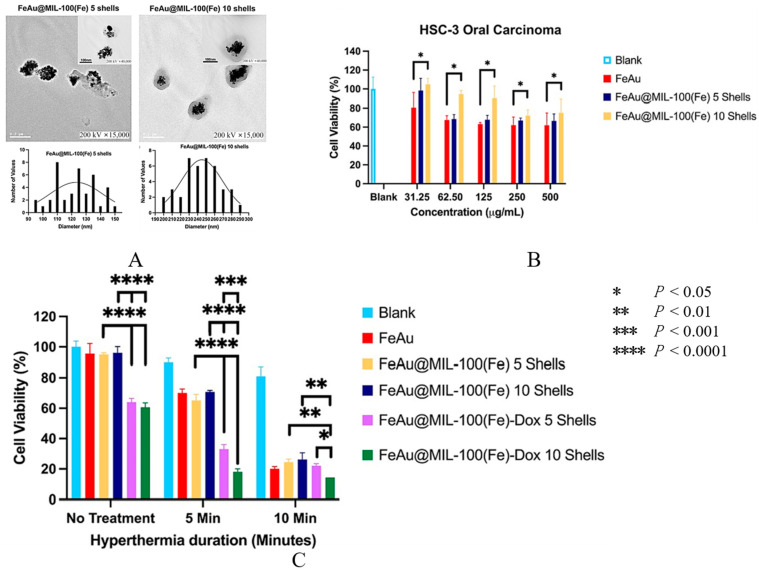
(A) TEM micrographs and size distribution of FeAu@MIL-100(Fe) 5-shell nanostructures and FeAu@MIL-100(Fe) 10-shell nanostructures. (B) Cell viability of HSC-3 OSCC cells in the presence of FeAu NPs and FeAu@MOF nanostructures. (C) Post-hyperthermia cell viability analysis of HSC-3 OSCC cells with or without DOX-encapsulated within FeAu@MOF nanostructures. Reproduced with permission from ref. [173] (Copyright 2022 Elsevier).
Figure 7
Figure 7
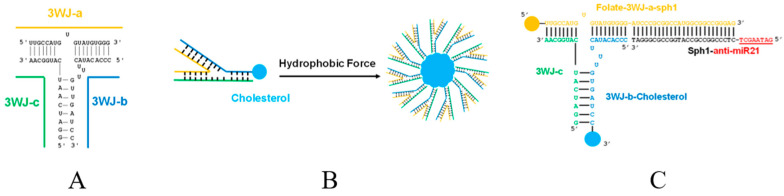
Design, construction, and characterization of RNA micelles. (A) 3WJ motif of pRNA from bacteriophage phi29 DNA packaging motor. (B) pRNA-3WJ micelle formation by hydrophobic force. (C) 2D structure of 3WJ/FA/anti-miR21 micelles. Reproduced with permission from ref. [57]. (Copyright 2019 ACS Nano).

References

    1. Sachdeva A., Dhawan D., Jain G.K., Yerer M.B., Collignon T.E., Tewari D., Bishayee A. Novel Strategies for the Bioavailability Augmentation and Efficacy Improvement of Natural Products in Oral Cancer. Cancers. 2022;15:268. doi: 10.3390/cancers15010268. - DOI - PMC - PubMed
    1. Nor J.E., Gutkind J.S. Head and Neck Cancer in the New Era of Precision Medicine. J. Dent. Res. 2018;97:601–602. doi: 10.1177/0022034518772278. - DOI - PubMed
    1. Yang C.M., Chu T.H., Tsai K.W., Hsieh S., Kung M.L. Phytochemically Derived Zingerone Nanoparticles Inhibit Cell Proliferation, Invasion and Metastasis in Human Oral Squamous Cell Carcinoma. Biomedicines. 2022;10:320. doi: 10.3390/biomedicines10020320. - DOI - PMC - PubMed
    1. Cardona-Mendoza A., Olivares-Nino G., Diaz-Baez D., Lafaurie G.I., Perdomo S.J. Chemopreventive and Anti-tumor Potential of Natural Products in Oral Cancer. Nutr. Cancer. 2022;74:779–795. doi: 10.1080/01635581.2021.1931698. - DOI - PubMed
    1. Vyas K., Rathod M., Patel M.M. Insight on nano drug delivery systems with targeted therapy in treatment of oral cancer. Nanomedicine. 2023;49:102662. doi: 10.1016/j.nano.2023.102662. - DOI - PubMed

LinkOut - more resources