Breast Cancer Incidence Among US Women Aged 20 to 49 Years by Race, Stage, and Hormone Receptor Status
- PMID: 38277147
- PMCID: PMC10818222
- DOI: 10.1001/jamanetworkopen.2023.53331
Breast Cancer Incidence Among US Women Aged 20 to 49 Years by Race, Stage, and Hormone Receptor Status
Abstract
Importance: Breast cancer in young women has a less favorable prognosis compared with older women. Yet, comprehensive data on recent trends and how period and cohort effects may affect these trends among young women are not well-known.
Objective: To evaluate breast cancer incidence among young women in the US over a 20-year period by race and ethnicity, hormone receptor status (estrogen receptor [ER] and progesterone receptor [PR]), tumor stage, and age at diagnosis, as well as how period and cohort effects may affect these trends.
Design, setting, and participants: This cross-sectional study used data from Surveillance, Epidemiology, and End Results 17 registries (2000-2019). Women aged 20 to 49 years with a primary invasive breast cancer were included. Data were analyzed between February and June 2023.
Main outcomes and measures: Age-standardized incidence rates (ASIR), incidence rate ratios (IRR), and average annual percent changes (AAPC) stratified by race and ethnicity, hormone receptor status, tumor stage, and age at diagnosis.
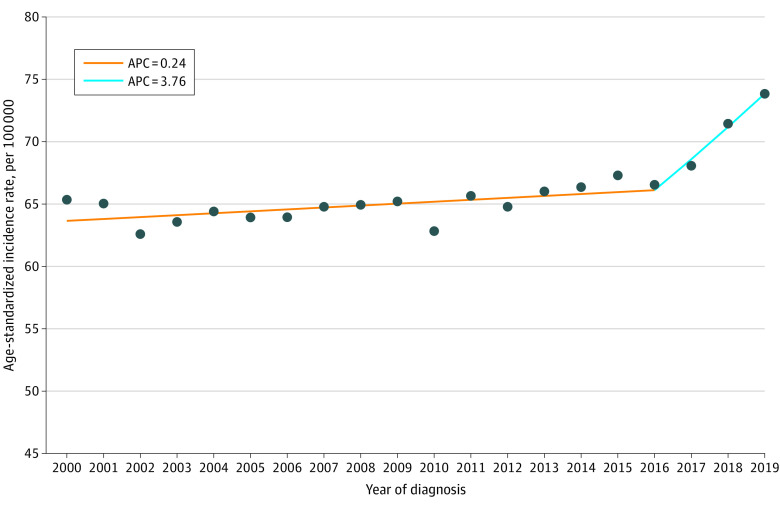
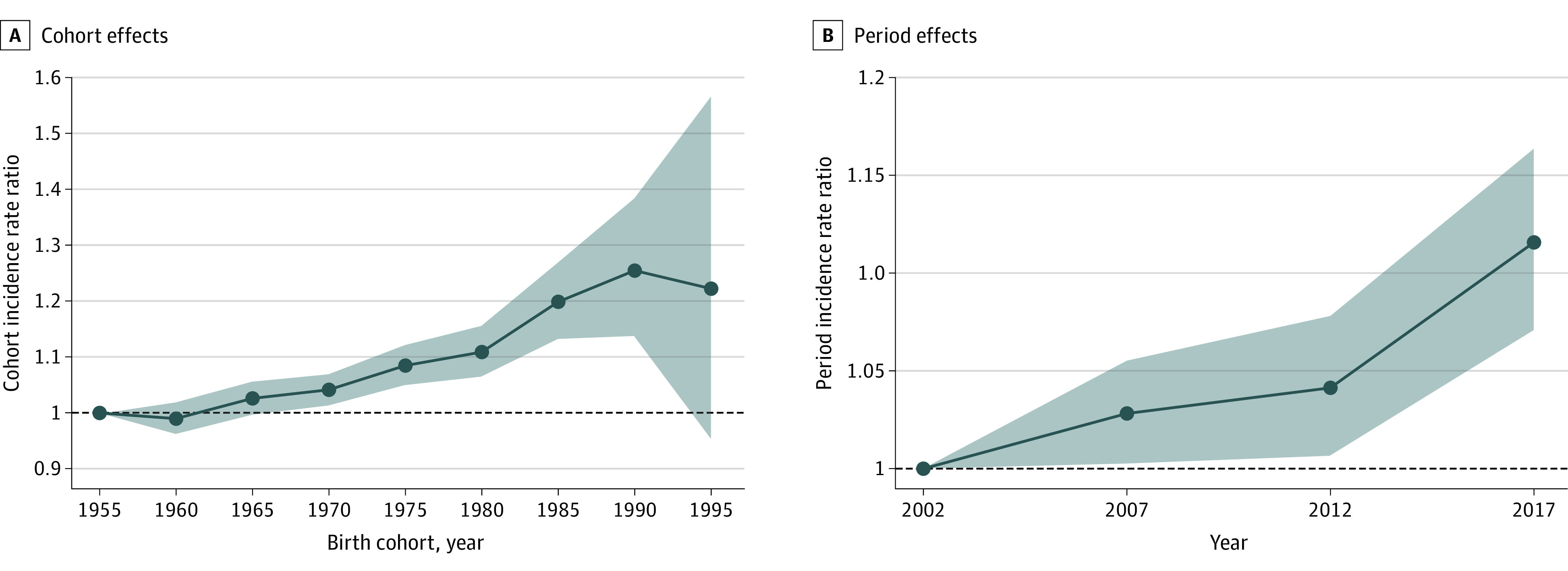
Results: Out of 217 815 eligible women (1485 American Indian or Alaska Native [0.7%], 25 210 Asian or Pacific Islander [11.6%], 27 112 non-Hispanic Black [12.4%], 37 048 Hispanic [17.0%], 126 960 non-Hispanic White [58.3%]), the majority were diagnosed with an ER+/PR+ tumor (134 024 [61.5%]) and were diagnosed with a stage I tumor (81 793 [37.6%]). Overall, invasive breast cancer incidence increased (AAPC, 0.79; 95% CI, 0.42 to 1.15), with increasing trends across almost all racial and ethnic groups. ASIR increased for ER+/PR+ (AAPC, 2.72; 95% CI, 2.34 to 3.12) and ER+/PR- tumors (AAPC, 1.43; 95% CI, 1.00 to 1.87), and decreased for ER-/PR+ (AAPC, -3.25; 95% CI, -4.41 to -2.07) and ER-/PR- tumors (AAPC, -0.55; 95% CI, -1.68 to 0.60). For women aged 20 to 29 and 30 to 39 years, ASIRs were highest among non-Hispanic Black women (age 20-29 years: IRR, 1.53; 95% CI, 1.43 to 1.65; age 30-39 years: IRR, 1.15; 95% CI, 1.12 to 1.18). For women aged 40 to 49 years, ASIR was lower for non-Hispanic Black women (IRR, 0.96; 95% CI, 0.94 to 0.97) compared with non-Hispanic White women. Incidence rates increased for stages I and IV tumors but decreased for stage II and III tumors. Age-period-cohort analysis demonstrated both cohort and period effects on breast cancer incidence (P < .001).
Conclusions and relevance: In this population-based cross-sectional analysis, an increase in breast cancer incidence rates among young US women and age-related crossover between non-Hispanic White and Black women were observed. Prevention efforts in young women need to adopt a targeted approach to address racial disparities in incidence rates observed at different age phases.
Conflict of interest statement
Figures
References
Publication types
MeSH terms
Substances
Grants and funding
LinkOut - more resources
Full Text Sources
Medical
Research Materials