


Mobile and Computer-Based Applications for Rehabilitation Monitoring and Self-Management After Knee Arthroplasty: Scoping Review
- PMID: 38277195
- PMCID: PMC10858429
- DOI: 10.2196/47843
Mobile and Computer-Based Applications for Rehabilitation Monitoring and Self-Management After Knee Arthroplasty: Scoping Review
Abstract
Background: Successful post-knee replacement rehabilitation requires adequate access to health information, social support, and periodic monitoring by a health professional. Mobile health (mHealth) and computer-based technologies are used for rehabilitation and remote monitoring. The extent of technology use and its function in post-knee replacement rehabilitation care in low and middle-income settings are unknown.
Objective: To inform future mHealth intervention development, we conducted a scoping review to map the features and functionality of existing technologies and determine users' perspectives on telerehabilitation and technology for self-management.
Methods: We followed the Joanna Briggs Institute methodology for scoping reviews. We searched the Embase, Medline, PsycINFO via OVID, and Cochrane Central Register of Controlled Trials databases for manuscripts published from 2001 onward. We included original research articles reporting the use of mobile or computer-based technologies by patients, health care providers, researchers, or family members. Studies were divided into the following 3 categories based on the purpose: validation studies, clinical evaluation, and end user feedback. We extracted general information on study design, technology features, proposed function, and perspectives of health care providers and patients. The protocol for this review is accessible in the Open Science Framework.
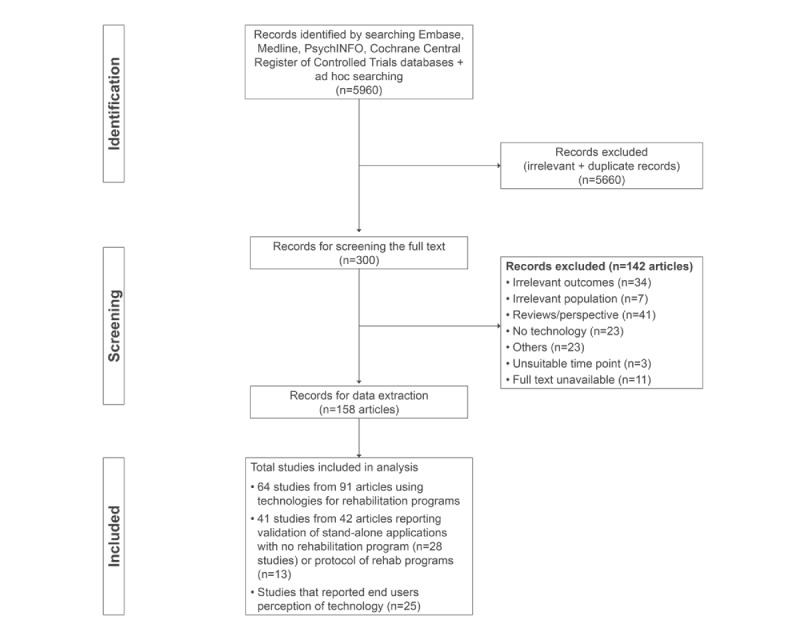
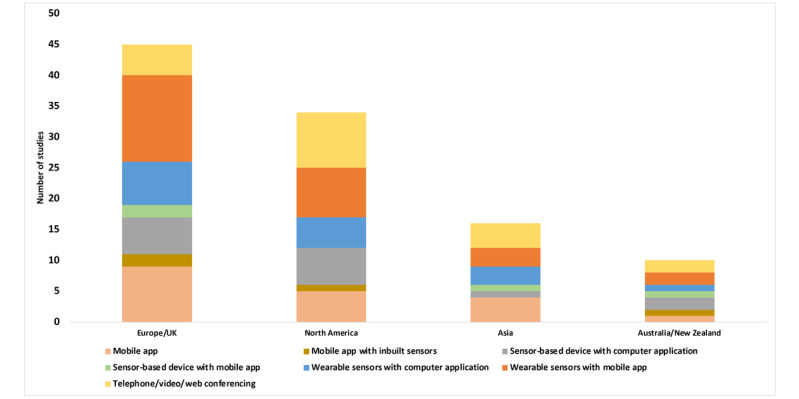
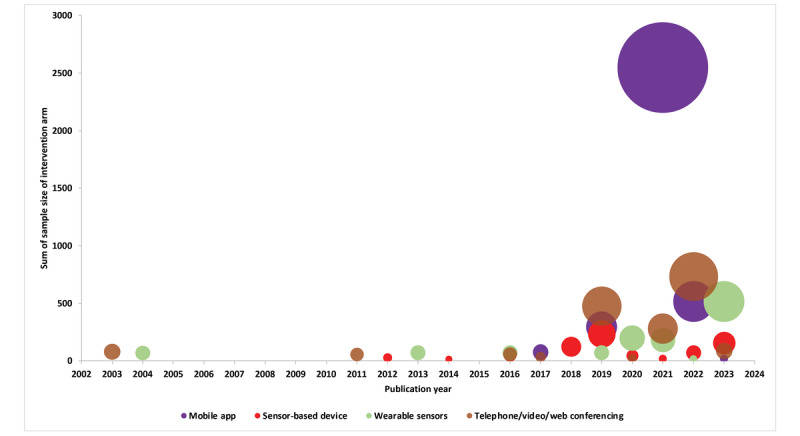
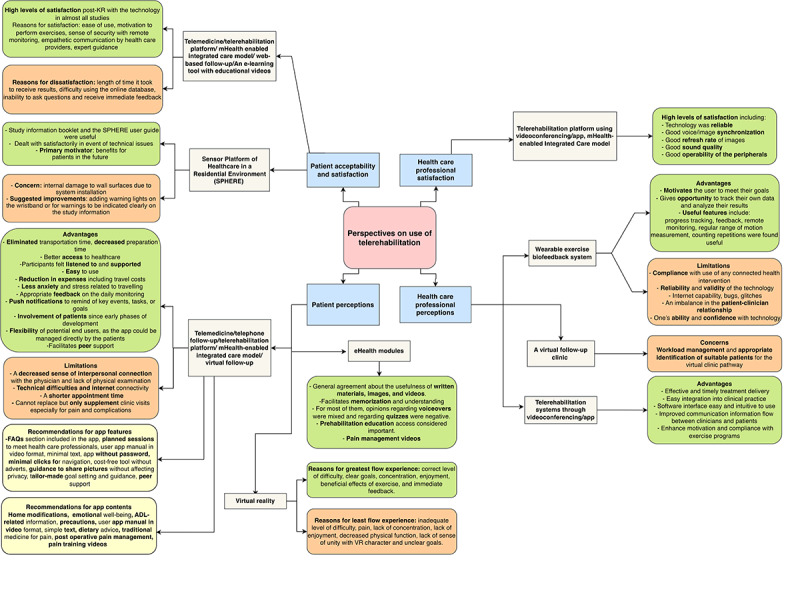
Results: Of the 5960 articles, 158 that reported from high-income settings contributed to the qualitative summary (64 studies on mHealth or telerehabilitation programs, 28 validation studies, 38 studies describing users' perceptions). The highest numbers of studies were from Europe or the United Kingdom and North America regarding the use of a mobile app with or without wearables and reported mainly in the last decade. No studies were from low and middle-income settings. The primary functions of technology for remote rehabilitation were education to aid recovery and enable regular, appropriate exercises; monitoring progress of pain (n=19), activity (n=20), and exercise adherence (n=30); 1 or 2-way communication with health care professionals to facilitate the continuum of care (n=51); and goal setting (n=23). Assessment of range of motion (n=16) and gait analysis (n=10) were the commonly validated technologies developed to incorporate into a future rehabilitation program. Few studies (n=14) reported end user involvement during the development stage. We summarized the reasons for satisfaction and dissatisfaction among users across various technologies.
Conclusions: Several existing mobile and computer-based technologies facilitate post-knee replacement rehabilitation care for patients and health care providers. However, they are limited to high-income settings and may not be extrapolated to low-income settings. A systematic needs assessment of patients undergoing knee replacement and health care providers involved in rehabilitation, involving end users at all stages of development and evaluation, with clear reporting of the development and clinical evaluation can make post-knee replacement rehabilitation care in resource-poor settings accessible and cost-effective.
Keywords: arthroplasty; development; knee; knee arthroplasty; knee replacement; mHealth; mHealth intervention; monitoring; rehabilitation; scoping review; self-management; social support; telerehabilitation.
©Sabhya Pritwani, Purnima Shrivastava, Shruti Pandey, Ajit Kumar, Rajesh Malhotra, Ralph Maddison, Niveditha Devasenapathy. Originally published in JMIR mHealth and uHealth (https://mhealth.jmir.org), 26.01.2024.
Conflict of interest statement
Conflicts of Interest: None declared.
Figures
References
-
- Zhang W, Moskowitz RW, Nuki G, Abramson S, Altman RD, Arden N, Bierma-Zeinstra S, Brandt KD, Croft P, Doherty M, Dougados M, Hochberg M, Hunter DJ, Kwoh K, Lohmander LS, Tugwell P. OARSI recommendations for the management of hip and knee osteoarthritis, Part II: OARSI evidence-based, expert consensus guidelines. Osteoarthritis Cartilage. 2008 Feb;16(2):137–62. doi: 10.1016/j.joca.2007.12.013. https://linkinghub.elsevier.com/retrieve/pii/S1063-4584(07)00397-4 S1063-4584(07)00397-4 - DOI - PubMed
-
- Artz N, Elvers KT, Lowe CM, Sackley C, Jepson P, Beswick AD. Effectiveness of physiotherapy exercise following total knee replacement: systematic review and meta-analysis. BMC Musculoskelet Disord. 2015 Feb 07;16(1):15. doi: 10.1186/s12891-015-0469-6. https://bmcmusculoskeletdisord.biomedcentral.com/articles/10.1186/s12891... 10.1186/s12891-015-0469-6 - DOI - DOI - PMC - PubMed
-
- Goldsmith LJ, Suryaprakash N, Randall E, Shum J, MacDonald V, Sawatzky R, Hejazi S, Davis JC, McAllister P, Bryan S. The importance of informational, clinical and personal support in patient experience with total knee replacement: a qualitative investigation. BMC Musculoskelet Disord. 2017 Mar 24;18(1):127. doi: 10.1186/s12891-017-1474-8. https://bmcmusculoskeletdisord.biomedcentral.com/articles/10.1186/s12891... 10.1186/s12891-017-1474-8 - DOI - DOI - PMC - PubMed
-
- Groeneveld BS, Dekkers T, Mathijssen NMC, Vehmeijer SBW, Melles M, Goossens RHM. Communication preferences in total joint arthroplasty: exploring the patient experience through generative research. Orthop Nurs. 2020;39(5):292–302. doi: 10.1097/NOR.0000000000000694.00006416-202009000-00005 - DOI - PubMed
-
- Westby MD, Backman CL. Patient and health professional views on rehabilitation practices and outcomes following total hip and knee arthroplasty for osteoarthritis:a focus group study. BMC Health Serv Res. 2010 May 11;10(1):119. doi: 10.1186/1472-6963-10-119. https://bmchealthservres.biomedcentral.com/articles/10.1186/1472-6963-10... 1472-6963-10-119 - DOI - DOI - PMC - PubMed
Publication types
MeSH terms
Grants and funding
LinkOut - more resources
Full Text Sources
Medical
