Meta-Analysis
. 2024 Jan 26;14(1):2221.
doi: 10.1038/s41598-024-52277-z.

A systematic review and meta-analysis of how social memory is studied

Affiliations
Meta-Analysis

A systematic review and meta-analysis of how social memory is studied

Meghan Cum et al. Sci Rep. .

Abstract

Social recognition is crucial for survival in social species, and necessary for group living, selective reproduction, pair bonding, and dominance hierarchies. Mice and rats are the most commonly used animal models in social memory research, however current paradigms do not account for the complex social dynamics they exhibit in the wild. To assess the range of social memories being studied, we conducted a systematic analysis of neuroscience articles testing the social memory of mice and rats published within the past two decades and analyzed their methods. Our results show that despite these rodent's rich social memory capabilities, the majority of social recognition papers explore short-term memories and short-term familiarity levels with minimal exposure between subject and familiar stimuli-a narrow type of social memory. We have identified several key areas currently understudied or underrepresented: kin relationships, mates, social ranks, sex variabilities, and the effects of aging. Additionally, reporting on social stimulus variables such as housing history, strain, and age, is limited, which may impede reproducibility. Overall, our data highlight large gaps in the diversity of social memories studied and the effects social variables have on social memory mechanisms.


Conflict of interest statement

The authors declare no competing interests.

Figures
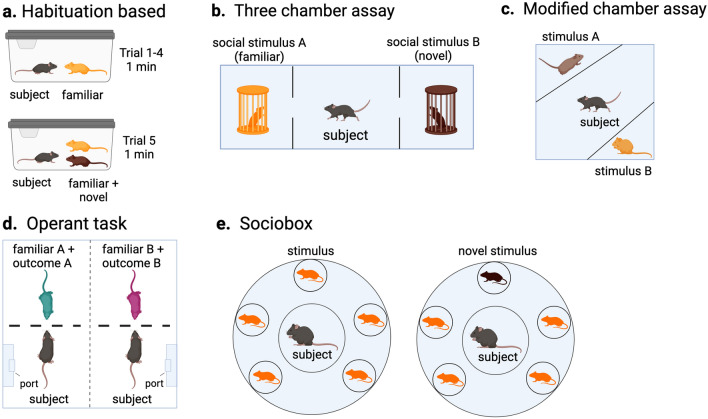
Figure 1
Figure 1
Social memory paradigms. (a) Schematic showing standard trial-based social memory assays. (b) Schematic of classic 3-chamber social memory assay. (c) Modified chamber assay apparatus. (d) Operant task where subject learns to associate familiar social stimuli with a non-social outcome; social discrimination is judged based on subject’s learned behavioral output. (e) Sociobox apparatus designed to test social memory against multiple present familiar social stimuli. Left shows phase one for familiarization and right is social recognition phase.
Figure 2
Figure 2
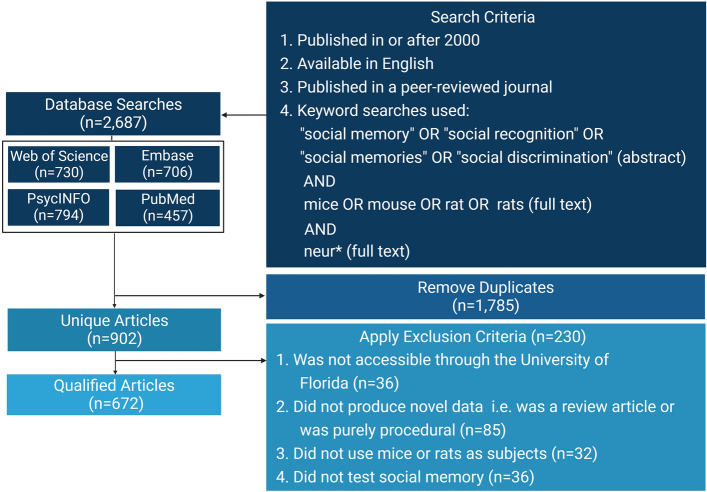
Methodological flowchart. Databases searched with number (n) of articles found per site alongside key terms and search criteria, number of duplicates, and list of exclusion criteria with the number (n) of articles removed for each item.
Figure 3
Figure 3
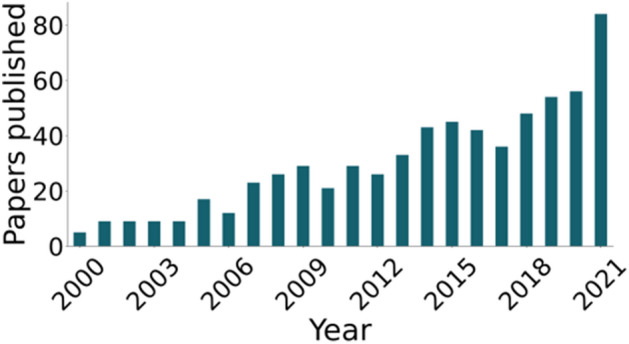
Social Memory Articles Published in the 2000's. Articles that satisfied our inclusion criteria and were included in this studied plotted by the year they were published.
Figure 4
Figure 4
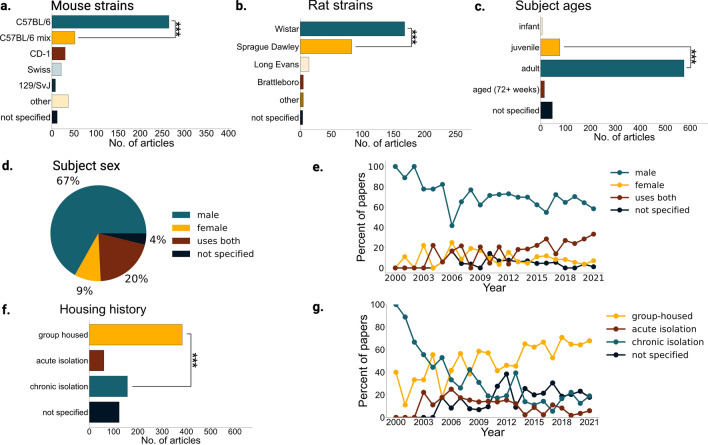
Subject Identity in social memory studies. (a) Number of articles using different strains of mice (n = 406 from 672 articles). Other strains for mice included: BALB/c, BTBR, A/J, C3H, FVB/NJ, ICR, OF1, NMRI, DBA, CF-1, and wild mice. C57BL/6 mix vs C57BL6 two sample chi-square, X2 = 492.96, p = 3.22 × 10–109. (b) Number of articles using different strains of rats (n = 275 from 672). Other strains for rats included Lewis, SHR, and WAG/Rjj. Sprague Dawley vs Wistar two sample chi-square, X2 = 110.53, p = 7.50 × 10–26. Note that the 1% articles that included both rats and mice and are represented in both (a) and (b). (c) Ages of subjects across all articles reviewed. Infant < 3 weeks, juvenile 3–7 weeks, adult > 7 & < 72 weeks, aged > 72 weeks. Juveniles vs adults two sample chi-square, X2 = 3,637.64, p = 0. (d) Pie chart showing the percentage of all articles (n = 672) from years 2000–2022 that use one, both or unspecified sex of mice or rats. (e) Percent of articles from years 2000–2021 (n = 665) that use one, both, or unspecified sexes of mice or rats. If no sexes were stated, we marked papers as “sex not specified”. (f) Number of articles from years 2000–2021 (n = 665) that use group-housing, acute isolation (over a day—less than a week), chronic isolation (over a week), or do not specify the housing history of the subjects. Chronic isolation vs group housed two sample chi-square, X2 = 310.09, p = 2.09 × 10–69. (g) Number of articles from 2000 to 2022 reporting each type of housing history.
Figure 5
Figure 5
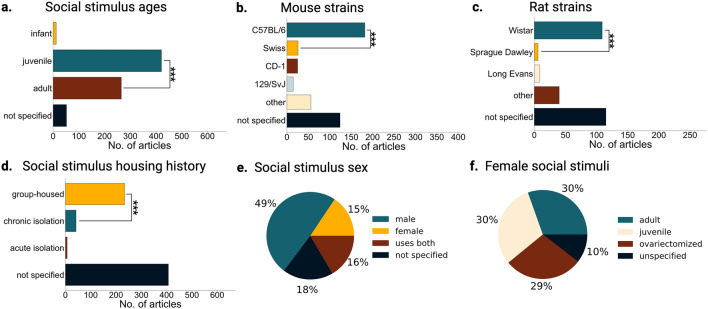
Social stimulus identities in social memory studies. (a) Age of social stimuli across all articles, adult vs juveniles two sample chi-square, X2 = 154.76, n = 672, p = 1.58 × 10–35. (b) For 406 mouse articles that included social stimuli, mouse strains that were used for social stimuli. Other mouse strains include BALB/c, BTBR, A/J, C3H, FVB/NJ, ICR, OF1, NMRI, DBA, and wild mice. Swiss vs C57BL/6 two sample chi-square, X2 = 239.51, p = 5.02 × 10–54. (c) For 279 rat articles that included social stimuli, rat strains that were used for social stimuli. Other rat strains include Lewis, Lister Hooded, WAG/Rij and F344. Sprague Dawley vs Wistar two sample chi-square, X2 = 83.64, p = 5.95 × 10–20. (d) Number of articles that used group-housing, acute isolation (over a day—less than a week), chronic isolation (over a week), or do not specify the housing history for social stimuli. Chronic isolation vs group housed two sample chi-square, X2 = 241.70, n = 672, p = 1.67 × 10–54. (e) Percent of all articles (n = 672) that use one, both, or unspecified sexes of mice or rats for social stimuli. (f) Of those articles that used female social stimuli (n = 220), percentage of those that used juvenile, ovariectomized, adult intact or unspecified age females.
Figure 6
Figure 6
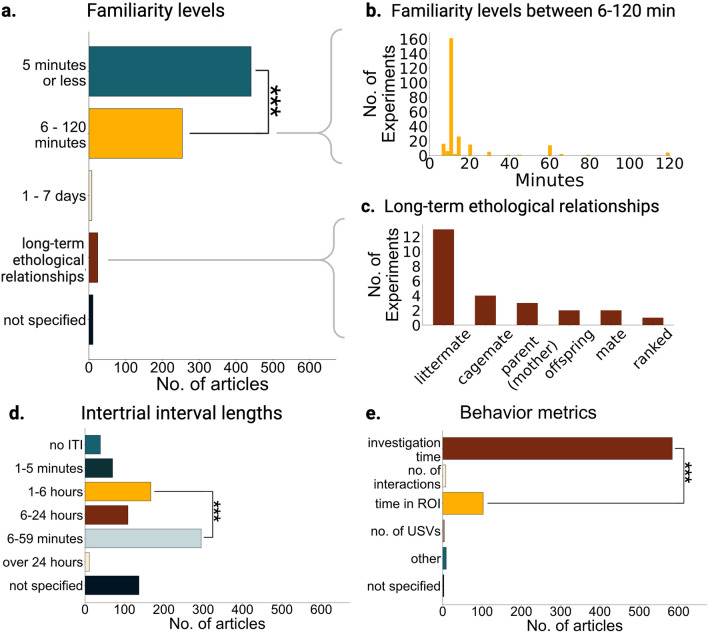
Types of social memories studied and how they were measured. (a) Number (No.) of articles that use various levels of familiarity. 6–120 min vs 5 min or less, two sample chi-square, X2 = 230.68, n = 672, p = 4.25 × 10–52. (b) Histogram showing all familiarity levels used from 6 to 120 min. (c) A breakdown of all the types of ethologically relevant relationships tested in a social memory paradigm in n = 25 articles. (d) Number of articles that use various intertrial interval (ITI) lengths; ITI being the time in between trials, both learning and test trials. 1–6 h vs 6–59 min two sample chi-square, X2 = 99.00, n = 672, p = 2.53 × 10–23. (e) Metrics cited across all articles. Investigation time refers to interaction time, sniffing time, and contact time while number of interactions refers to a unit of interaction bouts rather than a cumulative time metric; time in region of interest (ROI) includes time spent near or in a chamber or other target area. Time in ROI vs investigation time two sample chi-square, X2 = 3025.27, n = 672, p = 0.

Update of

References

    1. Alper TG, Korchin SJ. Memory for socially relevant material. J. Abnorm. Soc. Psychol. 1952;47:25–37. doi: 10.1037/h0055826. - DOI - PubMed
    1. Witryol SL, Kaess WA. Sex differences in social memory tasks. J. Abnorm. Psychol. 1957;54:343–346. - PubMed
    1. Carr WJ, Yee L, Gable D, Marasco E. Olfactory recognition of conspecifics by domestic Norway rats. J. Comp. Physiol. Psychol. 1976;90:821–828. doi: 10.1037/h0077266. - DOI - PubMed
    1. Porter RH, Wyrick M, Pankey J. Sibling recognition in spiny mice (Acomys cahirinus) Behav. Ecol. Sociobiol. 1978;3:61–68. doi: 10.1007/BF00300046. - DOI
    1. Hurst JL. Behavioural variation in wild house mice Mus domesticus Rutty: A quantitative assessment of female social organization. Anim. Behav. 1987;35:1846–1857. doi: 10.1016/S0003-3472(87)80077-5. - DOI